
ASTM D5594 Standard Test Method for Determination of the Vinyl Acetate Content of Ethylene-Vinyl Acetate (EVA) Copolymers by Fourier Transform Infrared Spectroscopy (FT-IR)

    What is ASTM D5594? 

    ASTM D5594 describes a standard test method for determining the vinyl acetate content of ethylene-vinyl acetate (EVA) copolymers by Fourier transform infrared spectroscopy (FT-IR). The method applies to EVA specimens in the form of pressed films and molded plaques, and involves infrared absorption measurements with internal corrections for specimen thickness. It covers EVA copolymers with 0.5 to 55 % vinyl acetate, but limits use to materials with talc. The test uses characteristic infrared absorption bands of vinyl acetate and ethylene and uses calibration relationships to determine the percentage of vinyl acetate. ASTM D5594(Standard Test Method for Determination of the Vinyl Acetate Content of Ethylene-Vinyl Acetate (EVA) Copolymers by Fourier Transform Infrared Spectroscopy (FT-IR)) provides a method for evaluating the composition of EVA and for ensuring the uniformity of the material.

    Read more

    Get Certified ASTM D5594 Testing Services 

    ASTM D5594 testing services provide laboratories with the vinyl acetate content of ethylene-vinyl acetate (EVA) copolymers by measuring the content of these materials with FT-IR spectroscopy. The method offers a uniform way of assessing the composition of EVA and can be used for quality control and material verification programs. The laboratories employ appropriate FT-IR instrumentation, specimen preparation procedures, and calibration protocols to perform this test. ASTM D5594 is the current version listed in the plastics standards of ASTM. Manufacturers, suppliers and purchasers who require EVA material specifications to be documented,seek this documentation from a qualified testing laboratory. ASTM laboratory programs also aid laboratory proficiency and quality assurance.

    What is the Scope of the ASTM D5594 Test Standard? 

    ASTM D5594 is a method for determining the vinyl acetate content in ethylene-vinyl acetate (EVA) copolymers by FT-IR spectroscopy. The standard outlines the procedures for analyzing EVA by pressed films or molded plaques, and the thickness corrections. ASTM D5594 standard-

    Read more

    • Analyzes and quantifies the percent of vinyl acetate in EVA copolymers.
    • Applies Fourier transform infrared spectroscopy (FTIR).
    • Carries out the analysis of EVA by means of pressed films or molded plaques.
    • Applies to EVA copolymers with a vinyl acetate content between 0.5 and 55% vinyl acetate.
    • Uses internal corrections for sample thickness.
    • Provides a uniform method for EVA composition analysis.
    • Removes resins that contain talc and have less than 5 % vinyl acetate, because talc interferes with the 1020 cm⁻¹ vinyl acetate band.
    • Helps laboratories check the amount of vinyl acetate in EVA samples.

    What are the Uses of ASTM D5594 Testing?

    ASTM D5594 is a test that assists laboratories in determining the amount of vinyl acetate in EVA copolymers by FT-IR spectroscopy. Manufacturers and engineers use the results for quality-control activities, verifying material composition and comparing EVA materials. This standard-

    • Measures the amount of vinyl acetate in EVA copolymers.
    • Supports the verification of EVA material specifications.
    • Supports comparison of various EVA formulations.
    • Assists in quality assurance and batch-to-batch uniformity.
    • Assists in distinguishing between different compositions of EVA.
    • Helps select materials and develop products.
    • Assists in raw material and finished product evaluations of EVA.

    Which materials can be tested under ASTM D2565?

    ASTM D5594 covers ethylene-vinyl acetate (EVA) copolymers that analysts can make into appropriate test specimens for FT-IR analysis. The method is applicable to EVA materials from about 0.5 to 55 % vinyl acetate.  The material suitable for a pressed film or molded plaque. An analyst should determine the EVA material, range of vinyl acetate concentration, specimen form, and ensure that there are no interfering components that will impact the measurement using FT-IR. Talc in materials may need special consideration since talc can cause interference with the measurement. 

    Why is ASTM D5594 Important? 

    ASTM D5594 is a standardized FT-IR procedure for determining the amount of vinyl acetate in ethylene-vinyl acetate (EVA) copolymers. EVA properties such as flexibility, crystallinity, polarity, adhesion, and processability can vary with vinyl acetate content. The test results help manufacturers and engineers to confirm the composition of EVA, to compare different material types, and to ensure consistency between production lots. Manufacturers and engineers also use these results as a quantitative measurement of the vinyl acetate content of the tested EVA copolymer to aid in material selection and quality control and for product development. 

    ASTM D5594 Equipment and Sample Preparation Guide 

    The ASTM D5594 is a standard FT-IR procedure for measuring vinyl acetate concentration in ethylene-vinyl acetate (EVA) copolymers. Key EVA properties such as flexibility, crystallinity, polarity, adhesion, and processability are sensitive to variations in vinyl acetate content. Test results help manufacturers and engineers to ensure consistency between batches, compare materials, and confirm EVA composition. The results can also support material selection, quality control, and product development because the test provides quantitative data on the vinyl acetate content in the tested EVA copolymer. 

    Read more

    Sample and Specimen Details  Representative samples of ethylene-vinyl acetate (EVA) copolymers are tested in the laboratory to determine their vinyl acetate content by FT-IR. 
    Specimen Preparation Technicians prepare suitable EVA specimens as pressed films or molded plaques, and ensure that the specimens are clean and appropriate for infrared measurement. 
    Specimen Dimensions Analysts prepare specimens with a thickness suitable for the FT-IR measurement and apply the required thickness correction during analysis.
    Instrumentation The test uses an FT-IR spectrometer, suitable specimen holder or sampling accessory, infrared measurement system, and appropriate calibration materials or standards. 

    Testing Procedures and Requirements for ASTM D5594

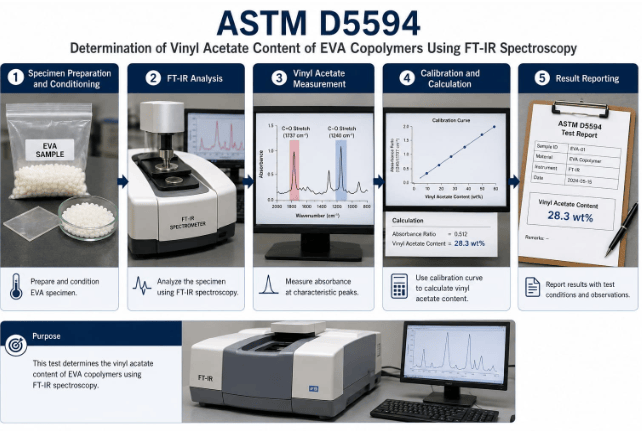
    The laboratory prepares representative EVA copolymer samples and uses Fourier Transform Infrared Spectroscopy (FT-IR) to analyze these samples. The laboratory records the infrared absorbance of vinyl acetate and compares it with the calibration standards. The laboratory then computes and reports the vinyl acetate content in the EVA copolymer.  The ASTM D5594 test methods comprise the following test procedure-

    Read more

    Specimen Preparation & Conditioning Technicians prepare representative EVA copolymer samples in a suitable form for FT-IR analysis, and ensure that the samples are clean and suitable for infrared measurement. 
    FT-IR Analysis Technicians place the EVA sample in the FT-IR instrument and obtain its infrared spectrum over the required spectral range.
    Vinyl Acetate Measurement Technicians measure the absorbance of the characteristic vinyl acetate band in the EVA spectrum, and use the specified reference band for quantitative analysis. 
    Calibration & Calculation Engineers compare the measured absorbance ratio with calibration standards or the established calibration relationship to determine the vinyl acetate content of the EVA copolymer.
    Result Reporting Laboratories report the vinyl acetate content as a percentage by mass (%) of the EVA copolymer, and include the relevant FT-IR measurement and calculation results. 

    ASTM D5594 Testing Process and Data Collection 

    Technicians press an EVA specimen into a film or mold it into a plaque for use in the FT-IR spectrometer. This instrument obtains the infrared spectrum of the specimen within the set range. Technicians find and measure the specific absorption bands for vinyl acetate and ethylene. They consider specimen thickness and use the correct calibration relationship to the measured infrared response. The lab then determines the amount of vinyl acetate in the EVA copolymer. Analysts record the FT-IR measurements, the calculated value, the specimen identification, and the test conditions. The final product is expressed as % vinyl acetate (by weight).

    This infographic shows EVA copolymer testing by FT-IR spectroscopy, including specimen preparation and conditioning, FT-IR analysis, vinyl acetate measurement, calibration and calculation, and result reporting.
    ASTM D5594 Vinyl Acetate Content Testing of EVA Copolymers Using FT-IR Spectroscopy

    Common Challenges and Troubleshooting

    When technicians use a nonrepresentative specimen, improper specimen preparation, or inadequate calibration, ASTM D5594 testing may yield false results. Different specimen thickness or different measurement conditions may also affect the infrared response. Consistently handle samples and use an appropriate calibration, and keep the FT-IR instrument in good condition. Any significant variance of repeated measurements indicates that the laboratory must verify the validity of the specimen preparation, instrument performance, calibration, or measurement setup prior to reporting the final measurement.   

    ASTM D5594 Analysis Results and Interpretation 

    The report is the summary of the FT-IR analysis of the content of vinyl acetate contained in ethylene-vinyl acetate (EVA) copolymer specimens. The measurement results are compared with the calibration relationship developed for known EVA materials.

    Read more

    • The laboratory reports the amount of vinyl acetate as a percent by mass, based on the specimen’s infrared absorbance spectrum.
    • The analyst determines the appropriate absorption ratio using the characteristic infrared absorption bands of vinyl acetate and ethylene.
    • Analysts apply the calibration equation to convert the infrared absorption ratio to the specimen content, which is the amount of vinyl acetate.
    • The report compares the measured amount of vinyl acetate with the expected or specified amount (if applicable), enabling the laboratory to determine the composition and consistency of the EVA copolymer.
    •  The laboratory reports results within the calibration curve range and does not extrapolate beyond it.

    Link to ASTM D5594

    FAQ

    What does ASTM D5594 determine?
    Ethylene-vinyl acetate (EVA) copolymers contain a percentage of vinyl acetate that ASTM D5594 determines using FT-IR spectroscopy. The outcome verifies the composition and specifications of EVA materials.
    The test uses an FT-IR spectrometer equipped with the proper sampling accessory and calibration. Technicians prepare EVA films or molded plaques for analysis.
    The test result is reported as a % by mass of vinyl acetate. Technicians compute the value based on the measured infrared response and the relevant calibration.
    Suyog Kamble
    About Author
    Suyog Kamble
    Suyog Kamble is an Operations Associate at MaTestLab Inc. and holds a postgraduate degree in Organic Chemistry.
    Testimonials
    Real results
    Engineers trust us with what matters most
    Start Your Testing
    Project Today
    Define your requirements and get access to
    specialized laboratories ready to deliver results
    Partners with us
    Clients
    Vendors
    Process for testing
    • STEP 01

      You share your testing requirements

    • STEP 02

      You share your sample(s)

    • STEP 03

      We deliver your test reports

    Get your testing done

    Let us known your testing requirements and we will be right back with a solution.

      Let us root for each other. Collaborate to grow, expand, and accelerate our businesses.

      Partner with us

        Contact Us

        Discover more from MaTestLab

        Subscribe now to keep reading and get access to the full archive.

        Continue reading