
ASTM D5523 describes a standard test method to determine the hydrolyzable chlorine content of monomeric, aromatic isocyanates as a basis for reporting as HCl acidity in the isocyanate, which are used as raw materials in the manufacture of polyurethanes. The method is used for toluene diisocyanate (TDI) and monomeric methylene di(phenylisocyanate), or MDI. The method targets acids that produce hydrochloric acid when they react with alcohols and water. ASTM D5523 (Standard Test Method for Polyurethane Raw Materials: Acidity by Argentometric Determination of Hydrolyzable Chlorine in Monomeric, Aromatic Isocyanates) provides standard procedures for the consistent evaluation of the carbamyl chlorides, acid chlorides, and dissolved phosgene as the main sources of hydrolyzable chlorine in these materials.
ASTM D5523 Standard Test Method for Polyurethane Raw Materials: Acidity by Argentometric Determination of Hydrolyzable Chlorine in Monomeric, Aromatic Isocyanates
What is ASTM D5523?
What is the Scope of ASTM D5523?
ASTM D5523 measures the hydrolyzable chlorine content of monomeric, aromatic isocyanates expressed as HCl acidity. The ASTM D5523 standard-
- Determines the “measures hydrolyzable chlorine” content.
- Expresses hydrolyzable chlorine as HCl acidity.
- Applies to Toluene Diisocyanate (TDI).
- Applies to monomeric methylene di(phenylisocyanate) (MDI).
- Includes monomeric isocyanates, the acidity being supplied by species that produce HCl on solvolysis.
- Identifies carbamyl chlorides, acid chlorides, and dissolved phosgene as main sources of hydrolyzable chlorine and acidity.
What are the Uses of ASTM D5523 Testing?
ASTM D5523 testing provides the laboratory with a characterization of TDI and MDI. The standard is suitable both for research and quality-control applications. This standard-
- Describes the acidity of TDI.
- Describes the acidic nature of MDI.
- Determines the amount of hydrolyzable chlorine.
- Supports research activities.
- Supports quality-control programs.
- Offers an alternative method for measuring low-level acidity when reagent alcohols interfere with the glass electrode.
What Materials Can Be Tested Under ASTM D5523?
ASTM D5523 applies to monomeric, aromatic isocyanates, such as TDI and monomeric MDI. The method applies only when all acidity in the material comes from species that generate HCl through solvolysis. Laboratories therefore ensure that the material tested complies with the method’s scope before applying the procedure.
Why is ASTM D5523 Important?
Acidity provides useful information in determining the quality and composition of polyurethane raw materials. ASTM D5523 provides a method for measuring hydrolyzable chlorine and reporting results as HCl acidity in a laboratory. The method also addresses challenges that arise when using a glass electrode in alcohol solvents at low acidity levels. This allows the procedure to be useful for characterization of TDI and MDI in research and quality-control applications.
ASTM D5523 Equipment and Sample Preparation Guide
ASTM D5523 uses argentometric determination with potentiometric titration. The apparatus used in the ASTM procedure includes a potentiometric titrator and a combination silver billet electrode. It also identifies a magnetic stirrer and other laboratory equipment for preparing and titrating the sample.
| Sample and Specimen Details | Technicians use representative samples of monomeric, aromatic isocyanates such as TDI or MDI. The sample must be representative of the material being tested. |
| Specimen Preparation | Technicians prepare the isocyanate sample for argentometric titration. The sample is hydrolyzed to convert hydrolyzable chlorine to chloride ions, which are then determined by argentometric titration. |
| Specimen Dimensions | Sample size is based on mass, not physical dimensions. The standard specifies appropriate sample mass for the titration procedure. |
| Instrumentation | The test uses titration equipment including a burette, pH meter or potentiometric titrator, and appropriate glassware for hydrolysis and titration. |
Testing Procedures and Requirements for ASTM D5523
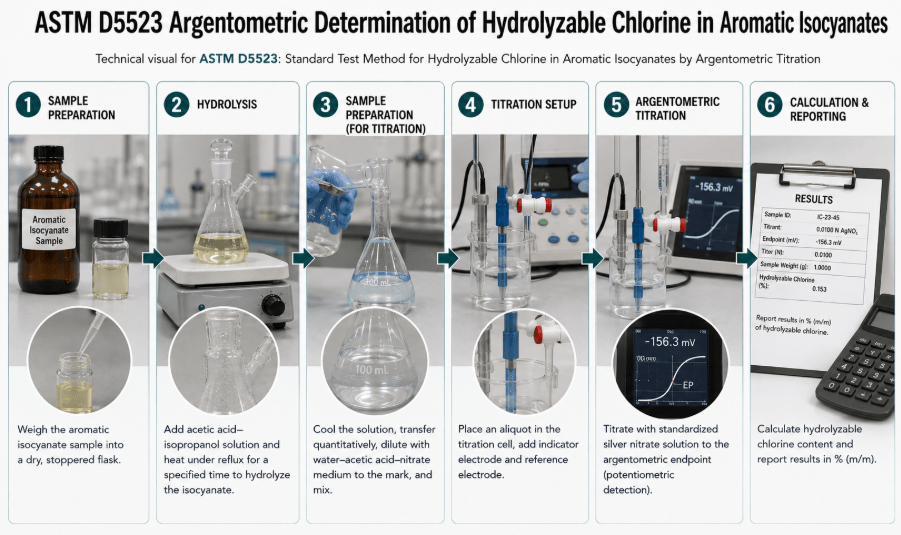
Technicians weigh the specified sample into a beaker and add 2-propanol. They then cover and stir the sample, then add methanol and stir again. Next, analysts add concentrated nitric acid, cool the solution if needed, and proceed. The analyst then titrates the sample solution potentiometrically with the suitable methanolic silver nitrate solution till the endpoint, and records the volume of titrant at the endpoint.
| Sample Hydrolysis | Technicians hydrolyze the isocyanate sample to convert hydrolyzable chlorine to chloride ions. |
| Sample Preparation for Titration | Technicians prepare the hydrolyzed sample for argentometric titration. |
| Argentometric Titration | Technicians titrate the sample using a standardized silver nitrate solution. The chloride ions react with silver nitrate to form a silver chloride precipitate. |
| Endpoint Detection | Technicians determine the endpoint of the titration using a pH meter, potentiometric titrator, or indicator. |
| Result Calculation & Reporting | Technicians calculate the hydrolyzable chlorine content (or acidity equivalent) from the titration results. Laboratories report results in parts per million (ppm) by mass. |
ASTM D5523 Testing Process and Data Collection
A technician takes a sample of isocyanate and makes a solution using the specified reagents. They swirl the solution and then add the concentrated nitric acid before performing the titration. The analyst titrates the prepared solution potentiometrically with methanolic silver nitrate and records the titrant volume at the endpoint. The laboratory will use the titration result to calculate the hydrolyzable chlorine content and report this in terms of HCl acidity.
Common Challenges and Troubleshooting
Accurate results require appropriate sample preparation, suitable reagents, proper electrode condition, and controlled titration. Low-level acidity measurements become difficult if reagent alcohol solvents contain interfering acidic or basic species such as those found in the glass-electrode method. ASTM D5523 specifically addresses this issue. Technicians maintain the silver electrode properly, follow the specified sample preparation sequence, and record the titration endpoint carefully. They are aware that monomeric MDI can be supplied as solids and may need suitable storage before testing.
ASTM D5523 Analysis Results and Interpretation
The laboratory reports hydrolyzable chlorine content as HCl acidity for the tested monomeric aromatic isocyanate.
- This test measures the amount of hydrolyzable chlorine.
- The result is expressed as the amount of HCl acidity in the laboratory.
- The method applies to TDI and MDI within the scope of the method.
- The result supports characterization of polyurethane raw materials.
- The result is suitable for laboratory use in research and quality control.
Get Certified ASTM D5523 Testing for Reliable Polyurethane Raw Material Analysis
ASTM D5523 provides a standardized approach for determining the acidity in TDI and MDI. The method applies to laboratory research and quality control. The method deals with the problems encountered in low-level acidity measurements with a glass electrode in reagent alcohol solvents, as there are acidic and basic species present in reagent alcohol solvents that interfere with low-level measurements.
FAQ
Updated on September 4, 2026


Project Today
specialized laboratories ready to deliver results