
ASTM D5208 Standard Practice for Fluorescent Ultraviolet (UV) Exposure of Photodegradable Plastics

    What is ASTM D5208?

    ASTM D5208 outlines a method for exposing photodegradable plastics to fluorescent UV light under carefully controlled conditions. The method assesses how these plastics react when exposed to radiation and other specific factors. A technician selects the plastic samples, prepares them, and places them in a UV exposure chamber. The samples undergo repeated UV exposure cycles. Depending on the applicable exposure cycle, the specimens may also be subjected to controlled moisture or condensation conditions. ASTM D5208 testing (Standard Practice for Fluorescent Ultraviolet (UV) Exposure of Photodegradable Plastics) helps understand how photodegradable plastics break down over time. It enables material comparisons, supports product development, and meets quality-control needs.

    Read more

    Get Certified ASTM D5208 Fluorescent UV Exposure Testing

    ASTM D5208 testing is useful for plastic manufacturers, material suppliers, developers, engineers, and quality-control professionals when they study how photodegradable plastics break down or change after UV exposure. They place the specimens in the UV apparatus and expose them for the selected cycle and time. During and after exposure, technicians note the conditions and record their observations. Analysts compare the state or properties of the exposed specimens with the required evaluation criteria or with specimens that have not been exposed when that is relevant. ASTM D5208 testing helps to compare materials, keep track of changes in formulations, and support quality-control and product-development work.

    What is the scope of ASTM D5208?

    ASTM D5208 is a guide for subjecting photodegradable plastics to fluorescent ultraviolet light in a laboratory setting. This guide offers information on specimen preparation, exposure conditions, and an assessment of the changes that occur during fluorescent UV exposure. The standard covers:

    Read more

    • Photodegradable Plastics: Evaluates applicable plastic materials designed to undergo changes when exposed to ultraviolet radiation.
    • Fluorescent UV Exposure: Subjects specimens to controlled ultraviolet radiation using fluorescent UV lamps.
    • Controlled Exposure Conditions: Establishes selected exposure cycles and environmental conditions for evaluating material response.
    • Photodegradation Evaluation: Supports examination of changes in material condition or applicable properties following exposure.
    • Material Comparison: Allows technicians and engineers to compare the UV exposure response of applicable plastic materials.
    • Quality Control: Supports monitoring of material consistency and formulation changes.

    What are the uses of ASTM D5208 testing?

    ASTM D5208 provides information about the response of photodegradable plastics to controlled fluorescent UV exposure. The practice helps to:

    • Evaluate changes in photodegradable plastics following UV exposure.
    • Compare the photodegradation behavior of different plastic materials.
    • Assess the influence of exposure duration on material condition.
    • Support evaluation of photodegradable plastic formulations.
    • Identify changes in applicable material properties after exposure.
    • Support material development and product evaluation.
    • Assist in quality control and production-monitoring activities.

    Which materials can be tested according to ASTM D5208?

    Photodegradable plastic materials that require fluorescent UV light exposure can be tested according to ASTM D5208. Technicians must determine the material type, specimen configuration, exposure cycle, and assessment needs before testing. The practice applies to:

    • Photodegradable Plastics: Evaluates applicable plastics designed to undergo photodegradation under UV exposure.
    • Plastic Films and Sheets: Supports exposure of applicable thin plastic materials when suitable specimen preparation is used.
    • Molded or Fabricated Plastic Products: Allows applicable plastic specimens or products to be exposed under controlled conditions.
    • Different Plastic Formulations: Supports comparison of photodegradable formulations and material compositions.
    • Production Samples: Supports evaluation of representative samples from manufacturing or production batches.

    Why is ASTM D5208 testing important?

    Ultraviolet light induces physical and chemical changes in photodegradable plastics. Photodegradation can change the material’s appearance or physical properties, such as color, surface properties, mechanical properties, or other attributes. ASTM D5208 procedure involves exposing photodegradable materials to fluorescent UV light. The practice helps technicians and engineers compare material responses under selected exposure conditions and evaluate changes associated with UV exposure. The results can support material selection, formulation development, product evaluation, and quality-control activities.

    ASTM D5208 Equipment and Sample Preparation Guide

    Technicians need representative photodegradable plastic specimens and suitable equipment for controlled fluorescent UV exposure and evaluation of changes after exposure.

    Read more

    Sample IdentificationTechnicians identify the plastic material, formulation, product type, production batch, and other relevant sample information before testing.
    Specimen PreparationTechnicians prepare representative specimens according to the applicable exposure and evaluation requirements and inspect them for visible damage or contamination.
    Fluorescent UV Exposure EquipmentTechnicians use a suitable fluorescent UV exposure apparatus capable of maintaining the required UV radiation and applicable exposure-cycle conditions.
    Monitoring and Evaluation EquipmentTechnicians use suitable calibrated equipment to monitor exposure conditions and evaluate applicable changes in specimen condition or material properties.

    ASTM D5208 Testing Procedures and Requirements

    Technicians first identify and prepare representative photodegradable plastic specimens according to the applicable requirements. They prepare the fluorescent UV exposure apparatus and establish the required exposure cycle and test conditions. The specimens are placed in the apparatus and exposed for the specified duration. Technicians monitor the applicable exposure conditions and evaluate the specimens according to the required procedure. The ASTM D5208 testing process involves the following steps.

    Read more

    Sample Identification and Specimen PreparationTechnicians identify the photodegradable plastic and prepare representative specimens according to the applicable requirements.
    Exposure Apparatus PreparationTechnicians prepare the fluorescent UV apparatus and establish the specified radiation and exposure-cycle conditions.
    Fluorescent UV Exposure and MonitoringTechnicians expose the specimens for the required duration and record applicable exposure conditions and observations.
    Post-Exposure Evaluation and Data RecordingAnalysts evaluate changes in specimen condition or applicable material properties and record the relevant results.

    ASTM D5208 Testing Process and Data Collection

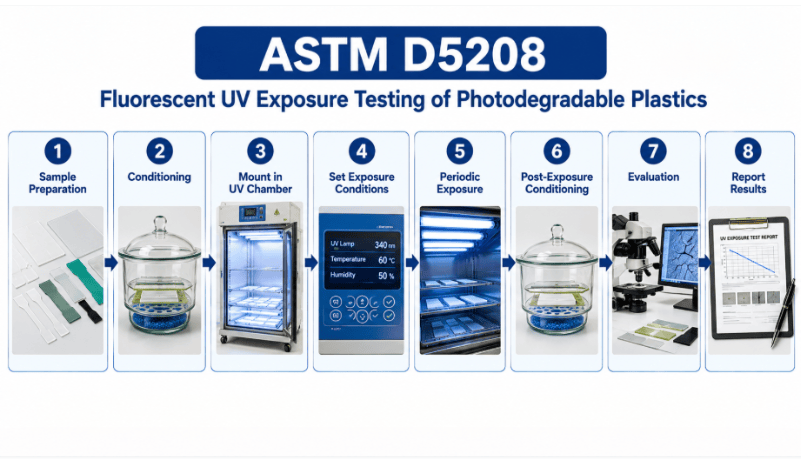
    Technicians start testing by identifying the photodegradable plastic material and preparing representative specimens for exposure. They inspect the specimens and record relevant material and specimen information before testing. The technician prepares the fluorescent UV exposure apparatus and establishes the selected exposure cycle. The technician places the specimens in the apparatus and exposes them to controlled ultraviolet radiation for the specified duration. Technicians monitor and record the applicable exposure conditions and test duration. After exposure, they inspect the specimens and perform any required property evaluations. Analysts review the observations and measurements to determine changes in the material following fluorescent UV exposure. The recorded results can be compared with the initial condition of the specimen or with other applicable evaluation requirements.

     ASTM D5208 testing process showing photodegradable plastic specimen identification and preparation, placement in a fluorescent UV exposure apparatus, controlled ultraviolet radiation exposure, monitoring of exposure conditions, post-exposure specimen evaluation, and recording of test results.
    ASTM D5208 Fluorescent UV Exposure Testing of Photodegradable Plastics

    Common Challenges and Troubleshooting

    Uneven specimen preparation, contamination, specimen misplacement, variations in UV light exposure, temperature fluctuations, moisture or condensation fluctuations, exposure-apparatus malfunction, and lack of monitoring are common causes of problems with ASTM D5208. Technicians should obtain representative specimens and adhere to the same exposure procedure that is chosen. They are responsible for checking the condition and operation of the fluorescent UV exposure equipment and maintaining the exposure conditions. If the results do not match the expected results, the technicians are advised to check the preparation of the specimen, the exposure time, the position of the sample, the UV exposure conditions, the performance of the apparatus, environmental conditions, and the post-exposure evaluation procedure.

    Analysis Results and Interpretation

    The report summarizes the response of the tested photodegradable plastic material to the applicable fluorescent ultraviolet exposure conditions. It presents the observed or measured changes together with the relevant specimen information, exposure cycle, exposure duration, and other required test conditions.

    Read more

    • ASTM D5208 produces exposure-response results rather than a single overall test value. 
    • Laboratories report the applicable changes according to the selected post-exposure evaluation. Exposure duration is commonly reported in h, temperature in °C, and other measured physical or mechanical properties in their applicable SI units.
    • The report includes the exposure conditions, specimen identification, exposure duration, and the observations or property measurements used to assess changes in the plastic. 

    Link to ASTM D5208

    FAQ

    What does ASTM D5208 evaluate?
    ASTM D5208 estimates the response of appropriate photodegradable plastics to controlled fluorescent ultraviolet exposure.
    The practice applies to photodegradable plastic materials and specimens that can be prepared and exposed according to the required procedure.
    Technicians record applicable specimen information, exposure conditions, exposure duration, and observations or property measurements obtained during post-exposure evaluation.
    The units depend on the property being evaluated. Exposure duration may be reported in h, temperature in °C, and other measured properties in their applicable SI units.
    Controlled exposure conditions help technicians compare specimens under consistent UV and environmental conditions and improve the reliability and comparability of the results.
    Suyog Kamble
    About Author
    Suyog Kamble
    Suyog Kamble is an Operations Associate at MaTestLab Inc. and holds a postgraduate degree in Organic Chemistry.
    Testimonials
    Real results
    Engineers trust us with what matters most
    Start Your Testing
    Project Today
    Define your requirements and get access to
    specialized laboratories ready to deliver results
    Partners with us
    Clients
    Vendors
    Process for testing
    • STEP 01

      You share your testing requirements

    • STEP 02

      You share your sample(s)

    • STEP 03

      We deliver your test reports

    Get your testing done

    Let us known your testing requirements and we will be right back with a solution.

      Let us root for each other. Collaborate to grow, expand, and accelerate our businesses.

      Partner with us

        Contact Us

        Discover more from MaTestLab

        Subscribe now to keep reading and get access to the full archive.

        Continue reading