ASTM D4964 Tension and Elongation of Elastic Fabrics
What is ASTM D4964?
ASTM D4964 is a standard test method for measuring the tension and elongation of wide and narrow elastic fabrics using a constant-rate-of-extension (CRE) tensile testing machine. The method applies to elastic fabrics made from natural or man-made elastomers, either alone or combined with other textile yarns. Technicians take the fabric specimens in loops and attach them to the band clamps of the tensile testing machine. The test evaluates loop tension at specified elongations or elongation at specified loop tensions. Experts cycle each specimen three times, using the third cycle for the required measurements. ASTM D4964 (Standard Test Method for Tension and Elongation of Elastic Fabrics (Constant-Rate-of-Extension Type Tensile Testing Machine)) also provides requirements for specimen preparation, apparatus setup, conditioning, testing, calculations, and reporting. This method is used for acceptance testing of commercially supplied elastic fabric and for assessing fabric suitability for use in foundation garments, brassieres, and swimwear.
Get Certified ASTM D4964 Testing for Reliable Elastic Fabric Tension and Elongation Evaluation
The performance of elastic fabric depends on how it stretches and stands up to stress when it’s in use. The ASTM D4964 provides a standard CRE method to test such properties. The method may be used to identify elastic fabrics, support quality-control programs, and evaluate appropriateness for intended end use by manufacturers. To obtain consistent and reliable results, proper specimen preparation, specimen conditioning, correct machine setup, and controlled cycling are important.
What is the scope of ASTM D4964?
ASTM D4964 covers the measurement of tension and elongation of wide or narrow elastic fabrics containing natural or man-made elastomers. The method involves tensile testing at a constant rate of extension and must agree on whether the tension or the extension of the loop is to be reported.
Material type: Wide or narrow elastic fabrics containing natural or man-made elastomers, with or without other textile yarns.
Purpose: Determine fabric tension at specified elongation or elongation at specified tension.
Property measured: Loop tension and elongation of elastic fabric.
Method: Uses a constant-rate-of-extension (CRE) tensile testing machine and loop-shaped specimens.
Result: Reports tension at specified elongation and/or elongation at specified loop tension.
Test Limitations: Results are dependent on machine set-up, extension rate, maximum load or extension, specimen specification, and measurement points selected.
Environmental conditions: Specimens require conditioning according to the applicable textile testing conditions; laundering conditions require agreement on temperature and the number of washing and drying cycles.
Applications: Elastic fabrics for foundation garments, brassieres, swimsuits, commercial acceptance testing, quality control, and product development.
What are the uses of ASTM D4964 testing?
ASTM D4964 testing aids laboratories in assessing the tension and stretch properties of elastic fabrics under controlled loading conditions. Manufacturers use these results to compare fabric performance and assess material suitability. This standard-
Controls the consistency of tension and elongation among batches in elastic fabric production.
Supports the evaluation and acceptance of commercial shipments of elastic fabrics according to agreed requirements.
Evaluates elastic fabric in foundation garments, brassieres, swimwear, and other textile garments.
Enables analysts to compare elastic fabrics using consistent specimen preparation and testing conditions.
Helps manufacturers evaluate loop tension and elongation to determine whether fabrics meet application-specific performance requirements.
ASTM D4964 Equipment and Sample Preparation Guide
ASTM D4964 specifies a CRE-type tensile testing machine with automatic recording and cycling controls. Technicians prepare elastic fabric specimens as loops and condition them under the standard atmosphere for textile testing before measurement. Technicians should maintain the specified loop dimensions, specimen preparation, clamp arrangement, and testing conditions.
Technicians select representative elastic fabric samples and prepare five specimens from each applicable swatch. For testing in both directions, skilled personnel prepare five specimens parallel and five specimens perpendicular to the long dimension.
Sample Preparation
Technicians cut wide elastic fabric specimens at 350 × 100 mm and trim or ravel the width to approximately 75 ± 2 mm. They mark the specimen at 250 ± 2 mm intervals and fold and sew it to form a loop.
Specimen Dimension
Wide elastic fabric uses a 350 × 100 mm starting specimen, with the width trimmed or raveled to approximately 75 ± 2 mm. The two gauge marks remain 250 ± 2 mm apart to establish the loop circumference. Narrow elastic fabric is based upon the width of 350 mm along the length of the fabric.
Instrumentation
Analysts use a CRE-type tensile testing machine conforming to ASTM D76, automatic recording equipment, cycling controls, band clamps, and a single-needle sewing machine. Band-clamp anvils use a diameter of 13.0 ± 0.25 mm or 6.5 ± 0.25 mm, with an anvil length of at least 76 mm.
Testing Procedures and Requirements for ASTM D4964
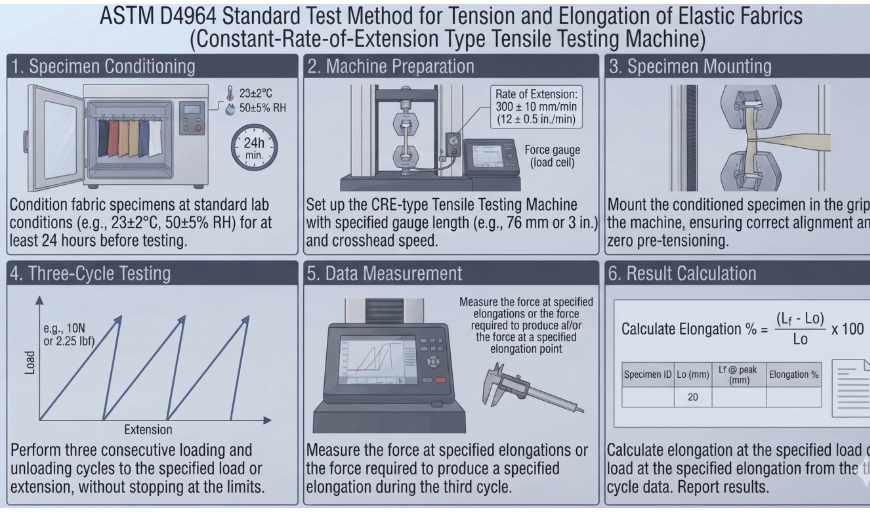
ASTM D4964 is used to measure loop tension or extension by performing controlled extension and recovery cycles. Technicians install a conditioned loop specimen on the CRE tensile machine and conduct three loading and unloading cycles. Analysts obtain the required measurements from the third cycle or directly from the instrument. Other reference documents include D76, D123, D1775, and D1776. The complete procedure for ASTM D4964 is given as:
Skilled personnel bring the fabric samples to moisture equilibrium at 21 ± 1°C and 65 ± 2% relative humidity and allow them to relax without loop tension for at least 16 h.
Machine Preparation
Technicians set the CRE tensile testing machine with a loop distance around the clamps of 250 ± 2 mm. Typically, they have a loading and unloading crosshead speed of 500 ± 15 mm/min.
Specimen Mounting
Analysts mount the prepared loop around the band clamps and position the seam between the clamps. They ensure that the loop remains properly positioned without unnecessary slack or distortion.
Three-Cycle Testing
Skilled personnel extend the specimen to the specified test condition and return it to zero tension. They repeat the loading and unloading cycle two additional times to obtain a total of three cycles.
Data Measurement
Analysts record at least the loading and extension data from the third cycle. They determine tension at specified elongation or elongation at specified loop tension according to the selected test procedure.
Result Calculation
Technicians calculate extension for specified elongations and determine the corresponding loop tension or determine percentage elongation at a specified loop tension. They can also calculate averages, standard deviation, and coefficient of variation when required.
ASTM D4964 Testing Process and Data Collection
Technicians first select representative elastic fabric samples and prepare the required test specimens. Skilled personnel cut the specimens to the required dimensions and form each specimen into a sewn loop. Analysts condition the samples at 21 ± 1°C and 65 ± 2% relative humidity for at least 16 h. Technicians check the clamp position and set up the CRE tensile testing machine for the desired loop distance and crosshead speed. Technicians mount each loop with the seam between the clamps, then run three extension-recovery cycles. Skilled personnel record the loading and extension data, with at least the third cycle providing the required test measurements. Technicians record the specimen dimensions, machine setup, crosshead speed, maximum tension, testing condition, cycle employed, and calculated results.
ASTM D4964 Testing Procedure Using a CRE-type Tensile Testing Machine
Common Challenges and Troubleshooting
Proper specimen preparation is critical to ensure consistent loop tension and elongation results. Technicians must preserve the specimen dimensions, sewing quality, conditioning conditions, and the machine settings. Common challenges include incorrect specimen dimensions, poorly sewn loops, incorrect clamp spacing, improper conditioning, incorrect crosshead speed, specimen slippage, and machine-to-machine differences. Laboratories should report machine setup, extension rate, maximum loading or extension, and specimen specifications because these factors can affect the measured results.
ASTM D4964 Analysis Results and Interpretation
The report provides a brief summary of the tension and elongation characteristics of the tested elastic fabric during the applied constant-rate-of-extension (CRE) test configuration. The findings enable the engineer to assess the loop tension and elongation at specific locations and to compare the actual performance to the appropriate fabric specifications.
Laboratories report results for elastic fabric in %, force in N, extension in mm, coefficient of variation in %, and dimension in mm.
Technicians record the measured tension at specified elongations and elongation at specified tensions, together with the specimen specifications and selected test conditions.
Analysts document the CRE tensile-testing-machine configuration, rate of extension, maximum loading or extension, specimen identification, and loop tension or recovery characteristics observed during testing.
Engineers compare the measured loop tension and elongation with applicable material or product requirements to evaluate the tested elastic fabric’s performance for intended end uses.
What type of tensile machine does ASTM D4964 require?
The method requires a constant-rate-of-extension (CRE) type tensile testing machine that conforms to ASTM D76 and includes automatic recording and cycling controls.
ASTM D4964 calls for how many cycles?
The test requires three extension-recovery cycles. Analysts normally use the third cycle to obtain the required tension or elongation measurements.
What are the specimen dimensions for ASTM D4964?
For wide elastic fabric, technicians initially cut specimens measuring 350 × 100 mm and trim or ravel the width to approximately 75 ± 2 mm. The gage marks remain 250 ± 2 mm apart when forming the loop.
Suyog Kamble is an Operations Associate at Matestlab Inc. Suyog holds a postgraduate degree in organic chemistry and is trained in material science topics. Know More
Testimonials
Real results
Engineers trust us with what matters most
“We had a great experience working with this company for our ASTM E84 testing. They were the first company to respond to our inquiry within just a few minutes of submitting it. From start to finish, the communication was excellent, and the entire process was swift, straightforward, and hassle-free.”
Ivars FancyWalls
United States
“Very good communication, testing associates were very patient with delays on our end. Reasonable turnaround time for results and nicely detailed report. Analysts were also quick to answer any follow-up questions. Happy with results.”
Skye Henderson
United States
“Matestlab connected us with an accredited lab within days, cutting weeks off our product validation timeline.”
Rebecca Kozodoy-Pins
United States
Start Your Testing Project Today
Define your requirements and get access to specialized laboratories ready to deliver results