ASTM D4226 Standard Test Methods for Impact Resistance of Rigid Poly(Vinyl Chloride) (PVC) Building Products

    What is ASTM D4226?

    ASTM D4226 is a standard test method to determine the impact resistance of rigid poly(vinyl chloride) (PVC) building products. The method (Standard Test Methods for Impact Resistance of Rigid Poly(Vinyl Chloride) (PVC) Building Products) outlines procedures to evaluate the resistance of PVC products to impact conditions and to evaluate the resistance of the material or product to impact damage in the laboratory. Rigid PVC building products may be subject to impact during manufacturing, transportation, installation, handling, and service. Technicians prepare representative samples of the rigid PVC building product and test them under controlled conditions for the applicable impact testing procedure. The lab documents the impact conditions, the specimen’s response, and observations and measurements. 

    Read more

    Get Certified ASTM D4226 Impact Resistance Testing

    Manufacturers, suppliers, processors, engineers, and quality-control laboratories can use ASTM D4226 to assess rigid PVC building products. Technicians select representative samples, process them in line with the requirements, and conduct the prescribed impact evaluations. Laboratories record specimen data, test conditions, impact response, and observations. The results help manufacturers track production consistency, identify changes in impact performance, compare applicable products, and support quality control and product development. 

    What is the scope of ASTM D4226?

    ASTM D4226 provides test methods for evaluating the impact resistance of applicable rigid PVC building products. The methods provide a controlled approach for subjecting specimens to specified impact conditions and evaluating their response. The standard covers-

    Read more

    • Rigid PVC Building Products: Evaluates applicable rigid poly(vinyl chloride) building products. 
    • Impact Resistance: Determines how specimens respond to specified impact conditions. 
    • Specimen Evaluation: Examines specimens after impact for the applicable damage or failure characteristics. 
    • Product Comparison: Supports comparison of impact performance between applicable PVC products. 
    • Quality Control: Helps manufacturers monitor consistency in impact performance between production samples and batches. 

    What are the uses of ASTM D4226 Testing?

    ASTM D4226 provides impact-resistance data that help manufacturers and engineers evaluate rigid PVC building products. The results support product comparison, quality control, material evaluation, and product development. The test helps to-

    • Evaluate the impact resistance of applicable rigid PVC building products. 
    • Compare impact performance between applicable products or materials. 
    • Identify differences in impact response. 
    • Support production quality control. 
    • Help evaluate changes in material or product characteristics. 
    • Support product development and material selection. 
    • Provide data for assessing resistance to impact-related damage. 

    Which materials can be tested according to ASTM D4226?

    ASTM D4226 applies to rigid PVC building products that require impact-resistance evaluation. Laboratories should confirm the product type, specimen requirements, applicable test method, and test conditions before testing.

    The standard applies to:

    • Rigid PVC Building Products: Evaluates applicable rigid PVC products used in building applications. 
    • PVC Profiles and Components: Supports evaluation of applicable rigid PVC product forms where the impact test is applicable. 
    • Production Samples: Allows evaluation of representative samples from production batches. 
    • Different Product Designs: Supports comparison of applicable rigid PVC building products with different designs or constructions. 

    Why is ASTM D4226 testing important?

    Rigid PVC building products may experience impact during handling, installation, transportation, or service. Insufficient impact resistance can cause cracking, fracture, deformation, or other damage. ASTM D4226 provides a standardized approach for evaluating the response of applicable rigid PVC building products to specified impact conditions. The results help manufacturers identify variations in impact performance, monitor production consistency, and compare applicable products. The data can support quality control, product development, material selection, and evaluation of rigid PVC building products.

    ASTM D4226 Equipment and Sample Preparation Guide

    Technicians need representative rigid PVC specimens and suitable calibrated impact-testing equipment to evaluate the applicable requirements. They identify the product, select representative specimens, and prepare them according to the applicable test procedure.

    Read more

    Sample IdentificationTechnicians identify the rigid PVC product, product type, production batch, dimensions, and other relevant information before testing.
    Specimen Selection and  PreparationTechnicians select representative specimens and prepare them according to the applicable dimensions and test requirements.
    Specimen ConditioningTechnicians condition specimens under the specified conditions when required by the applicable test procedure.
    Impact-Testing EquipmentLaboratories use suitable calibrated impact-testing equipment capable of applying the specified impact conditions.

    ASTM D4226 Testing Procedures and Requirements

    Technicians first identify the rigid PVC building product and select representative specimens. They prepare and condition the specimens according to the applicable requirements before performing the specified impact test. The testing process includes the following steps-

    Read more

    Sample Identification and Specimen PreparationTechnicians identify the rigid PVC product and prepare representative specimens according to the applicable requirements.
    Specimen Conditioning and Test SetupLaboratories condition the specimens when required and prepare the impact-testing equipment under the specified conditions.
    Impact Testing and Data RecordingTechnicians subject the specimens to the applicable impact conditions and record the test response, measurements, and observations.
    Impact Response EvaluationEngineers evaluate the specimen response and document the applicable impact-resistance results and failure characteristics.

    ASTM D4226 Testing Process and Data Collection

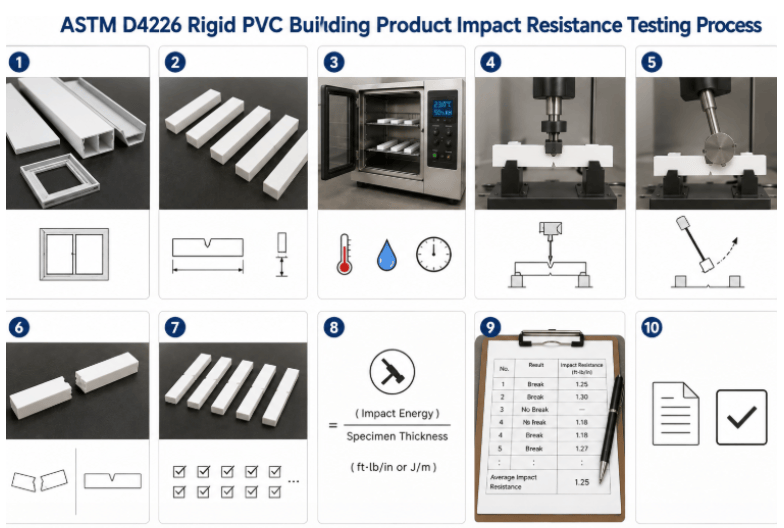
    Technicians start testing by identifying the rigid PVC building product and selecting representative specimens. They prepare the specimens according to the applicable requirements and condition them when required before testing. Analysts prepare the impact-testing equipment and subject the specimens to the specified impact conditions. Technicians record the impact conditions, specimen response, visible damage or failure, and other required observations. Engineers then evaluate the recorded results to assess the impact resistance of the tested rigid PVC building product.

     The image shows the ASTM D4226 testing process, showing rigid PVC specimen preparation, conditioning, placement in impact-testing equipment, impact application, specimen response evaluation, and recording of test results.
    ASTM D4226 Rigid PVC Building Product Impact Resistance Testing Process

    Common Challenges and Troubleshooting

    Specimen preparation, specimen dimensions, conditioning, impact conditions, equipment calibration, specimen positioning, and operator technique can affect ASTM D4226 results. Technicians should prepare representative specimens and consistently follow the applicable test procedure. Laboratories should verify the calibration and condition of the impact-testing equipment before use. Technicians should also check specimen positioning, test setup, impact conditions, and specimen condition before testing.

    Analysis Results and Interpretation

    The report summarizes the impact response of the tested rigid PVC building product under the applicable test conditions. It presents the measured or observed results, along with relevant specimen information, impact conditions, test conditions, and failure observations.

    Read more

    • ASTM D4226 produces impact-resistance results based on the applicable test method rather than a single universal value for all rigid PVC building products.
    • Laboratories report the applicable impact measurements in the units specified by the selected test method, along with specimen information, test conditions, and observed damage or failure characteristics when required.
    • Laboratories can achieve reliable, comparable results by performing appropriate specimen preparation, conditioning, impact setup, equipment calibration, and controlled test conditions.

    Link to ASTM D4226 

    FAQ

    Where can I get the astm d4226 tested?
    You can share your astm d4226 testing requirements with MaTestLab. MaTestLab has a vast network of material testing laboratories, spread across the USA and Canada. We support your all material testing needs ranging from specific astm d4226 test to various testing techniques.
    Please contact us for a detailed quote for your astm d4226 testing needs. Cost incurred to carry out different astm d4226 testing methodology depends on the type of raw material; number of samples, coupons, or specimens; test conditions, turn around time etc. Costs of some ASTM testing methods start from $100 and the final value depends upon the factors listed above. Please contact us for the best and latest prices.
    The required number of samples or specimens should comply with the procedure given in the astm d4226 standard. However, the MaTestLab operations team can assist you for your special requirements once you share your testing details with us.
    MaTestLab has a vast testing laboratory network, hence we bring you the best testing facilities in a cost-effective way. We offer considerable discounts (15-20%) to our returning customers based on test volume and frequency.
    The turnaround time for astm d4226 test methodology depends upon the test procedure mentioned in the standard test document. However, we at MaTestLab understand your research requirements and hence try to get your test completed within the least possible time.
    Laraib Hashmi
    About Author
    Laraib Hashmi
    Laraib Hashmi is an aspiring research enthusiast and science content professional with a strong interdisciplinary skill set, holding a postgraduate degree in Applied Microbiology from KIIT Bhubaneshwar, Odisha.
    Testimonials
    Real results
    Engineers trust us with what matters most
    Start Your Testing
    Project Today
    Define your requirements and get access to
    specialized laboratories ready to deliver results
    Partners with us
    Clients
    Vendors
    Process for testing
    • STEP 01

      You share your testing requirements

    • STEP 02

      You share your sample(s)

    • STEP 03

      We deliver your test reports

    Get your testing done

    Let us known your testing requirements and we will be right back with a solution.

      Let us root for each other. Collaborate to grow, expand, and accelerate our businesses.

      Partner with us

        Contact Us

        Discover more from Matestlab Inc

        Subscribe now to keep reading and get access to the full archive.

        Continue reading