
ASTM D4218 Standard Test Method for Determination of Carbon Black Content in Polyethylene Compounds by the Muffle-Furnace Technique

    What is ASTM D4218?

    ASTM D4218 describes a standard test method for determining the carbon black content of polyethylene and polypropylene compounds using the muffle-furnace method. Manufacturers often add carbon black to these polymers to improve UV resistance, mechanical strength, and colorfastness. In this method, technicians pyrolyze the polymer sample in a muffle furnace between 550°C and 600°C, so the heat breaks down the polymer material and leaves the carbon black residue as an inorganic ash. ASTM D4218 (Standard Test Method for Determination of Carbon Black Content in Polyethylene Compounds by the Muffle-Furnace Technique) provides a reliable and reproducible method for the quantification of carbon black loading. Manufacturers use this test to confirm carbon black is within specification limits. Quality control laboratories use this method to assure uniformity of polymer compound production. 

    Read more

    Get Certified ASTM D4218 

    The certification assures accurate determination of the carbon black content in polyethylene and polypropylene compounds, in accordance with standard procedures. Manufacturers use experienced lab testing to ensure carbon black loading is within specification. Manufacturers use ASTM D4218 Certified Testing for quality control, material verification, and product development. Professional laboratory services ensure compliance with standard requirements and provide confidence in test results. Engineers use certified testing to guarantee the material performance and UV resistance of finished products. 
    What is the Scope of the ASTM D4218 Test Standard? 

    ASTM D4218 specifies the procedures for determining the carbon black content in polyethylene and polypropylene compounds by the muffle-furnace technique. The test method covers the entire analytical process, from sample preparation to residue measurement. The ASTM D4218 standard-

    Read more

    • Measures the amount of carbon black in polyethylene compounds.
    • Measures the amount of carbon black in polypropylene compounds.
    • Outlines the pyrolytic decomposition technique (muffle furnace).
    • Formulators use this ingredient in a variety of compounds. 
    • Measures the amount of carbon black loading in terms of weight percent.
    • Assists in quality control and material checking.
    • Reliable (repeatable) results between laboratories. 

    What are the Uses of ASTM D4218 Testing?

    Manufacturers use the muffle-furnace technique to verify carbon black content in polyethylene and polypropylene compounds, and ASTM D4218 testing aids manufacturers in doing so. The test results are useful for quality control, material verification, and product development. Polymer manufacturing laboratories and quality control laboratories utilize this standard. This standard- 

    • Production quality control of polymer compounds.
    • Checking of the carbon black loading specifications.
    • Evaluation of UV durability of finished products.
    • Assistance in product development and formulation.
    • Property comparison of materials.
    • Failure analysis of materials.
    • Documentation for compliance of supplier materials.

    Which materials can be tested under ASTM D4218?

    ASTM D4218 applies to carbon black-filled polyethylene and polypropylene compounds. Technicians use the test method for a variety of compound formulations, such as filled and unfilled compounds. The standard applies to testing various product forms (pellets, powders, molded parts). Proper sample preparation ensures technicians obtain representative test results. 

    Why is ASTM D4218 Important? 

    ASTM D4218 provides a standard method for determining the carbon black content in polyethylene and polypropylene compounds by the muffle-furnace method. The test method provides testing requirements to assist manufacturers in ensuring carbon black loading is within specification limits. The standard sets uniformity in testing methods and analysis. These test results are critical for quality control engineers to ensure that the material is resistant to UV and performs as intended. The pyrolytic method is suitable for accurate and reproducible results of the carbon black quantification.

    ASTM D4218 Equipment and Sample Preparation Guide

    ASTM D4218 requires a muffle furnace that has the ability to maintain temperatures between 550°C and 600°C for complete pyrolysis of polymer compounds. Technicians carefully prepare representative samples in the laboratory for the carbon black analysis and evaluation. Equipment includes a Muffle furnace, analytical balance, weighing containers, and a desiccator. 

    Read more

    Sample and Specimen Details Homogeneous polyethylene or polypropylene samples. Representative of the material lot. Sample size: 1 g to 5 g. 
    Specimen Preparation Technicians weigh samples accurately on an analytical balance. They place materials in clean, pre-weighed containers. Samples remain free from contamination and moisture. 
    Specimen Dimensions 1-5 grams evenly distributed in containers for uniform pyrolysis. 
    Instrumentation Muffle furnace (550°C-600°C), analytical balance (0.1 mg accuracy), desiccator, weighing containers, tongs. 

    Testing Procedures and Requirements for ASTM D4186 

    ASTM D4218 tests ensure the correct determination of carbon black content using the muffle-furnace method with pyrolytic decomposition procedures. Laboratories conduct tests in a standardized way to enable reliable and accurate results. Technicians set the furnace to the required temperature, and technicians monitor the pyrolysis process continuously. The ASTM D4218 test method consists of the following tests:

    Read more

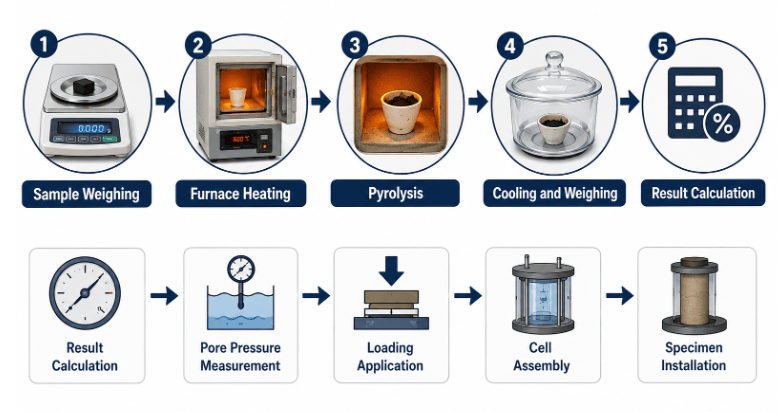
    Sample Weighing Technicians weigh the sample accurately on an analytical balance. They record the initial weight. They place the sample in a clean, pre-weighed container. 
    Furnace Heating Technicians preheat the muffle furnace to 550°C-600°C. They maintain this temperature consistently throughout the test. 
    Pyrolysis Technicians place the sample in the muffle furnace and heat it until the polymer fully decomposes. The remaining residue remains as carbon black. 
    Cooling and Weighing Technicians remove the container from the furnace and cool it in a desiccator. They weigh the residue accurately on an analytical balance. 
    Result Calculation Analysts calculate carbon black content as the percentage of residue weight relative to initial sample weight. They report results as weight percent. 

    ASTM D4218 Testing Process and Data Collection

    ASTM D4218 tests ensure the correct determination of carbon black content using the muffle-furnace method with pyrolytic decomposition procedures. Laboratories conduct tests in a standardized way to enable reliable and accurate results. Technicians set the furnace to the required temperature, and technicians monitor the pyrolysis process continuously. The ASTM D4218 test method consists of the following tests:

    The image depicts the five-step process for determining carbon black content in polyethylene compounds using the ASTM D4218 muffle-furnace technique, including sample weighing, furnace heating, pyrolysis, cooling and weighing, and result calculation. 
    ASTM D4218 Standard Test Method for Determination of Carbon Black Content in Polyethylene Compounds by the Muffle-Furnace Technique

    Common Challenges and Troubleshooting

    ASTM D4218 problems include incomplete pyrolysis of the sample, contamination, and inaccurate weighing. These issues result in errors in carbon black content measurement. Incomplete pyrolysis may result if the temperature in the muffle furnace is not at or below the minimum for complete pyrolysis, and heating time is not sufficient. Extraneous materials can contaminate the residues and affect the residue weight. Problems are minimized by proper sampling, furnace calibration, and regular balance calibration. Technicians become reliable by following standard procedures and maintaining good equipment; experienced technicians.

    ASTM D4218 Analysis Results and Interpretation

    The report summarizes the carbon black level in the polymer compound technicians tested. It shows the measured values, along with relevant specimen and unit information. The interpretation compares these measured values to the specification requirements. 

    Read more

    • The laboratory reports carbon black as a weight percent 
    • The laboratory usually reports results to 2 decimal places.
    • Analysts compare the values to specification limits.
    • Results indicate the compound’s UV protection capability.
    • Standardized sampling procedures and test conditions help laboratories generate reliable data.
    • Quality control engineers use these results to verify material compliance and product performance.

    Link to ASTM D4218 

    FAQ

    What is ASTM D4218 used for?
    The muffle-furnace technique determines the carbon black content of polyethylene and polypropylene compounds, as specified by ASTM D4218. Quality control engineers use the test results for quality control, material verification, and product development.
    The test method pyrolyzes the polymer sample in a muffle furnace at 550℃-600℃, leaving carbon black residue. Technicians weigh the residue and report it as a weight percent.
    Manufacturers use it in polyethylene and polypropylene to give them color stability, mechanical properties, and UV protection. The amount of carbon black directly affects the material’s resistance to the environment and UV degradation.
    The usual sample size is between 1 gram and 5 grams. The sample represents the material lot, and it must remain free of any contamination.
    Analysts report the results as weight percent of carbon black in the polymer compound. They typically report values to two decimal places and compare them with the specification limits.

    Updated on September 2, 2026

    Laraib Hashmi
    About Author
    Laraib Hashmi is an aspiring research enthusiast and science content professional with a strong interdisciplinary skill set, holding a postgraduate degree in Applied Microbiology from KIIT Bhubaneshwar, Odisha.
    Know More
    Testimonials
    Real results
    Engineers trust us with what matters most
    Start Your Testing
    Project Today
    Define your requirements and get access to
    specialized laboratories ready to deliver results
    Partners with us
    Clients
    Vendors
    Process for testing
    • STEP 01

      You share your testing requirements

    • STEP 02

      You share your sample(s)

    • STEP 03

      We deliver your test reports

    Get your testing done

    Let us know your testing requirements and we will be right back with a solution.

      Let us root for each other. Collaborate to grow, expand, and accelerate our businesses.

      Partner with us

        Discover more from Matestlab

        Subscribe now to keep reading and get access to the full archive.

        Continue reading