
ASTM D4186 Standard Test Method for One-Dimensional Consolidation Properties of Saturated Cohesive Soils Using Controlled-Strain Loading

    What is ASTM D4186?

    ASTM D4186 describes a standard method for determining the consolidation properties of cohesive soils saturated with water under controlled-strain loading. This test method differs from conventional consolidation testing, which uses incremental loading steps, by applying a constant strain rate. This approach allows data to be collected continuously as consolidation occurs and significantly reduces testing time compared with the traditional method. ASTM D4186 (Standard Test Method for One-Dimensional Consolidation Properties of Saturated Cohesive Soils Using Controlled-Strain Loading) is a test method that gives crucial parameters to help predict the behavior of soil settlement under structural loads. The controlled-strain loading test lets engineers assess consolidation behavior across the full stress range in a single test. This standard is used with other geotechnical tests, such as ASTM D2435 and ASTM D4546, to fully characterize soil.

    Read more

    Get Certified ASTM D4186 Testing for Reliable Geotechnical Project Success

    Accurate consolidation properties are key factors in safe foundation design. Reliable, standardized measurement techniques ensure accurate soil settlement predictions. Professional lab testing provides consistent results that aid engineering decisions. Working with experienced testing partners helps engineers verify test execution and data interpretation. ASTM D4186 testing supports confidence in geotechnical designs and minimizes the risk of differential settlement. 
    What is the Scope of the ASTM D4186 Test Standard? 

    The ASTM D4186 standard applies to saturated cohesive soils tested under continuous controlled-strain axial compression. The apparatus laterally holds the specimen while allowing axial drainage on one side. Technicians use this method on intact, remolded, and laboratory-reconstituted specimens. This standard-

    Read more

    • Determine the amount of consolidation and its rate.
    • Measures axial deformation, axial force, and base excess pressure.
    • Provides complete data on axial stress and axial strain.
    • Provides information for calculating the coefficient of consolidation and hydraulic conductivity.
    • Supports one-dimensional settlement and geotechnical engineering analysis.

    What are the Uses of ASTM D4186Testing?

    ASTM D4186 testing helps geotechnical engineers assess soil consolidation properties for various civil engineering applications. The test results are used for foundation design, embankment construction, and settlement analysis. This standard has applications in-

    • Design of structures and building foundations.
    • Construction of embankments and dams.
    • Road and highway settlement analysis.
    • Assessment of soft clay and organic soil properties.
    • Evaluation of soil improvement methods.

    Which materials can be tested under ASTM D4186?

    ASTM D4186 applies to saturated soil specimens, including undisturbed soil samples from the field and remolded soil specimens prepared in the laboratory. The test method is suitable for various soil types, including clays, silts, and organic soils. The standard covers testing of soil samples from different depths and locations. Proper sample handling and preservation are essential for obtaining representative test results.

    Why is ASTM D4186 Important? 

    ASTM D4186 provides a standard method for measuring the one-dimensional consolidation characteristics of soils under controlled-strain loading. The test method defines the test requirements to enable engineers to establish reliable consolidation parameters for settlement analysis and foundation design. The standard ensures consistency in testing procedures and data interpretation. Geotechnical engineers rely on these test results to predict settlement behavior and design appropriate foundations. The controlled-strain method is particularly useful for rapid testing of soft clays.

    ASTM D4186 Equipment and Sample Preparation Guide

    ASTM D4186 requires a loading frame capable of controlled-strain loading with the capability to measure load, displacement, and pore-water pressure. Technicians carefully prepare representative soil samples in the laboratory for consolidation testing and evaluation. The equipment includes a consolidation cell, loading mechanism, pore pressure measurement system, and data acquisition system

    Read more

    Sample and Specimen Details Technicians use undisturbed field samples or carefully remolded saturated soil specimens and trim them to minimize disturbance.
    Specimen Preparation Analysts trim the specimens to the required dimensions, place filter paper and porous stones at the top and bottom, and saturate the specimens before placing them in the consolidation cell.
    Specimen Dimensions Analysts prepare specimens with dimensions appropriate to the soil type and testing requirements, using the specified diameter and height-to-diameter ratio.
    Instrumentation The test uses a controlled-strain loading frame, consolidation cell, pore pressure measurement system, displacement device, data acquisition system, filter paper, porous stones, and specimen preparation tools. 

    Testing Procedures and Requirements for ASTM D4186 

    ASTM D4186 testing verifies soil consolidation properties using controlled-strain loading procedures. Laboratories perform the tests using standard procedures to ensure reliable and valid results. Technicians adjust the required loading parameters and record the test results throughout the test. This specification includes standards such as ASTM D2435 and  D6026. The ASTM D4186 test method includes the following test procedure.

    Read more

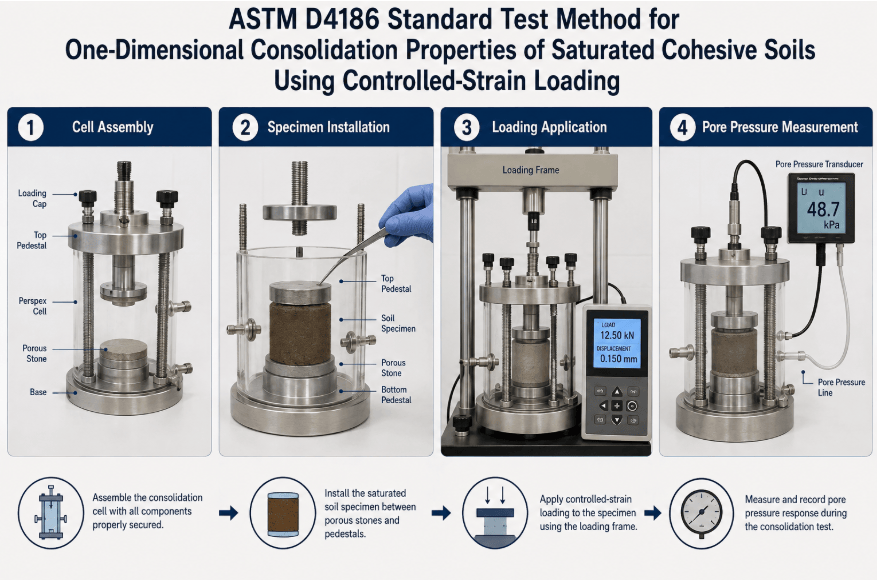
    Specimen Installation Technicians place the prepared soil specimen in the consolidation cell with filter paper and porous stones at the top and bottom and ensure proper seating in the consolidation ring.
    Cell Assembly Technicians assemble the consolidation cell and fill it with water to saturate the specimen and porous stones. The cell is checked for proper sealing and saturation conditions. 
    Loading Application Analysts apply controlled-strain loading to the specimen at a constant rate while measuring load and displacement. The loading rate is selected based on soil type and testing requirements. 
    Pore Pressure Measurement Technicians measure pore water pressure at the base of the specimen during loading. Pore pressure response provides information about consolidation behavior. 
    Result Calculation Analysts calculate consolidation properties, including the compression index and coefficient of consolidation, from the test data. Calculations follow procedures specified in ASTM D4186. 

    ASTM D4186 Testing Process and Data Collection

    The testing process starts with preparing the soil sample to the specified dimensions. Technicians delicately cut the specimen and fit it into the consolidation ring. They stack filter paper and porous stones on the top and bottom of the specimen. They fully saturate the specimen and then put it into the consolidation cell. They assemble the cell and add water to maintain saturation. The apparatus applies loading under controlled-strain conditions while the system continuously records load, displacement, and pore pressure data. The test continues until the desired strain is attained. Analysts measure various consolidation parameters such as compression index, recompression index, coefficient of consolidation, and coefficient of secondary compression.

     The image shows a controlled-strain loading frame, consolidation cell with soil specimen, pore pressure measurement system, and data acquisition equipment used for ASTM D4186 consolidation testing of soil.
    ASTM D4186 Controlled-Strain Consolidation Testing Equipment

    Common Challenges and Troubleshooting

    Typical problems encountered in the ASTM D4186 test include specimen disturbance, Insufficient specimen water saturation, and erroneous pore pressure measurements. These factors can affect the consolidation properties’ validity. Soil preparation and sampling can alter soil structure and consolidation properties. However, incorrect saturation can lead to errors in the response to the pore pressure and consolidation parameters. Problems are minimized by careful specimen preparation, proper specimen saturation procedures, and frequent calibration of pressure measurement equipment. The results are always reliable and obtained by experienced technicians through standard procedures and proper equipment maintenance.

    ASTM D4186 Analysis Results and Interpretation

    This report is a summary of the consolidation properties of the soil sample tested. It shows the values of the parameter measured, the units of measurement, and the specimen data. These measured values are then compared to the requirements of the project and to benchmarks. These results are applied to geotechnical engineers for settlement analysis and design of foundations.

    Read more

    • The laboratory reports the compression index (Cc) and recompression index (Cr) as dimensionless values, while the coefficient of consolidation (cv) is reported in cm²/s or m²/year.
    • The analyst reports the coefficient of secondary compression (Cα) as a dimensionless value and the preconsolidation pressure in kPa or psi.
    • The engineer interprets the consolidation parameters to evaluate the soil’s compressibility, consolidation behavior, and potential settlement under applied loads.
    • The laboratory uses the test results to support settlement analysis and foundation design, particularly when assessing the expected response of soil beneath structural loads.

    What Factors Should You Consider for ASTM D4186 Testing?

    Reliable laboratories have adequate equipment, control of test conditions, and proper specimen preparation. The following can be considered when selecting a lab for this testing:

    • Expertise: The technicians have experience preparing specimens and conducting consolidation testing, analyzing, and interpreting the results. Highly trained staff provide consistent and repeatable test results.
    • Speed: Faster lab testing shortens project timelines and enables timely decision-making. Efficient testing helps keep construction projects on schedule.
    • Cost: Comprehensive testing offers dependable data to design foundations and helps to avoid expensive settlement issues. Investing in the right testing prevents future foundation failure.
    • Confidentiality: Matestlab keeps the process confidential and discloses results only to the relevant stakeholders.

    Link to ASTM D4186

    FAQ

    What is ASTM D4186 used for?
    ASTM D4186 is a standard for measuring one-dimensional consolidation characteristics of saturated soils under controlled-strain loading. The test reports help in foundation design, embankment construction, and settlement analysis.
    The test method applies to many saturated soil types, such as clays, silts, and organic soils. Technicians can test both undisturbed and remolded specimens.
    ASTM D4186 uses controlled-strain loading, while ASTM D2435 uses incremental loading. ASTM D4186 is especially valuable for soft clays where the need for a speedy consolidation test is a requirement and provides an alternative to traditional tests.
    ASTM D4186 determines the compression index, recompression index, coefficient of consolidation, and coefficient of secondary compression. These parameters describe soil consolidation behavior under loading.
    Engineers apply the results to settlement analysis, foundation design, embankment construction, and soil improvement techniques. They use these parameters to estimate soil settlement behavior under structural loads.

    Updated on September 2, 2026

    Gokula Srinivasan Selvam
    About Author
    Gokula Srinivasan Selvam is a Material Testing Associate at Matestlab Inc. and holds a postgraduate degree in Ceramic Engineering from IIT (BHU), Varanasi. His academic background and professional experience are centered on advanced ceramic materials, their processing, characterization, and performance evaluation.
    Know More
    Testimonials
    Real results
    Engineers trust us with what matters most
    Why Choose Matestlab?
    Matestlab is a unified testing services partner based in the USA. Matestlab offers raw material and product testing services through accredited, expert laboratories primarily based in the USA. Matestlab supports physical, thermal, chemical, electrical, mechanical, environmental, and characterization testing needs through its global network of 2200+ accredited testing laboratories. Matestlab's in-house materials science experts curate and design comprehensive testing programs matched to the sample material and specific testing need, with regulatory requirements and confidentiality in mind.

    If you are looking for a managed and trusted testing partner to achieve your research goals, feel free to schedule a meeting with us or send us a request at connect@matestlabs.com to learn more about our services. For a quick quote, call us at (302)244-7710. We are happy to serve you.
    Start Your Testing
    Project Today
    Define your requirements and get access to
    specialized laboratories ready to deliver results
    Partners with us
    Clients
    Vendors
    Process for testing
    • STEP 01

      You share your testing requirements

    • STEP 02

      You share your sample(s)

    • STEP 03

      We deliver your test reports

    Get your testing done

    Let us know your testing requirements and we will be right back with a solution.

      Let us root for each other. Collaborate to grow, expand, and accelerate our businesses.

      Partner with us