ASTM D3632 Standard Test Method for Accelerated Aging of Adhesive Joints by the Oxygen-Pressure Method

    What is ASTM D3632?

    ASTM D3632 is a standard test method for estimating the relative resistance of adhesive films and adhesive-bonded joints to deterioration in a high-pressure oxygen environment. The method covers wood-to-wood and wood-to-metal bonded joints, as well as free adhesive films, and technicians can evaluate the effects of chemicals such as fire retardants, preservatives, or wood extractives by incorporating them into the adherends. ASTM D3632 (Standard Test Method for Accelerated Aging of Adhesive Joints by the Oxygen-Pressure Method) applies primarily to elastomer-based construction adhesives. However, technicians can also use it for other adhesive types susceptible to oxygen degradation. The accelerated test does not correlate exactly with natural aging, since natural aging involves varied conditions and factors such as moisture and stress that this method does not replicate. Engineers compare the results with the adhesion performance of bonded materials after accelerated aging. 

    Read more

    Get Certified ASTM D3632 Testing for Reliable Adhesive Aging Evaluation

    Adhesive manufacturers need a reliable way to estimate how their products will resist deterioration over time in demanding environments. ASTM D3632 gives manufacturers a controlled, accelerated method for research and development, manufacturing control, specification acceptance, and adhesive selection.

    What is the Scope of the ASTM D3632 Test Standard?

    ASTM D3632 estimates the relative resistance of adhesive films and bonded joints to deterioration when technicians expose them to high-pressure oxygen under controlled temperature conditions. The method covers wood-to-wood joints, wood-to-metal joints, and unsupported adhesive films. It primarily applies to elastomer-based construction adhesives but also covers other adhesives that may degrade under oxygen exposure. This standard-

    Read more

    • Evaluates the resistance of adhesive films and bonded joints to oxygen-induced deterioration.
    • Applies primarily to elastomer-based construction adhesives and extends to other adhesives susceptible to oxygen-related degradation.
    • Tests wood-to-wood and wood-to-metal lap-shear specimens, as well as unsupported adhesive films for flexibility.
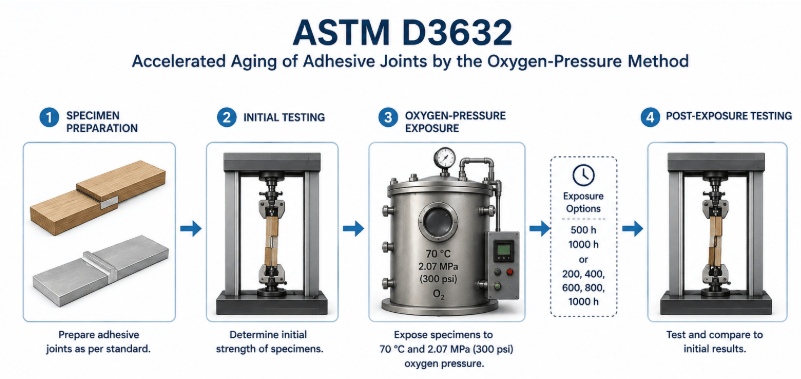
    • Exposes specimens to 70°C and 2.07 MPa (300 psi) oxygen pressure.
    • Offers a 500-hour or 1000-hour constant exposure option, or a program with repeated evaluations at 200, 400, 600, 800, and 1000 hours.
    • Allows evaluation of adherend chemicals, such as fire retardants, preservatives, and wood extractives, and provides comparative results rather than an exact prediction of natural aging.

    What are the Uses of ASTM D3632 Testing?

    ASTM D3632 testing helps adhesive manufacturers and engineers evaluate how adhesive materials and bonded joints respond to accelerated oxidative aging. The results support research and development, manufacturing control, specification acceptance, and adhesive selection. The ASTM D3632 standard-

    • Evaluates changes in adhesive performance after high-pressure oxygen exposure, comparing aged and unaged joint strength.
    • Supports research and development of elastomer-based construction adhesives.
    • Assists manufacturing control by helping manufacturers monitor changes in adhesive performance.
    • Supports specification acceptance when applicable product requirements define the evaluation.
    • Guides adhesive selection through comparative performance data under controlled oxygen-aging conditions.
    • Identifies interactions between oxygen, chemicals, or degradation products, including cases where oxidative crosslinking increases strength rather than causing deterioration.

    Which Materials Can Be Tested Under ASTM D3632?

    ASTM D3632 applies to adhesive films and adhesive-bonded joints, primarily elastomer-based construction adhesives. Technicians prepare wood-to-wood and wood-to-metal bonded specimens using dense wood species such as Douglas-fir, hemlock, southern pine, or yellow birch, along with metal adherends matching the manufacturer’s specified materials. Technicians also prepare unsupported film specimens made directly from the test adhesive.

    Why is ASTM D3632 Important?

    ASTM D3632 is important because it gives adhesive manufacturers a standardized, accelerated way to estimate long-term resistance to oxygen-related deterioration without waiting for natural aging to occur. The method’s dual focus on bonded joints and free films lets technicians separate the adhesive’s own oxidative behavior from its behavior within an actual bonded assembly, since some adhesives gain strength from oxidative crosslinking in a joint even though a film flexibility test alone would not reveal this.

    ASTM D3632 Equipment and Sample Preparation Guide

    ASTM D3632 requires equipment for specimen conditioning, high-pressure oxygen exposure, and post-exposure mechanical testing. Samples are set up as adhesive-bonded specimens in accordance with the adherend and then subjected to a controlled exposure to the oxygen-pressure environment.

    Read more

    Sample and Specimen DetailsTechnicians prepare wood-to-wood lap shear, wood-to-metal lap shear, or unsupported film specimens from the adhesive and specified adherend materials.
    Specimen PreparationTechnicians condition the fabricated specimens by oven drying before exposure, then load them into the oxygen-pressure vessel.
    Specimen Dimensions Technicians prepare specimen dimensions according to the selected ASTM D3632 configuration and measure the bonded area required for shear evaluation. 
    InstrumentationThe test uses an oxygen-pressure vessel, a controlled heating system, temperature-monitoring equipment, an air curing/drying oven, and a testing machine with suitable grips for lap-shear evaluation. 

    ASTM D3632 Testing Procedure and Requirements

    ASTM D3632 subjects adhesive specimens to a high-pressure oxygen environment for a fixed exposure period, then compares post-exposure properties with baseline values. The ASTM D3632 test procedure comprises the following steps-

    Read more

    Specimen FabricationTechnicians fabricate wood-to-wood, wood-to-metal, or free film specimens from the test adhesive and specified adherend materials.
    Specimen ConditioningTechnicians condition the fabricated specimens by oven drying at an elevated temperature under ambient humidity and pressure before exposure.
    Oxygen-Pressure ExposureAnalysts place the conditioned specimens in the oxygen vessel and expose them to elevated oxygen pressure and temperature for a constant period of 1000 hours.
    Post-Exposure TestingAnalysts remove the specimens after exposure and test the applicable physical property, typically shear strength for bonded joints.
    Result ComparisonEngineers compare the post-exposure results with baseline or unexposed specimen values to assess deterioration.

    ASTM D3632 Testing Process and Data Collection

    Technicians select representative adhesive specimens and fabricate them as wood-to-wood joints, wood-to-metal joints, or free films. Technicians condition the specimens by oven drying, then place them in the high-pressure oxygen vessel for the full 1000-hour exposure period. After exposure, technicians remove the specimens and test the relevant physical property, most often shear strength for bonded joints. Analysts compare the exposed results with baseline measurements and record the exposure conditions, specimen details, and observed changes.

    The image shows adhesive-bonded wood and metal joint specimens being prepared and tested for initial strength, exposed to 70 °C and 2.07 MPa (300 psi) oxygen pressure for accelerated aging, and tested again to compare post-exposure performance according to ASTM D3632. 
    ASTM D3632 Accelerated Aging of Adhesive Joints by the Oxygen-Pressure Method 

    Common Challenges and Troubleshooting

    The accuracy of the ASTM D3632 results will require consistent specimen fabrication, controlled conditioning, and stable oxygen-pressure exposure conditions. The measured deterioration can vary depending on variations in the adherend material, bond line thickness, or conditioning temperature. Technicians minimize this risk through the use of high-quality, defect-free wood adherends, through defined conditioning procedures, and by ensuring the oxygen vessel’s pressure and temperature remain stable throughout the 1000-hour exposure.

    ASTM D3632 Analysis Results and Interpretation

    ASTM D3632 reports the change in the tested physical property, typically shear strength, after the specimen completes the 1000-hour oxygen-pressure exposure. Analysts compare exposed specimens with unexposed or baseline specimens to assess deterioration.

    Read more

    • The technician reports the shear strength of the bonded joint specimens in MPa (N/mm²) or psi, as applicable.
    • The analyst compares the exposed specimens with the baseline specimens to determine the extent of any change or deterioration in shear strength.
    • A significant reduction in shear strength indicates a loss of joint performance after exposure, which may indicate poor resistance to the specified aging conditions.
    • Stable or increased shear strength indicates better resistance to the exposure conditions, although the analyst should consider the failure mode and other test observations when interpreting the result.

    Link to ASTM D3632

    Updated on August 30, 2026

    Gokula Srinivasan Selvam
    About Author
    Gokula Srinivasan Selvam is a Material Testing Associate at Matestlab Inc. and holds a postgraduate degree in Ceramic Engineering from IIT (BHU), Varanasi. His academic background and professional experience are centered on advanced ceramic materials, their processing, characterization, and performance evaluation.
    Know More
    Testimonials
    Real results
    Engineers trust us with what matters most
    Start Your Testing
    Project Today
    Define your requirements and get access to
    specialized laboratories ready to deliver results
    Partners with us
    Clients
    Vendors
    Process for testing
    • STEP 01

      You share your testing requirements

    • STEP 02

      You share your sample(s)

    • STEP 03

      We deliver your test reports

    Get your testing done

    Let us know your testing requirements and we will be right back with a solution.

      Let us root for each other. Collaborate to grow, expand, and accelerate our businesses.

      Partner with us

        Discover more from Matestlab

        Subscribe now to keep reading and get access to the full archive.

        Continue reading