ASTM D3575 Standard Test Methods for Flexible Cellular Materials Made From Olefin Polymers
What is ASTM D3575?
ASTM D3575 is a group of standard test methods for evaluating flexible closed-cell materials made from olefin polymers or blends of olefin polymers with other polymers. The ASTM D3575 standard covers different procedures for assessing the physical, mechanical, thermal, and other performance characteristics of these materials. Engineers and technicians use ASTM D3575 (Standard Test Methods for Flexible Cellular Materials Made from Olefin Polymers) to determine compression, tear resistance, water absorption, tensile strength, density, thermal stability, thermal conductivity, and other properties. Therefore, ASTM D3575 specifies test procedures for flexible cellular materials and enables engineers to evaluate the mechanical and thermal performance of polymers and plastics under standard test conditions
Get ASTM D3575 Testing for Reliable Flexible Cellular Material Performance
Flexible cellular materials made from olefin polymers can undergo compression, temperature cycles, moisture, tearing, and other processes during service. ASTM D3575 testing provides engineers with test procedures that evaluate the material response to specific test conditions. The obtained results enable material selection, product development, quality control, and other processes that require comparative data on flexible cellular materials.
What is the Scope of the ASTM D3575 Test Standard?
ASTM D3575 is the method for testing flexible closed-cell materials made from olefin polymers or blends of olefin polymers with other polymers. The standard offers multiple test procedures for evaluating selected physical, mechanical, thermal, and performance characteristics of these materials. The scope of ASTM D3575 includes:
Material type: Flexible closed-cell materials made from olefin polymers or blends of olefin polymers with other polymers.
Purpose: Determine and compare the selected properties of flexible cellular materials under specified test conditions.
Properties evaluated: Compression set, compression deflection, tear resistance, water absorption, thermal stability, tensile strength, elongation, thermal conductivity, density, and other applicable properties.
Testing method: Uses individual procedures selected according to the material property being evaluated.
Results: Results may include compression values, force, dimensional changes, water absorption, tensile strength, elongation, density, thermal conductivity, or other measured properties.
Test limitations: ASTM D3575 provides test procedures but does not specify a single standard that defines the requirements for all flexible cellular olefin materials; instead, the requirements are specified separately in ASTM D4819.
Use conditions: Technicians perform testing under specified environmental, dimensional, temperature, time, and equipment conditions for the selected procedure.
Applications: Material evaluation, product development, quality control, performance comparison, and specification assessment.
What are the Uses of ASTM D3575 Testing?
ASTM D3575 testing helps engineers and manufacturers evaluate the performance of flexible cellular olefin materials under standard testing conditions. Testing procedures are selected depending on the characteristics of interest. This standard-
Evaluate the compression characteristics of flexible cellular olefin materials.
Determine compression set after subjecting material specimens to defined compression and recovery conditions.
Measures the force required to compress a specimen to a specified deflection.
Evaluates tear resistance of cellular materials.
Determines water absorption after controlled immersion.
Assesses dimensional stability after elevated-temperature exposure.
Measures tensile strength and elongation.
Evaluates thermal conductivity.
Determines material density.
Supports material comparison, product development, and quality control.
Which materials can be tested under ASTM D3575?
ASTM D3575 applies to flexible closed-cell materials made from olefin polymers or blends of olefin polymers with other polymers. These materials can include flexible polyethylene and polypropylene-based foams, including cross-linked and non-cross-linked cellular materials. Engineers may apply the appropriate procedures to materials used in packaging components, cushioning products, thermal barriers, vibration-damping applications, and other products where flexible cellular olefin materials require performance evaluation.
Why is ASTM D3575 Important?
ASTM D3575 provides controlled procedures for evaluating important properties of flexible cellular olefin materials. These materials can experience compression, moisture, temperature changes, tearing, and other conditions during service. Engineers can use the resulting measurements to compare materials, identify changes in performance, support product development, and evaluate materials against applicable product specifications or purchaser requirements. Because the resulting data reflects performance only under the specific test conditions used, engineers should not assume the same material would behave identically in a different environment or use condition.
ASTM D3575 Equipment and Sample Preparation Guide
ASTM D3575 procedures can use various equipment, depending on the selected test methods. Technicians can prepare specimens according to the requirements of the selected test procedures and measure the relevant dimensions prior to testing.
Technicians can prepare representative specimens of flexible closed-cell materials made from olefin polymers or olefin polymers blended with other polymers for the applicable ASTM D3575 procedure.
Specimen Preparation
Technicians cut the test specimens from the submitted material, condition the specimens in accordance with the requirements of the selected procedures, identify the test specimens, and prepare the specimens for testing while measuring the relevant dimensions.
Specimen Dimensions
Technicians can determine the length, width, thickness, and other dimensions of test specimens in accordance with the requirements of the selected procedures and material type.
Instrumentation
The test procedures can use compression and force-measuring equipment, dimensional measuring instruments, environmental or heating equipment, immersion equipment, tensile equipment, thermal-conductivity equipment, density-measuring equipment, and other relevant instruments.
Testing Procedures and Requirements for ASTM D3575
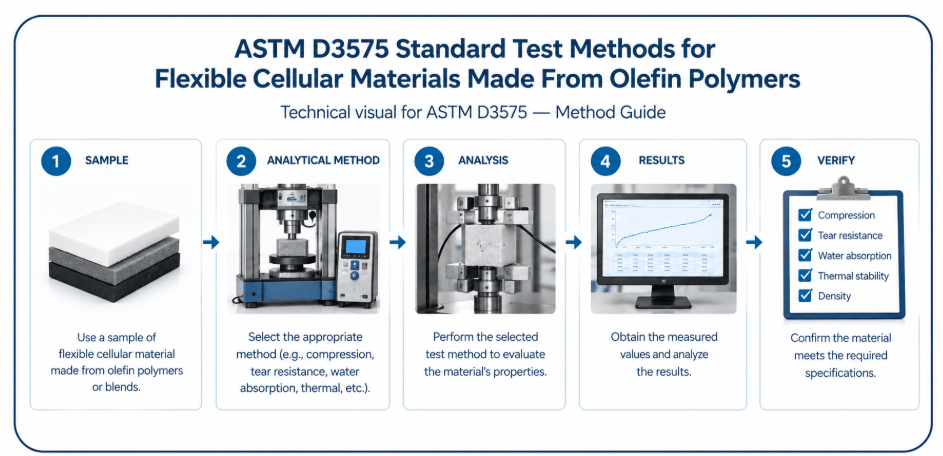
ASTM D3575 procedures can be used to determine various material properties of flexible cellular materials made from olefin polymers or olefin polymers blended with other polymers. Technicians select and perform the appropriate procedures depending on the characteristics of interest. The ASTM D3575 procedure comprises the following steps:
Technicians identify the material, prepare representative specimens, measure the required dimensions, and record the initial condition before testing.
Compression and Compression Set Testing
Technicians evaluate the material response to compression and determine the compression set by subjecting the specimens to specified compression conditions and measuring the resulting force, specimen deflection, or specimen thickness after recovery in accordance with the selected procedures.
Mechanical Resistance Testing
Technicians evaluate tear resistance of material specimens to tear forces and evaluate tensile strength and material elongation in accordance with the relevant specimen configurations, equipment, and procedures.
Water Absorption and Thermal Testing
Technicians expose specimens to the specified water-immersion or elevated-temperature conditions and measure water absorption or dimensional changes. For thermal conductivity, engineers use the applicable thermal-conductivity measurement procedure.
Density and Other Applicable Property Testing
Technicians determine density and perform other applicable ASTM D3575 procedures, such as resilience, energy absorption, abrasion, flex resistance, staining resistance, electrical properties, or impact resistance, when required by the testing program.
Result Evaluation and Reporting
Analysts review the measured data, calculate the applicable results, compare the findings with the relevant product specification or purchaser requirement, and document the test conditions and results.
ASTM D3575 Testing Process and Data Collection
The analyst selects appropriate test specimens and relevant ASTM D3575 procedures for the evaluation. The technician prepares the test specimens in accordance with the requirements of the selected procedures and measures the relevant dimensions prior to recording the initial conditions. The operator then sets up the applicable equipment and performs the selected compression, mechanical, water absorption, thermal, density, or other test procedure. After testing, technicians record the measured values and inspect the specimens for relevant changes. Analysts calculate the required results, compare the findings to the applicable requirements, and report the results for material evaluation.
ASTM D3575 Testing of Flexible Cellular Materials Made From Olefin Polymers
Common Challenges and Troubleshooting
Accurate ASTM D3575 results require proper specimen preparation, accurate dimensions, suitable equipment, and controlled test conditions. Differences in specimen thickness, cutting, conditioning, or positioning can affect the measured results. Technicians should verify specimen dimensions and inspect the equipment before testing. If measurements appear inconsistent, the operator should check equipment calibration, specimen alignment, test settings, and environmental conditions. Analysts should also review the recorded data for unusual variations before accepting the final results. Proper operator training and consistent specimen preparation help improve repeatability between tests.
ASTM D3575 Analysis Results and Interpretation
The report contains the results of the ASTM D3575 procedures performed for the flexible cellular material.
The technician records the material identification, specimen information, selected ASTM D3575 procedure, and applicable test conditions.
The analyst records the relevant properties, including the compression set, compression deflection, tear resistance, water absorption, tensile strength, elongation, density, thermal conductivity, or dimensional changes, depending on the selected procedure.
The technician records the required dimensions, force measurements, mass measurements, temperature conditions, exposure duration, and other applicable test data.
The analyst calculates the relevant results using the findings from the ASTM D3575 procedures and reports the results in the units specified for the selected procedures.
The engineer compares the results with the applicable specification, purchaser requirements, or other relevant criteria if applicable.
The analyst documents any relevant observations, unusual specimen changes, or deviations that could affect interpretation of the results.
The report presents the measured properties and test conditions so engineers can compare the performance of different flexible cellular materials under the specified test conditions.
ASTM D3575 is used for evaluating specified physical, mechanical, thermal, and other properties of flexible closed-cell materials made from olefin polymers or blends of olefin polymers with other polymers.
What is ASTM D3575 testing used to measure?
ASTM D3575 testing can measure properties such as compression set, compression deflection, tear resistance, water absorption, tensile strength, elongation, density, thermal conductivity, and thermal stability, depending on the selected procedure.
Which materials does ASTM D3575 cover?
ASTM D3575 covers flexible closed-cell materials made from olefin polymers or blends of olefin polymers with other polymers, including applicable polyethylene and polypropylene-based cellular materials.
How does ASTM D3575 support material selection?
ASTM D3575 provides comparative test data on the selected properties of flexible cellular materials made from olefin polymers or blends of olefin polymers with other polymers. Thus, the test results can help engineers choose the most suitable material for a specific application.
Davis Scott is an Electrical and Electronics Engineer specializing in multidisciplinary validation, quality assurance, and comprehensive electro-mechanical testing. Know More
Testimonials
Real results
Engineers trust us with what matters most
“We had a great experience working with this company for our ASTM E84 testing. They were the first company to respond to our inquiry within just a few minutes of submitting it. From start to finish, the communication was excellent, and the entire process was swift, straightforward, and hassle-free.”
Ivars FancyWalls
United States
“Very good communication, testing associates were very patient with delays on our end. Reasonable turnaround time for results and nicely detailed report. Analysts were also quick to answer any follow-up questions. Happy with results.”
Skye Henderson
United States
“Matestlab connected us with an accredited lab within days, cutting weeks off our product validation timeline.”
Rebecca Kozodoy-Pins
United States
Why Choose Matestlab?
Matestlab is a unified testing services partner based in the USA. Matestlab offers raw material and product testing services through accredited, expert laboratories primarily based in the USA. Matestlab supports physical, thermal, chemical, electrical, mechanical, environmental, and characterization testing needs through its global network of 2200+ accredited testing laboratories. Matestlab's in-house materials science experts curate and design comprehensive testing programs matched to the sample material and specific testing need, with regulatory requirements and confidentiality in mind.
If you are looking for a managed and trusted testing partner to achieve your research goals, feel free to schedule a meeting with us or send us a request at connect@matestlabs.com to learn more about our services. For a quick quote, call us at (302)244-7710. We are happy to serve you.
Start Your Testing Project Today
Define your requirements and get access to specialized laboratories ready to deliver results