ASTM D3518 In-Plane Shear Response of Polymer Matrix Composite Materials by Tensile Test 

    What is ASTM D3518? 

    ASTM D3518 is a standard test method for in-plane shear response of polymer matrix composite materials reinforced with high-modulus fibers. This test method applies a controlled uniaxial tensile stress to a continuous-fiber-reinforced ±45° laminate and measures the shear stress and shear strain responses. For characterization of shear stiffness and strength, back structural design and analysis, and for support in material specifications, ASTM D3518 (Standard Test Method for In-Plane Shear Response of Polymer Matrix Composite Materials by Tensile Test of a ±45° Laminate) is used in laboratories. Technicians then remove the samples under tension and measure the deformation using strain gauges or an extensometer. They then calculate the shear properties from these measurements and compare results across material batches and suppliers to assess shear performance. 

    Read more

    Get Certified ASTM D3518 Testing for Reliable Composite Shear Performance 

    ASTM D3518 certified testing helps engineers ensure a laminate provides the in-plane shear stiffness and strength required by the design. Technicians obtain shear data for material qualification by applying controlled tensile loading to a laminate made from ±45° angle material, as prescribed in ASTM D3518.  The results support supplier comparisons, quality control, and certification programs for aerospace, automotive, and marine composite structures. 

    What is the Scope of ASTM D3518? 

    ASTM D3518 covers determining the in-plane shear response of polymer matrix composite materials using the tensile test of a ±45° laminate. It tests the shear stiffness, shear stress, and shear strain of laminates made from continuous-fiber-reinforced composites under uniaxial tensile testing. This standard provides a uniform method for measuring a laminate’s shear characteristics under controlled tensile loading in a universal testing machine with bonded strain gauges.

    Read more

    ASTM D3518 intends to measure the in-plane shear stress-strain relationship of a symmetric ±45° laminate of composites when subjected to known tensile loading. This test is employed in industries for material specification, structural design and analysis, quality assurance, and research and development of composite formulation.

    The scope of ASTM D3518 includes-

    • Material form: Continuous-fiber-reinforced polymer matrix composites, unidirectional tape, woven fabric.
    • Purpose: Quantification of in-plane shear response.
    • Property measured: Shear Stress, Shear Strain, Shear Chord Modulus.
    • Method: Tensile load applied to a laminate specimen with the fibers oriented at ±45°, and a strain gauge used to measure the strain.
    • Result: Shear stress (MPa), modulus (MPa), and shear strain (%).
    • Test Limitations: Maximum shear strain reported is 5%.
    • Environmental conditions: Temperature, moisture, and specimen conditioning.
    • Applications: Aerospace and automotive qualification; comparison of designs; formulation quality control.

    What are the Uses of ASTM D3518Testing?

    ASTM D3518 testing is used to measure the behavior of a composite laminate when loaded in in-plane shear. The results are then fed back to the engineers to be compared with materials and used to assist with structural design allowables. This standard-

    • Produces in-plane shear stress vs. shear strain response data.
    • Calculates maximum in-plane shear stress of a ±45 laminate.
    • Calculates the largest engineering shear strain in the plane of failure.
    • Assists in material specification and research and development.
    • Helps with the comparison of composite formulations and stacking sequences.
    • Helps with quality control and qualification of suppliers.
    • Assists in the design and analysis of composite parts and structures. 

    What Materials Can Be Tested Under ASTM D3518? 

    ASTM D3518 is for continuous-fiber-reinforced polymer matrix composites capable of being formed into a ±45° laminate and of being tested to failure in tension in the x-direction of the laminate. This method applies to unidirectional tape and woven fabric material forms, when the laminate is stacked in a symmetric, balanced ±45° sequence. Analysts verify the material system, stacking sequence, and properties to be evaluated before conducting a test program. 

    Why is ASTM D3518Important? 

    ASTM D3518 defines the controlled tensile loading conditions used to measure the in-plane shear behaviour of composite laminates. Shear-dominated failure affects the performance of a structure, especially in the torsion-critical area or at joints of a composite component. The results help engineers compare materials, validate design allowables, and determine whether a laminate will perform acceptably under in-plane shear loading in service. 

    ASTM D3518 Equipment and Sample Preparation Guide

    ASTM D3518 calls for a universal testing machine with the ability to apply a controlled tensile load and record strain in two directions. Laboratories prepare representative specimens with a symmetric ±45° stacking sequence for testing. 

    Read more

    Sample and Specimen DetailsLaboratories select representative ±45° laminate specimens of unidirectional tape or woven fabric and prepare them for controlled tensile testing. 
    Specimen PreparationTechnicians cut, identify, and measure rectangular specimens with a symmetric, balanced ±45° stacking sequence before testing. 
    Specimen DimensionsTechnicians select a specimen width of approximately 25 mm (1.0 in.) and a length ranging from 200 mm to 300 mm (8 in. to 12 in.), based on the material form and stacking sequence. 
    InstrumentationThe test uses a universal testing machine, load cell, bonded strain gauges or a contacting/non-contacting extensometer, and a micrometer or caliper for thickness measurement. 

    Testing Procedures and Requirements for ASTM D3518

    This test method tests a laminate specimen under a controlled tensile load applied at ±45° and measures strain in both directions. Technicians set the required test parameters, and the testing machine completes the loading sequence. The ASTM D3518 test method comprises the following test procedure. 

    Read more

    Initial Evaluation Technicians measure and record specimen width, thickness, and stacking sequence before testing to establish baseline data. 
    Specimen Installation Technicians align and grip the specimen in the testing machine so the tensile load acts along the laminate x-direction. 
    Tensile Loading The machine pulls the specimen at a controlled crosshead speed, commonly around 2 mm/min, while strain gauges record deformation. 
    Strain Measurement Bonded strain gauges or an extensometer record longitudinal and transverse strain until the specimen reaches the target shear strain or fails. 
    Result Reporting Laboratories report the shear stress, shear strain, shear chord modulus, specimen information, and observed failure mode. 

    ASTM D3518Testing Process and Data Collection

    The analyst selects representative ±45° laminate specimens and determines which properties to evaluate. Next, technicians measure specimen dimensions and attach bonded strain gauges. The specimen is placed in the universal testing machine by the operator, and a controlled tensile load is applied. The crosshead speed is maintained constant, and strains are measured along and across the specimen with the help of strain gauges. Finally, it breaks or reaches the desired shear strain, and the shear stress and shear strain are determined from the data recorded. 

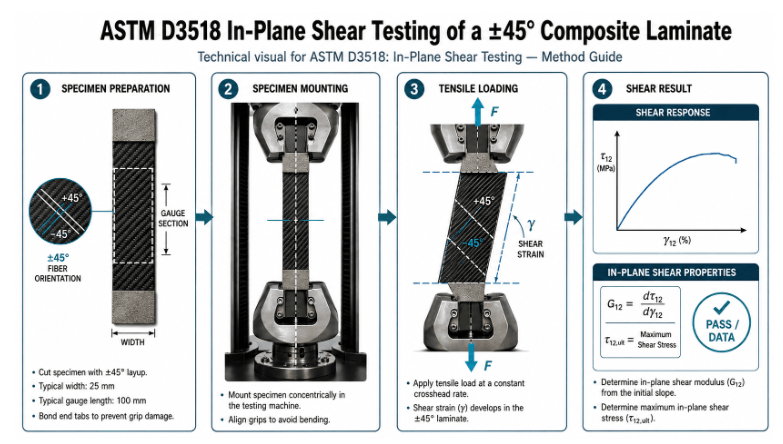
    The image depicts a composite laminate specimen mounted in a universal testing machine for in-plane shear testing as per ASTM D3518.
    ASTM D3518 In-Plane Shear Testing of a ±45° Composite Laminate

    Common Challenges and Troubleshooting

    Accurate ASTM D3518 results require careful specimen alignment, consistent gauge bonding, and calibrated equipment. Misalignment of specimens and lack of uniformity in thickness can cause errors in the measured shear response. Technicians should make sure to bond the strain gages and test the testing machine before testing. Laboratories also get reliable results when they prepare and condition their specimens in the same manner for all tests. 

    ASTM D3518Analysis Results and Interpretation

    The report provides a summary of the shear stress and shear strain response of the ±45 laminate over the course of loading. Analysts derive several properties from the recorded force and strain data.

    Read more

    • The laboratory reports the maximum in-plane shear stress on the laminate, generally in MPa or psi, for the ±45° laminate.
    • The analyst reports the maximum engineering shear strain in the plane, which is represented as a percentage.
    • The laboratory calculates the in-plane shear chord modulus of elasticity between two defined points on the shear stress-strain curve.
    • Analysts determine offset shear properties when the curve lacks a clearly defined linear region.
    • The report reports results as well as specimen stacking sequence, thickness, and void content, but does not provide a single overall performance value. 

    Link to ASTM D3518

    FAQ

    What is the significance of ASTM D3518?
    The significance of ASTM D3518 is that it provides a controlled tensile testing method for the in-plane shear response of polymer matrix composite materials through a laminate formed using a ±45° lay-up.
    ASTM D3518 is used to determine the in-plane shear stress, shear strain, and shear chord modulus of a composite laminate through tensile testing of a ±45° laminate configuration.
    The standard specifies a specimen cut from a symmetric stacking sequence at ±45° with a width of about 25 mm (1 in.) and a length of 200 mm to 300 mm (8 in. to 12 in.).

    Updated on September 14, 2026

    Suyog Kamble
    About Author
    Suyog Kamble is an Operations Associate at MaTestLab Inc. and holds a postgraduate degree in Organic Chemistry.
    Testimonials
    Real results
    Engineers trust us with what matters most
    Start Your Testing
    Project Today
    Define your requirements and get access to
    specialized laboratories ready to deliver results
    Partners with us
    Clients
    Vendors
    Process for testing
    • STEP 01

      You share your testing requirements

    • STEP 02

      You share your sample(s)

    • STEP 03

      We deliver your test reports

    Get your testing done

    Let us known your testing requirements and we will be right back with a solution.

      Let us root for each other. Collaborate to grow, expand, and accelerate our businesses.

      Partner with us

        Discover more from Matestlab

        Subscribe now to keep reading and get access to the full archive.

        Continue reading