ASTM D3465 Standard Guide for Purity of Monomeric Plasticizers by Gas Chromatography

    What is ASTM D3465?

    ASTM D3465 is a standard guide for using gas chromatography (GC) to determine the purity of monomeric plasticizers. The guide complements other purity-determination methods by using gas chromatography’s increased sensitivity to detect and evaluate low-level components. ASTM D3465 (Standard Guide for Purity of Monomeric Plasticizers by Gas Chromatography) covers monomeric plasticizers having a definite boiling point and molecular weight less than 1000 Daltons, such as dioctyl phthalate. The guide is useful for specifications, manufacturing control, and research and development. Laboratory results may be used to assess plasticizer purity, detect impurities, check plastic quality during manufacture, and compare the composition of different production lots.

    Read more

    Get Certified ASTM D3465 Monomeric Plasticizer Purity 

    ASTM D3465 testing lets manufacturers, plasticizer suppliers, chemical producers, and quality-control laboratories assess the purity of applicable monomeric plasticizers. Technicians inject a representative test portion into a gas chromatograph, separate the components on a chromatographic column, detect the separated components, and quantify their responses. The laboratory then tests the principal component and other identified components to report the level of purity and impurities. If the plasticizer content is less than 99.0% or the analytical result needs further confirmation, the guide recommends using an internal standard. 
    What is the scope of ASTM D3465?

    ASTM D3465 covers a gas chromatographic procedure for extending the range of purity determination of monomeric plasticizers. Because the plasticizer must be volatilized for GC analysis, the guide applies to monomeric plasticizers with definitive boiling points and molecular weights below 1000 Daltons. The guide covers:

    Read more

    • Monomeric Plasticizers: Evaluates the purity of applicable monomeric plasticizers by gas chromatography.
    • Gas Chromatographic Separation: Separates the plasticizer from other components using a suitable GC column.
    • Purity Determination: Determines purity from the total area response of the principal peak or peaks.
    • Impurity Detection: Identifies and quantifies other chromatographic components as impurities.
    • Area Percent Analysis: Uses area percent when the plasticizer area is 99.0% or higher.
    • Internal Standard Analysis: Uses an internal standard when the plasticizer area is below 99.0% or when questions arise about the analytical data.
    • Applicable Plasticizers: Includes suitable monomeric plasticizers with definitive boiling points and molecular weights below 1000 Daltons.

    What are the applications of ASTM D3465 Guide?

    ASTM D3465 provides a sensitive chromatographic approach for evaluating monomeric plasticizer purity. Gas chromatography can detect low-level components that infrared techniques may not readily detect. The guide suits specifications, manufacturing control, and research and development. The guide helps to:

    • Determine the purity of monomeric plasticizers.
    • Detect low-level impurities.
    • Identify chromatographic components based on retention times.
    • Monitor manufacturing consistency.
    • Support raw-material and product quality control.
    • Compare purity between production batches.
    • Support research and development activities.
    • Provide data for applicable material specifications.
    • Investigate unexpected changes in plasticizer composition.

    Which materials can be tested according to ASTM D3465?

    ASTM D3465 applies to monomeric plasticizers that can be volatilized and separated by gas chromatography. The guide specifically limits its scope to materials having definitive boiling points and molecular weights below 1000 Daltons. Dioctyl phthalate is given as an example of an applicable material. ASTM D3465 can be applied to-

    • Phthalate Plasticizers: Applicable volatile monomeric phthalates, such as dioctyl phthalate.
    • Adipate Plasticizers: Applicable monomeric adipate plasticizers within the scope.
    • Benzoate Plasticizers: Applicable monomeric benzoate plasticizers.
    • Trimellitate Plasticizers: Applicable monomeric trimellitate plasticizers.
    • Production Samples: Representative samples collected for manufacturing control or quality evaluation.
    • The guide identifies potential impurities such as alcohols, dibasic acids, and monoesters.

    Why is ASTM D3465 Guide Important?

    Plasticizer purity can influence the consistency and quality of plasticized polymer products. Some analytical techniques may not detect low-level impurities. ASTM D3465 uses gas chromatography because GC provides higher sensitivity for detecting low-level components. The test data help laboratories determine the proportion of the principal plasticizer component, evaluate impurity levels, monitor manufacturing processes, and support research and development. Accurate chromatographic separation is especially important because different components can have similar retention times.

    ASTM D3465 Equipment and Sample Preparation Guide

    Technicians determine the plasticizer and prepare an appropriate sample portion. They then set up the gas chromatograph to use a proper column, detector, carrier gas, and temperature program. The test portion is chromatographed in the column, separating components by their chromatographic behavior.

    Read more

    Sample PreparationTechnicians prepare a representative monomeric plasticizer sample using clean equipment and, when required, an internal standard.
    Gas ChromatographLaboratories use a gas chromatograph with a suitable chromatographic column, injector, detector, carrier gas, and temperature-control system.
    Sample QuantityTechnicians use the quantity required for GC analysis.
    Data SystemThe laboratory uses an electronic data system or integrator to measure chromatographic peak areas.

    ASTM D3465 Testing Procedures and Requirements

    Technicians identify the plasticizer type and collect a representative test sample. Then they set up the gas chromatograph using an appropriate column, detector, carrier gas, and temperature program. The test sample is introduced into the column, and the components separate based on their chromatographic properties. ASTM D3465 testing can be organized as follows:

    Read more

    Sample Identification and PreparationTechnicians identify the plasticizer, record relevant sample data, and prepare the sample for gas chromatographic analysis.
    Gas Chromatographic Separation and EvaluationThe chromatograph separates the plasticizer from other detectable components, and then an analyst analyzes the peaks that appear.
    Purity and Impurity DeterminationAnalysts determine the relative purity of the principal plasticizer component and evaluate other detected components using the applicable calculation approach.
    Result Recording and ReportingLaboratory personnel record analytical results, calculations, test conditions, and relevant observations and report the findings.

    ASTM D3465 Testing Process and Data Collection

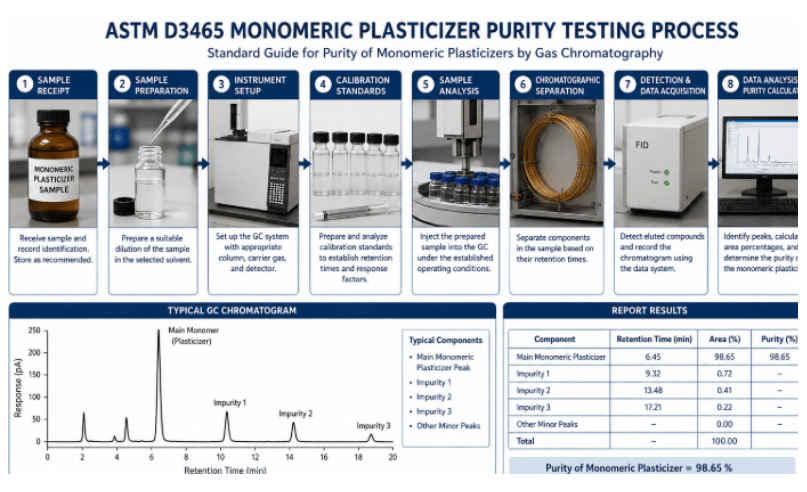
    Technicians start testing by selecting a representative plasticizer sample and preparing the gas chromatograph for analysis. They select a column that provides adequate separation and establish appropriate operating conditions. The guide describes a typical sample size of approximately 1 μL and specifies helium as a carrier gas with a typical flow range of 30 to 60 cm³/min. The analyst injects the sample into the GC column. The column separates the components, and the detector records their responses. The electronic data system or integrator measures the corresponding peak areas. Analysts then determine the purity from the total area response of the principal peak or peaks. The laboratory should also evaluate impurity peaks and, when appropriate, relate their retention times to known substances. If components overlap, the analyst should take appropriate steps to obtain adequate separation; GC/MS may help identify overlapping components.

    The image shows the ASTM D3465 testing process, including plasticizer sample preparation, gas chromatograph setup, sample injection, chromatographic separation, detector response, peak-area measurement, purity calculation, and impurity reporting.
    ASTM D3465 Monomeric Plasticizer Purity Testing Process

    Common Challenges and Troubleshooting

    Variations in ASTM D3465 results may be attributed to sample preparation, sample contamination, chromatographic separation, instrument performance, column performance, calculation errors, and test conditions. Technicians should collect representative samples and apply appropriate sample preparation and analysis procedures. Equipment should be suitably calibrated and checked before use. The technical staff must also check sample preparation, chromatographic conditions, instrument performance, and test data before reporting results. Laboratories should follow appropriate safety procedures when handling gases, solvents, and GC equipment and should check the system for leaks before operation.

    Analysis Results and Interpretation

    ASTM D3465 reports plasticizer purity based on the chromatographic area response of the principal component or components. The guide treats all other detected components as impurities.

    Read more

    • ASTM D3465 reports plasticizer purity from the chromatographic area response of the principal component or components. The laboratory reports other detected components as impurities.
    • Report the proportion of total area associated with impurities in %.
    • Report impurity retention times and relate them to known substances when applicable.
    • Identify the chromatographic column used.
    • Report relevant gas chromatographic operating conditions.
    • Internal Standard: Identify the internal standard when used for calibration.
    • When the plasticizer area is 99.0% or higher, the guide specifies an area-percent approach for determining component concentration. When the plasticizer area is below 99.0%, or when questions arise about the data, use an internal standard.

    Link to ASTM D3465 

    FAQ

    Where can I get the astm d3465 tested?
    You can share your astm d3465 testing requirements with MaTestLab. MaTestLab has a vast network of material testing laboratories, spread across the USA and Canada. We support your all material testing needs ranging from specific astm d3465 test to various testing techniques.
    Please contact us for a detailed quote for your astm d3465 testing needs. Cost incurred to carry out different astm d3465 testing methodology depends on the type of raw material; number of samples, coupons, or specimens; test conditions, turn around time etc. Costs of some ASTM testing methods start from $100 and the final value depends upon the factors listed above. Please contact us for the best and latest prices.
    The required number of samples or specimens should comply with the procedure given in the astm d3465 standard. However, the MaTestLab operations team can assist you for your special requirements once you share your testing details with us.
    MaTestLab has a vast testing laboratory network, hence we bring you the best testing facilities in a cost-effective way. We offer considerable discounts (15-20%) to our returning customers based on test volume and frequency.
    The turnaround time for astm d3465 test methodology depends upon the test procedure mentioned in the standard test document. However, we at MaTestLab understand your research requirements and hence try to get your test completed within the least possible time.
    Suyog Kamble
    About Author
    Suyog Kamble
    Suyog Kamble is an Operations Associate at MaTestLab Inc. and holds a postgraduate degree in Organic Chemistry.
    Testimonials
    Real results
    Engineers trust us with what matters most
    Start Your Testing
    Project Today
    Define your requirements and get access to
    specialized laboratories ready to deliver results
    Partners with us
    Clients
    Vendors
    Process for testing
    • STEP 01

      You share your testing requirements

    • STEP 02

      You share your sample(s)

    • STEP 03

      We deliver your test reports

    Get your testing done

    Let us known your testing requirements and we will be right back with a solution.

      Let us root for each other. Collaborate to grow, expand, and accelerate our businesses.

      Partner with us

        Contact Us

        Discover more from MaTestLab

        Subscribe now to keep reading and get access to the full archive.

        Continue reading