
ASTM D3295 Standard Specification for PTFE Tubing, Miniature Beading and Spiral Cut Tubing

    What is ASTM D3295?

    ASTM D3295 describes a standard specification for PTFE tubing, miniature beading, and spiral-cut tubing made from PTFE resin produced by dispersion. PTFE is a high-performance fluoropolymer known for its chemical resistance, low surface friction, and resistance to high temperatures. The specification introduces five sets of these products by size and type. It also categorizes the groups based on wall thickness. The specifications include five product groups: tubing based on AWG sizes, tubing based on fractional-inch sizes, tubing based on inside diameter and wall thickness, tube cut to spiral wrap, and miniature beading.

    Read more

    Get Certified ASTM D3295 Testing for Reliable PTFE Tubing Performance 

    ASTM D3295 testing helps laboratories assess PTFE tubing, miniature beading, and spiral-cut tubing against specified requirements. The specification covers properties of melting point, specific gravity, weight loss, tensile strength, elongation, dielectric breakdown voltage, heat resistance, and dimensional stability. Testing these properties helps manufacturers to evaluate the specified properties of PTFE products and aid quality-control activities.
    What is the Scope of the ASTM D3295 Test Standard? 

    ASTM D3295 applies to PTFE tubing, miniature beading, and spiral cut tubing constructed of PTFE resin from the dispersion in ASTM D4895. The ASTM D3295 standard-

    Read more

    • Covers PTFE tubing, Miniature beading, and spiral cut tubing. 
    • Classifies products into five groups based on size and type, including AWG, fractional-inch, inner diameter/wall thickness, spiral wrap, and miniature beading.
    • Classifies tubing according to wall thickness.
    • Covers miniature beading.
    • Specifies requirements for testing the melting point and specific gravity.
    • Specifies requirements for weight loss, tensile strength, and elongation.
    • Tests the breakdown voltage, heat resistance, and dimensional stability. 

    What are the Uses of ASTM D3295 Testing? 

    ASTM D3295 testing helps laboratories measure the properties of PTFE tubing, miniature beading, and spiral-cut tubing. The standard specifies requirements for physical, electrical, thermal, and dimensional properties. This standard-

    • Determines melting point and specific gravity.
    • Determines weight loss.
    • Measures resistance to stretching and elongation.
    • Evaluates dielectric breakdown voltage.
    • Assesses heat resistance.
    • Evaluates dimensional stability.
    • Supports testing of PTFE products and tubing to meet requirements. 

    Which materials can be tested under ASTM D3295? 

    ASTM D3295 covers tubing, miniature beading, and spiral-cut tubing manufactured from PTFE resin produced from dispersion. With the appropriate specimen configuration, the specification can be applied to assess different tubing sizes, wall thicknesses, and finished products. Before starting the testing program, an analyst should decide what material to test and what application it has, what form the specimens will be in (tubing, beading, or spiral cut), what group and class of material will be tested, and what properties will be evaluated.

    Why is ASTM D3295 Important? 

    ASTM D3295 specifies test methods for several key properties of PTFE tubing, miniature beading, and spiral-cut tubing. These include dimensions, workmanship, physical and electrical properties. Standardized requirements allow laboratories and manufacturers to use a standardized method to test materials. The standard evaluates the quality and performance of the tubing and beading in demanding applications.

    ASTM D3295 Equipment and Sample Preparation Guide 

    The ASTM D3295 test method employs different apparatus depending upon the property being measured. The required apparatus and the specimen preparation depend on applicable requirements and test procedure. 

    Read more

    Sample and Specimen DetailsTechnicians select representative samples from PTFE tubing, miniature beading, or spiral cut tubing. The material must be made from PTFE resin produced from dispersion. 
    Specimen PreparationTechnicians prepare test specimens from the tubing or beading, ensuring they meet the standard’s dimensional requirements. 
    Specimen DimensionsSpecimens must comply with the size and dimension requirements of ASTM D3295, according to the group and class being tested. 
    InstrumentationThe test uses equipment such as a tensile testing machine, dielectric strength tester, density measurement equipment, melting point apparatus, and visual inspection tools. 

    Testing Procedures and Requirements for ASTM D3295 

    ASTM D3295 evaluates the specified properties of PTFE tubing, miniature beading, and spiral cut tubing. Laboratories select the appropriate procedures, prepare the specimen, perform the measurements, and record the resulting data. The specification identifies melting point, specific gravity, weight loss, tensile strength, elongation, dielectric breakdown voltage, heat resistance, and dimensional stability as properties to be tested against specified requirements.

    Read more

    Other referenced ASTM documents include ASTM D149, D374, D618, D638, D792, and D883.

    Specimen Preparation Technicians prepare test specimens from PTFE tubing, miniature beading, or spiral-cut tubing, ensuring they meet the standard’s dimensional requirements. 
    Melting Point and Specific GravityTechnicians determine the thermal properties of the PTFE resin and the material density.  
    Weight Loss and Tensile PropertiesTechnicians measure weight loss to assess material stability and measure tensile strength and elongation to evaluate mechanical performance. 
    Dielectric Breakdown  Voltage and Heat ResistanceTechnicians assess insulating properties and resistance to electrical breakdown and evaluate the material’s ability to withstand elevated temperatures. 
    Dimensional Stability and Result Reporting Technicians determine the dimensional stability under specified conditions, while laboratories report results in SI units and compare them with standard requirements to determine material suitability. 

    ASTM D3295 Testing Process and Data Collection 

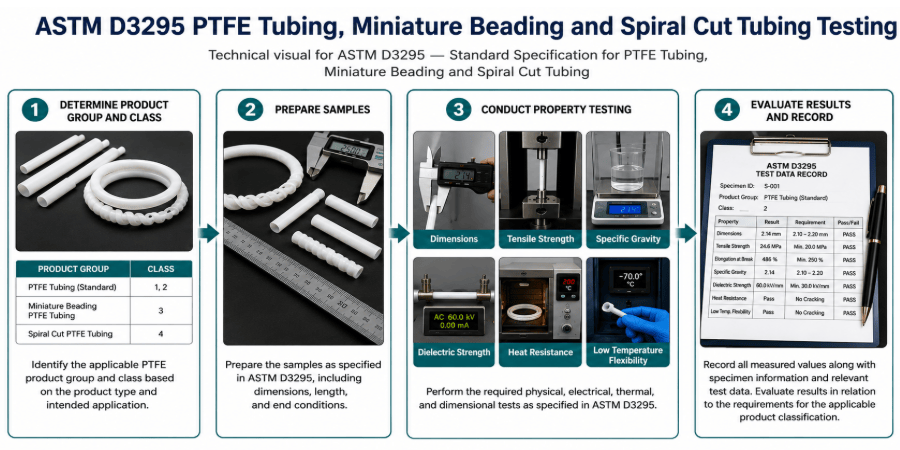
    Laboratories first determine the applicable PTFE product group and class. Technicians then prepare the samples as specified in the test procedure and perform the required property testing. The laboratory records the measured values for the applicable properties, along with the specimen information and relevant test data. The results are then evaluated against the requirements for the relevant product classification.

     The image shows PTFE tubing specimens being evaluated in a laboratory for physical, electrical, thermal, and dimensional properties as per ASTM D3295.
    ASTM D3295 PTFE Tubing, Miniature Beading and Spiral Cut Tubing Testing

    Common Challenges and Troubleshooting 

    Accurate results depend on proper specimen preparation, proper test procedures, and reliable equipment. Test results may differ because of variation in product dimensions, wall thickness, specimen condition, equipment setup, and measurement techniques. Before testing, a technician should determine the correct product group and class, review the equipment, and perform each test properly for each property. Conducting tests on well-prepared specimens and under controlled conditions aids laboratories in generating accurate values for the specified physical, electrical, thermal, and dimensional properties. 

    ASTM D3295 Analysis Results and Interpretation 

    The report summarizes the performance of the tested PTFE tubing, miniature beading, or spiral cut tubing for the applicable physical, electrical, thermal, and dimensional properties. It displays the measured results for the selected tests, along with the units and sample details. 

    Read more

    • ASTM D3295 provides results for each property tested rather than a single composite test value. 
    • Laboratories determine melting point, specific gravity, weight loss, tensile strength, elongation, dielectric breakdown voltage, heat resistance, and dimensional stability according to applicable requirements.
    • Results are interpreted according to the applicable product group and class.
    • Standardized specimen preparation, adequate equipment, and controlled test conditions contribute to laboratory reliability. 

    Link to ASTM D3295 

    Updated on August 28, 2026

    Gokula Srinivasan Selvam
    About Author
    Gokula Srinivasan Selvam is a Material Testing Associate at Matestlab Inc. and holds a postgraduate degree in Ceramic Engineering from IIT (BHU), Varanasi. His academic background and professional experience are centered on advanced ceramic materials, their processing, characterization, and performance evaluation.
    Know More
    Testimonials
    Real results
    Engineers trust us with what matters most
    Start Your Testing
    Project Today
    Define your requirements and get access to
    specialized laboratories ready to deliver results
    Partners with us
    Clients
    Vendors
    Process for testing
    • STEP 01

      You share your testing requirements

    • STEP 02

      You share your sample(s)

    • STEP 03

      We deliver your test reports

    Get your testing done

    Let us know your testing requirements and we will be right back with a solution.

      Let us root for each other. Collaborate to grow, expand, and accelerate our businesses.

      Partner with us

        Discover more from Matestlab

        Subscribe now to keep reading and get access to the full archive.

        Continue reading