ASTM D3294 Standard Specification for Polytetrafluoroethylene (PTFE) Resin Molded Sheet and Molded Basic Shapes
What is ASTM D3294?
ASTM D3294 describes a standard specification for molded sheet and molded basic shapes of polytetrafluoroethylene (PTFE) resin. It specifies requirements for the material, dimensions, workmanship, and physical and electrical properties of molded PTFE products. The specification applies to molded sheets produced from PTFE resin molding materials as specified in ASTM D4894 (Standard Specification for Polytetrafluoroethylene (PTFE) Resin Molded Sheet and Molded Basic Shapes) and molded basic shapes formed from molding materials. The specification covers important properties such as tensile strength, elongation, dielectric strength, specific gravity, porosity, and melting point. It also requires visual and dimensional inspection and examination for internal defects such as microscopic cracks, voids, inclusions, and other defects that could affect material serviceability.
Get Certified ASTM D3294 Testing for Reliable PTFE Material Performance
PTFE molded sheets and basic shapes require consistent material and performance characteristics for intended applications. Testing helps manufacturers assess material quality, dimensions, workmanship, and suitable physical and electrical properties. ASTM D3294 testing will offer a consistent method to assess these requirements. Results can assist with product evaluation, product quality control, material qualification, and specification compliance.
What is the Scope of ASTM D3294 Testing?
ASTM D3294 specifies the requirements and test methods for the material, dimensions, workmanship, and physical and electrical properties of molded PTFE sheet and molded basic shapes. The specification applies to molded sheets that are 0.794 mm (1/32 in.) thick or more. The specification also sets the requirements for basic shapes formed by molding using molding materials. It applies to products that are 12.7mm (0.5 in.) or more in a dimension perpendicular to the molding pressure direction and 300mm (12 in.) or less in a dimension parallel to the molding pressure direction. The ASTM D3294 standard-
Covers molded PTFE sheet with a minimum thickness of 0.794 mm (1/32 in.).
Evaluates tensile strength and elongation.
Determines the size of molded basic shapes.
Assesses specific gravity, dielectric strength, and porosity.
Determines the melting point.
Examines specimens for microscopic cracks, voids, inclusions, and other defects that may impact serviceability.
What are the Uses of ASTM D3294 Testing?
ASTM D3294 testing helps assess molded PTFE sheet and molded basic shapes on specified material, dimensional, workmanship, physical, and electrical requirements. The testing also enables visual and dimensional inspection and examination for internal defects that may impact material serviceability. This standard includes-
Evaluation of materials and products.
Measurement of dimensions for accuracy and consistency.
Evaluation of the quality of the workmanship and of the overall product quality.
Testing of tensile strength and elongation characteristics.
Measurement of electrical strength and electrical performance.
Assessment of specific gravity and porosity characteristics.
Melting point and thermal analysis.
Detection and diagnosis of internal faults and abnormalities.
Which Materials Can Be Tested Under ASTM D3294?
This ASTM D3294 applies to polytetrafluoroethylene (PTFE) resin molded sheet and molded basic shapes. The specification requires the sheet or molded basic shape to be of unpigmented PTFE and free from foreign matter. The specification applies to molded sheets made of PTFE resin molding materials. Also includes molded basic shapes within the dimensional limits.
Why is ASTM D3294 Important?
ASTM D3294 provides requirements for evaluating important characteristics of molded PTFE products. These are dimensions, workmanship, physical properties, electrical properties, and internal defects. Standardized testing enables laboratories and manufacturers to test materials according to requirements and procedures that apply to them. Visual and dimensional inspection and defect examination are also used to assist in the identification of conditions that may impact material serviceability.
ASTM D3294 Equipment and Sample Preparation Guide
Laboratories use appropriate equipment to inspect the material and assess the required qualities. Equipment selection is based on the property or inspection requirement being assessed.
Representative samples are taken from PTFE molded sheets or molded basic shapes. The material must be unpigmented and free from foreign matter.
Specimen Preparation
Technicians prepare test specimens from the molded sheet or shape, ensuring they meet the standard’s dimensional requirements. Specimens are visually and dimensionally inspected to verify compliance.
Specimen Dimensions
Specimens must comply with the size and dimension requirements of ASTM D3294. Sheets require a minimum thickness of 0.794 mm (1/32 in.). Shapes must be 300 mm (12 in.) or less parallel to and 12.7 mm (0.5 in.) or greater perpendicular to the molding pressure.
Instrumentation
The test uses equipment such as a tensile testing machine, dielectric strength tester, density measurement equipment, melting point apparatus, and visual inspection tools.
Testing Procedures and Requirements for ASTM D3294
Technicians examine PTFE molded sheets (or basic shape) and set up samples for the applicable evaluation. They conduct visual and dimensional examinations and test necessary physical and electrical attributes in accordance with the appropriate procedures. The specification covers tensile strength, elongation, dielectric strength, specific gravity, porosity, and melting point. It also must be examined for internal defects that may impact material serviceability. Other referenced ASTM documents include ASTM D149, D374, D618, D638, D792, and D883.
Technicians prepare test specimens from the molded sheet or shape, ensuring they meet the dimensional requirements of the standard.
Visual and Dimensional Inspection
Technicians inspect specimens for appearance and dimensions to verify compliance with standard requirements and ensure they are free from foreign matter.
Tensile and Dielectric Properties
Technicians measure tensile strength and elongation to evaluate mechanical performance and assess insulating properties and resistance to electrical breakdown.
Specific Gravity, Porosity and Melting Point
Technicians determine the density and void content of the material and thermal properties of the PTFE resin.
Internal Defect Examination
Technicians examine specimens to ensure they are free from microscopic cracks, voids, and inclusions.
Result Reporting
Laboratories report test results in SI units, as required by the standard, and compare them with the standard’s requirements to determine material suitability.
ASTM D3294 Testing Process and Data Collection
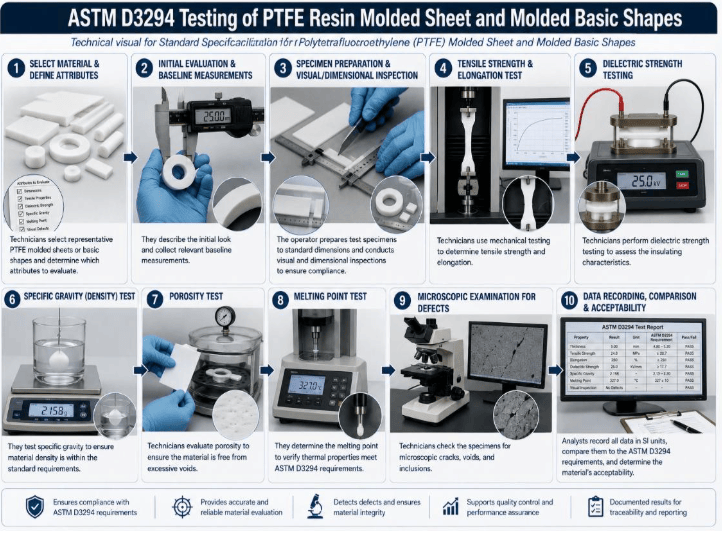
Technicians select representative PTFE molded sheets or basic shapes and determine which attributes to evaluate. They describe the initial look and collect relevant baseline measurements. The operator prepares test specimens to standard dimensions and conducts visual and dimensional inspections to ensure compliance. Technicians use mechanical testing to determine tensile strength and elongation, and dielectric strength testing to assess insulating characteristics. They also test specific gravity, porosity, and melting point to ensure material density and thermal properties. Finally, technicians check the specimens for microscopic cracks, voids, and inclusions. Analysts record all data in SI units, compare them to the ASTM D3294 requirements, and determine the material’s acceptability.
ASTM D3294 PTFE Resin Molded Sheet Testing
Common Challenges and Troubleshooting
Accurate results require careful specimen preparation, appropriate test techniques, and dependable equipment. Test findings may differ depending on specimen condition, size, surface conditions, equipment setup, and measurement methodologies. Technicians should determine the specimen condition prior to testing, inspect the apparatus, verify the test conditions, and choose appropriate procedures for the required property. Internal-defect examination technicians should thoroughly prepare and examine the specimen to detect microscopic cracks, voids, inclusions, and other defects. Consistent specimen preparation and controlled testing conditions help laboratories produce reliable results.
ASTM D3294 Analysis Results and Interpretation
The report summarizes the PTFE material’s performance based on dimensions, workmanship, physical, and electrical properties. It presents the measured values for the specified tests, along with the appropriate units, specimen data, and inspection findings.
ASTM D3294 provides property-specific results, reported in SI units, including tensile strength (MPa), elongation (%), dielectric strength (kV/mm), and melting point (°C) etc, instead of a single overall test value.
Laboratories report the results for tensile strength, elongation, dielectric strength, specific gravity, porosity, and melting point in accordance with the corresponding procedures.
Visual and dimensional inspection helps determine compatibility with applicable requirements.
Internal-defect examination detects microscopic cracks, voids, inclusions, and other flaws that may impair material serviceability.
Consistent preparation of specimens, suitable equipment, and controlled test conditions help laboratories produce reliable results.
Laraib Hashmi is an aspiring research enthusiast and science content professional with a strong interdisciplinary skill set, holding a postgraduate degree in Applied Microbiology from KIIT Bhubaneshwar, Odisha. Know More
Testimonials
Real results
Engineers trust us with what matters most
“We had a great experience working with this company for our ASTM E84 testing. They were the first company to respond to our inquiry within just a few minutes of submitting it. From start to finish, the communication was excellent, and the entire process was swift, straightforward, and hassle-free.”
Ivars FancyWalls
United States
“Very good communication, testing associates were very patient with delays on our end. Reasonable turnaround time for results and nicely detailed report. Analysts were also quick to answer any follow-up questions. Happy with results.”
Skye Henderson
United States
“Matestlab connected us with an accredited lab within days, cutting weeks off our product validation timeline.”
Rebecca Kozodoy-Pins
United States
Start Your Testing Project Today
Define your requirements and get access to specialized laboratories ready to deliver results