
ASTM D3030 Standard Test Method for Volatile Matter (Including Water) of Vinyl Chloride Resins

    What is ASTM D3030? 

    ASTM D3030 is a standard test method for quantitatively determining volatile matter (including water) in vinyl chloride resins. Laboratories use this method to determine the amount of volatile components in the resin. The method determines total volatile matter, not individual volatile components. ASTM D3030 requires SI units as the standard units of measure. Manufacturers use these results to monitor resin quality and compare resin materials during production and quality-control programs. Laboratories document sample identification, the initial and final mass measurements, the calculated volatile matter, and test conditions.

    Read more

    Get Certified ASTM D3030 Testing for Vinyl Chloride Resin Quality Control

    Vinyl chloride resins can contain volatile components, including moisture, that may affect material handling, processing, and quality. ASTM D3030 provides a standard method for quantitatively determining these volatile components. Laboratories can use the results for resin characterization, quality control, material comparison, and process control. ASTM D3030 (standard test method for volatile matter (including water) of vinyl chloride resins) is a standard test method for the quantitative determination of volatile matter (including water) in vinyl chloride resins.

    What is the scope of ASTM D3030? 

    ASTM D3030 specifies the quantitative determination of volatile matter (including water) in vinyl chloride resins. This method measures the total amount of volatiles and does not separate the individual chemical composition. The standard specifies SI units as the standard units. The ASTM D3030 standard:

    Read more

    • Determines volatile matter in vinyl chloride resins. 
    • Includes water within the measured volatile matter. 
    • Provides a quantitative measurement of volatile content. 
    • Supports resin quality-control testing. 
    • Helps laboratories compare vinyl chloride resin materials.

    What are the uses of ASTM D3030 testing?

    ASTM D3030 testing helps laboratories determine the volatile content of vinyl chloride resins. The results enable the manufacturer to monitor resin quality and compare resin materials during production and quality-control programs. ASTM specifically states that the test establishes the quantity of volatile components in the resin. This testing:

    • Determines volatile matter content and includes moisture within the volatile matter measurement.
    • Supports vinyl chloride resin quality control and material characterization and compares resin batches.
    • Provides quantitative data for resin evaluation.

    Which Materials Can Be Tested Under ASTM D3030?

    ASTM D3030 is a standard test for measuring volatile content in vinyl chloride resin. Using the same measurement, laboratories can compare resin batches to look for volatile content differences. The method also separates volatile matter from the resin’s individual components.

    ASTM D3030 Equipment and Sample Preparation Guide

    ASTM D3030 requires laboratory equipment that can accurately weigh the resin and control the test conditions needed to determine volatile matter. Technicians should prepare a representative resin sample and control the weighing and test conditions.

    Read more

    Sample and Specimen DetailsLaboratories use representative samples of vinyl chloride resin for volatile-matter determination.
    Specimen PreparationTechnicians prepare a representative resin portion and weigh it accurately before the volatile-matter determination.
    Specimen DimensionsASTM D3030 determines volatile matter from a resin sample rather than a specified dimensional test specimen. The laboratory follows the standard’s applicable sample quantity and procedure requirements.
    Instrumentation Analytical balance, appropriate drying/heating devices, weighing container, desiccator, and other lab handling equipment.

    Testing Procedures and Requirements for ASTM D3030

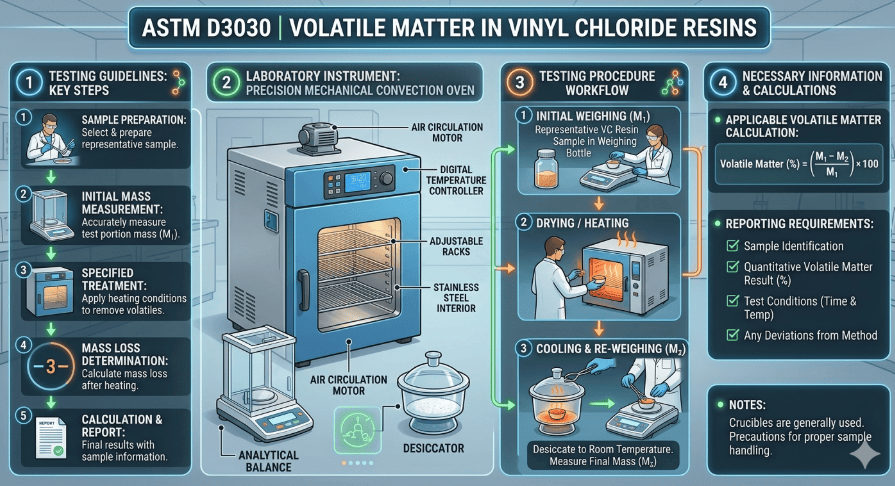
    ASTM D3030 determines volatile matter quantitatively by measuring the change associated with volatile components in a vinyl chloride resin sample. Technicians weigh the sample accurately, subject it to the specified test conditions, and calculate the volatile matter from the mass change. The testing procedures and requirements for ASTM D3030 are given below:

    Read more

    Other reference ASTM documents include D618, D883, D1600, E145, E456, and E2935.

    Sample Preparation and Initial WeighingTechnicians select and prepare a representative vinyl chloride resin sample and measure the mass of the test portion accurately.
    Volatile Matter and Final Weighing Determination Then, they apply the specified test conditions to remove the volatile components, including water, and determine the mass after the specified treatment and establish the mass loss.
    Calculation and Result ReportingAnalysts calculate the volatile matter from the applicable mass measurements and report the quantitative volatile matter result together with relevant sample and test information.

    ASTM D3030 Testing Process and Data Collection

    Laboratories first obtain a representative sample of vinyl chloride resin and measure its mass. Technicians then subject the sample to the required test conditions and measure its change in mass. The laboratory then determines the amount of volatile matter in the resin according to the mass values measured. The laboratory records the sample, the initial and final mass measurements, the calculated volatile matter, and the test conditions. ASTM D3030 establishes the quantity of volatile components but does not identify the individual components.

     This image depicts a precision mechanical connection oven used for heating as per ASTM D3030.
    ASTM D3030 Precision Mechanical Connection Oven 

    Common Challenges and Troubleshooting

    Accurate volatile matter results require representative sampling, accurate weighing, test conditions, and handling of the test specimen. Common challenges include inaccurate initial or final weighing, nonrepresentative resin sampling, inconsistent heating or drying conditions, sample moisture absorption, improper weighing-container handling, and incomplete removal of volatile components. Technicians should use calibrated balances, maintain consistent test conditions, and minimize unnecessary sample exposure to the laboratory environment.

    ASTM D3030 Analysis Results and Interpretation

    • ASTM D3030 yields a quantitative volatile matter result for vinyl chloride resin (including water). 
    • Laboratories should report on the measured volatile matter along with sample identification and test information.
    • Laboratories calculate volatile matter from the applicable mass measurements obtained before and after the specified test treatment. 
    • Laboratories report volatile matter results as a percentage. 
    • Laboratories should document the sample identification, the measured masses, the calculated volatile matter, and the test conditions.

    Link to ASTM D3030

    Read more

    FAQ

    Where can I get the astm d3030 tested?
    You can share your astm d3030 testing requirements with MaTestLab. MaTestLab has a vast network of material testing laboratories, spread across the USA and Canada. We support your all material testing needs ranging from specific astm d3030 test to various testing techniques.
    Please contact us for a detailed quote for your astm d3030 testing needs. Cost incurred to carry out different astm d3030 testing methodology depends on the type of raw material; number of samples, coupons, or specimens; test conditions, turn around time etc. Costs of some ASTM testing methods start from $100 and the final value depends upon the factors listed above. Please contact us for the best and latest prices.
    The required number of samples or specimens should comply with the procedure given in the astm d3030 standard. However, the MaTestLab operations team can assist you for your special requirements once you share your testing details with us.
    MaTestLab has a vast testing laboratory network, hence we bring you the best testing facilities in a cost-effective way. We offer considerable discounts (15-20%) to our returning customers based on test volume and frequency.
    The turnaround time for astm d3030 test methodology depends upon the test procedure mentioned in the standard test document. However, we at MaTestLab understand your research requirements and hence try to get your test completed within the least possible time.
    Suyog Kamble
    About Author
    Suyog Kamble
    Suyog Kamble is an Operations Associate at MaTestLab Inc. and holds a postgraduate degree in Organic Chemistry.
    Testimonials
    Real results
    Engineers trust us with what matters most
    Start Your Testing
    Project Today
    Define your requirements and get access to
    specialized laboratories ready to deliver results
    Partners with us
    Clients
    Vendors
    Process for testing
    • STEP 01

      You share your testing requirements

    • STEP 02

      You share your sample(s)

    • STEP 03

      We deliver your test reports

    Get your testing done

    Let us known your testing requirements and we will be right back with a solution.

      Let us root for each other. Collaborate to grow, expand, and accelerate our businesses.

      Partner with us

        Contact Us

        Discover more from MaTestLab

        Subscribe now to keep reading and get access to the full archive.

        Continue reading