ASTM D3014 Standard Test Method for Flame Height, Time of Burning, and Loss of Mass of Rigid Thermoset Cellular Plastics in a Vertical Position

    What is ASTM D3014? 

    ASTM D3014 is a standard test method for comparing the burning characteristics of rigid thermoset cellular plastics under controlled laboratory conditions. This method measures flame height, combustion duration, and the mass of material remaining after combustion. The test places a specimen vertically inside a test chimney with a glass front and exposes it to a controlled burner flame for 10 s. ASTM D3014 (test method for flame height, time of burning, and loss of mass of rigid thermoset cellular plastics in a vertical position) is a standard test method for comparative burning characteristics of rigid thermoset cellular plastics in a controlled laboratory setting. Laboratories evaluate flame height, burning duration, and the mass remaining on the specimens. ASTM D3014 is a small-scale test of relative burning characteristics. Manufacturers use these results to compare materials during product development and quality-control programs.

    Read more

    Get Certified ASTM D3014 Testing for Reliable Fire-Response Evaluation

    Rigid thermoset cellular plastics can respond differently to heat and flame depending on their composition and structure. ASTM D3014 provides controlled laboratory conditions that allow laboratories to compare the burning response of these materials. The test gives quantitative data on flame height, flame duration, and mass retention. Manufacturers and engineers can use these results to compare materials during product development and quality-control programs. 
    What is the scope of the ASTM D3014 test standard?

    ASTM D3014 covers a small-scale laboratory screening procedure for comparing the relative extent and time of burning and mass loss of rigid thermoset cellular plastics. The standard specifically states that laboratories should use the method only to establish relative burning characteristics. The ASTM D3014 standard:

    Read more

    • Measures rigid thermoset cellular plastics under controlled flame exposure and the height of the flame produced during combustion.
    • Measures the time of burning after ignition and determines the mass percent retained by the specimen after ignition.
    • Uses a vertical test arrangement with a glass-fronted chimney and applies a controlled burner flame for 10 s.
    • Provides a comparative screening method for burning characteristics.

    What are the uses of ASTM D3014 testing?

    What are the uses of ASTM D3014 testing? The ASTM D3014 test enables laboratories to measure and compare the relative burning characteristics of rigid thermoset cellular plastics. The measured results provide useful data for material evaluation, development, and quality-control activities. This standard:

    • Measures flame height during controlled ignition, burning duration, and mass retained after combustion and compares the relative burning characteristics of cellular plastics.
    • Supports material development and formulation studies and helps manufacturers compare different cellular plastic materials.
    • Supports quality-control testing under controlled laboratory conditions and provides comparative data for fire-response evaluation.
    • Helps engineers evaluate material behavior under the specific exposure conditions defined by the method.

    Which materials can be tested under ASTM D3014? 

    ASTM D3014 applies to rigid thermoset cellular plastics. Do not use the method for materials that drip or melt under the specified test conditions.

    Why is ASTM D3014 Important?

    ASTM D3014 offers a controlled procedure for comparing the rigidity response of thermoset cellular plastics to a given flame exposure. The method measures several characteristics rather than relying on visual observations alone.

    ASTM D3014 Equipment and Sample Preparation Guide

    ASTM D3014 specifies a controlled vertical combustion system, timing and weighing equipment, and environmental conditioning. Laboratories should prepare specimens with uniform density, smooth cut edges, and clean surfaces before testing.

    Read more

    Sample and Specimen DetailsLaboratories cut six specimens from material with uniform density.
    Specimen PreparationTechnicians cut the specimens with smooth edges and remove dust. They determine the density of each specimen and reject the sample if any specimen varies by more than the specified density limit from the group average.
    Specimen DimensionsTechnicians prepare specimens measuring 254 ± 1 mm × 19 ± 0.5 mm × 19 ± 0.5 mm.
    Instrumentation Vertical test chimney, heat-resistant glass panel, flame height scale, timer, standard gas burner, analytical balance, and relatively draft-free laboratory hood.

    Testing Procedures and Requirements for ASTM D3014

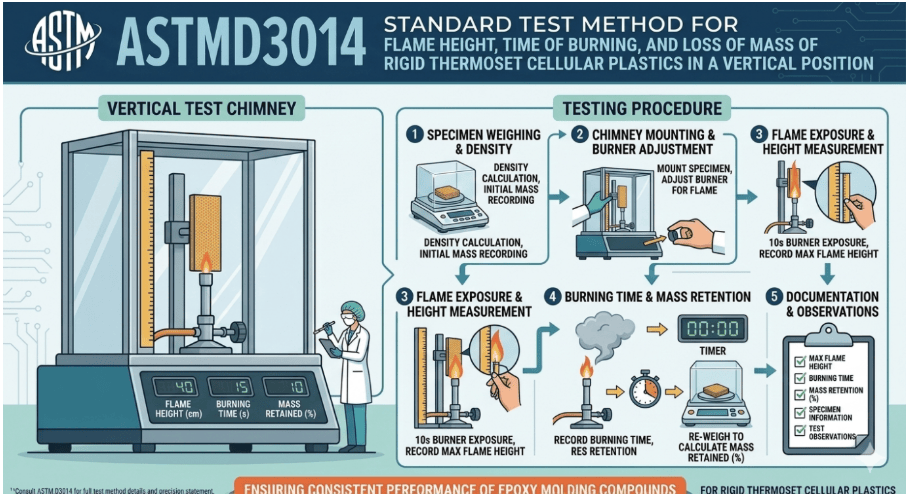
    Technicians place each specimen upright in the test chimney and subject it to a controlled burning flame according to ASTM D3014. The laboratory then observes and records the combustion response. The testing procedures and requirements for ASTM D3014 are given as-

    Read more

    Density Determination and Initial WeighingTechnicians determine the specimen density, weigh each specimen, and record the initial mass to the required accuracy.
    Specimen Installation and Burner PreparationTechnicians mount the specimen vertically on the specimen support inside the test chimney and adjust the burner to produce the specified flame conditions.
    Ignition and Flame ObservationThen, the analysts expose the specimen to the burner for 10 s and record the maximum flame height on the scale next to the chimney. 
    Burning-Time Measurement and Final Weighing Technicians record the time needed to burn after the required ignition exposure and measure the mass percentage retained.
    Result RecordingLaboratories document flame height, burning time, mass retention, specimen information, and relevant test observations.

    ASTM D3014 Testing Process and Data Collection

    Technicians first choose a representative rigid thermoset cellular plastic material, cut the required specimens, and pre-treat them under controlled temperature and humidity before testing. Then technicians measure the specimens’ density, record their initial mass, mount each specimen vertically inside the chimney, heat it under a controlled burner flame for 10 s, and calculate the mass percentage retained.

    This image shows an analytical balance used to determine flame height and mass weight as per ASTM D3014. 
    ASTM D3014 Analytical Balance 

    Common Challenges and Troubleshooting

    The reliable use of ASTM D3014 depends on consistent specimen preparation, controlled environmental conditions, accurate burner adjustment, and reliable measurement equipment. Common problems include uneven specimen density, incorrect specimen dimensions, rough or contaminated specimen edges, incorrect conditioning conditions, inaccurate burner adjustment, incorrect burner position, drafts inside the test chamber, inaccurate flame-height measurement, and inaccurate specimen weighing. Technicians should prepare the specified specimen dimensions and conditions and verify the burner, timer, balance, and test chimney before testing. Proper safeguards are also necessary during fire testing, as combustion may generate potentially hazardous gases or vapors.

    ASTM D3014 Analysis Results and Interpretation

    • ASTM D3014 produces property-specific fire-response results rather than one universal rating.
    • Laboratories measure the flame behavior, duration, and mass retention under these conditions and report them.
    • Laboratories report results for height of flame in mm, time taken in s, mass of the original specimen that remains after ignition in %, density in kg/m³, and mass of specimen in g.

    Link to ASTM D3014

    Read more

    FAQ

    Where can I get the astm d3014 tested?
    You can share your astm d3014 testing requirements with MaTestLab. MaTestLab has a vast network of material testing laboratories, spread across the USA and Canada. We support your all material testing needs ranging from specific astm d3014 test to various testing techniques.
    Please contact us for a detailed quote for your astm d3014 testing needs. Cost incurred to carry out different astm d3014 testing methodology depends on the type of raw material; number of samples, coupons, or specimens; test conditions, turn around time etc. Costs of some ASTM testing methods start from $100 and the final value depends upon the factors listed above. Please contact us for the best and latest prices.
    The required number of samples or specimens should comply with the procedure given in the astm d3014 standard. However, the MaTestLab operations team can assist you for your special requirements once you share your testing details with us.
    MaTestLab has a vast testing laboratory network, hence we bring you the best testing facilities in a cost-effective way. We offer considerable discounts (15-20%) to our returning customers based on test volume and frequency.
    The turnaround time for astm d3014 test methodology depends upon the test procedure mentioned in the standard test document. However, we at MaTestLab understand your research requirements and hence try to get your test completed within the least possible time.
    Suyog Kamble
    About Author
    Suyog Kamble
    Suyog Kamble is an Operations Associate at MaTestLab Inc. and holds a postgraduate degree in Organic Chemistry.
    Testimonials
    Real results
    Engineers trust us with what matters most
    Start Your Testing
    Project Today
    Define your requirements and get access to
    specialized laboratories ready to deliver results
    Partners with us
    Clients
    Vendors
    Process for testing
    • STEP 01

      You share your testing requirements

    • STEP 02

      You share your sample(s)

    • STEP 03

      We deliver your test reports

    Get your testing done

    Let us known your testing requirements and we will be right back with a solution.

      Let us root for each other. Collaborate to grow, expand, and accelerate our businesses.

      Partner with us

        Contact Us

        Discover more from MaTestLab

        Subscribe now to keep reading and get access to the full archive.

        Continue reading