
ASTM D2850 Standard Test Method for Unconsolidated-Undrained Triaxial Compression Test on Cohesive Soils

    What Is ASTM D2850?

    ASTM D2850 describes a standard test method for determining the unconsolidated-undrained triaxial compression behavior of cohesive soils. Technicians prepare a cylindrical soil specimen, place it in a triaxial testing cell, apply a confining pressure, and then axially load the soil specimen without allowing it to drain. ASTM D2850 (Standard Test Method for Unconsolidated-Undrained Triaxial Compression Test on Cohesive Soils) provides data used to determine undrained shear strength and assess the specimen’s response to applied stresses. The results help engineers assess cohesive soil behavior and can be used in conjunction with geotechnical investigations and engineering design.

    Read more

    Get Certified ASTM D2850 Triaxial Compression Testing

    ASTM D2850 testing helps geotechnical engineers, contractors, laboratories, and other professionals evaluate the undrained strength of cohesive soils. Analysts prepare representative specimens and place them in a calibrated triaxial compression testing system. Technicians apply the specified confining pressure and perform the axial loading under undrained conditions. The laboratory documents the stresses applied to the specimen, deformation, and the specimen’s response, and determines applicable strength parameters based on the test data.

    What is the scope of ASTM D2850?

    ASTM D2850 specifies the unconsolidated-undrained triaxial compression test for cohesive soils under controlled laboratory conditions. The method evaluates the strength and deformation response of soil specimens when drainage does not occur during shearing. The resulting data help engineers assess undrained soil behavior and compare the strength characteristics of suitable cohesive soil specimens. The standard covers:

    Read more

    • Cohesive Soils: Technicians evaluate cohesive soil specimens under controlled triaxial loading conditions.
    • Undrained Testing: The test prevents drainage during the shear stage to evaluate soil behavior under undrained conditions.
    • Confining Pressure: The apparatus applies controlled pressure around the cylindrical specimen before axial loading.
    • Axial Loading: Technicians apply axial load to the specimen under the specified test conditions.
    • Shear Strength: Engineers use the measured stress response to determine the soil’s undrained shear strength.
    • Soil Comparison: Laboratories can compare the strength behavior of suitable cohesive soil specimens under the specified test conditions.

    What are the uses of ASTM D2850 testing?

    ASTM D2850 provides geotechnical information that can be used to improve engineering understanding of the strength behavior of cohesive soils when loaded undrained. Results help in characterizing soils, analyzing structural properties, and making design decisions. The method-

    • Determines the undrained shear strength of cohesive soil.
    • Evaluates soil response under controlled triaxial compression.
    • Supports foundation and embankment design.
    • Helps engineers assess cohesive soil for slope and stability analysis.
    • Provides data for geotechnical site investigations.
    • Supports comparison of soil samples from different locations or depths.
    • Helps engineers evaluate soil behavior under short-term loading conditions.

    Which materials can be tested according to ASTM D2850?

    ASTM D2850 is for cohesive soil specimens that comply with the specifications of the test method. The soil parameters, condition of the samples, their dimensions and conditions of the tests should be verified in the laboratory before testing.

    • Cohesive Soils: Evaluates suitable cohesive soil specimens under unconsolidated-undrained conditions.
    • Undisturbed Soil Samples: Can provide strength information when representative undisturbed specimens are available and suitable for testing.
    • Remolded Soil Specimens: Applicable prepared soil specimens can be evaluated when the test requirements permit their use.
    • Laboratory-Prepared Specimens: Technicians can prepare specimens according to the applicable requirements for controlled soil evaluation.

    Why is ASTM D2850 testing important?

    In cohesive soils, strength can vary with drainage and loading. The ASTM D2850 standard offers a standardized approach for measuring soil resistance in a controlled environment where soil is not drained during the shear phase. The results aid engineers in understanding the undrained response of cohesive soil and in providing strength data for geotechnical analysis. The data can be useful for engineers in designing foundations, checking slopes, evaluating embankments, and other short-term loading applications.

    ASTM D2850 Equipment and Sample Preparation Guide

    A triaxial compression testing system applies controlled confining pressure and axial loading under the desired undrained conditions. They make representative soil samples and check them prior to placing them in the soil testing equipment.

    Read more

    Sample IdentificationTechnicians identify the soil type, sample location, depth, condition, and other relevant information.
    Specimen PreparationTechnicians prepare the cylindrical specimen and inspect it for damage or irregularities.
    Specimen MountingTechnicians place the specimen in the triaxial cell and establish the required test conditions.
    InstrumentationLaboratories use a triaxial compression testing system with controlled confining pressure and axial loading.

    ASTM D2850 Testing Procedures and Requirements

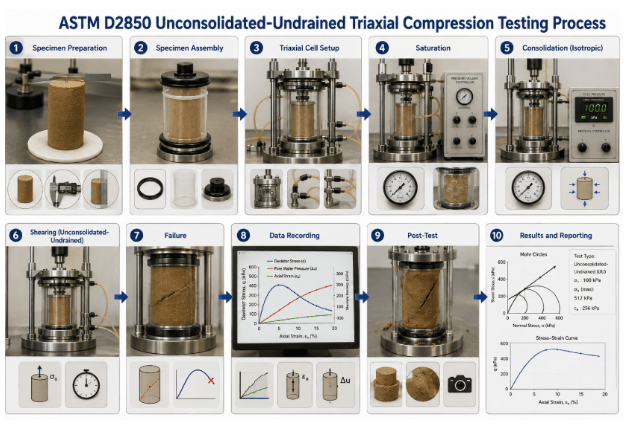
    Technicians prepare the cohesive soil specimen and place it in the triaxial cell. They apply the specified confining pressure without consolidation, then apply axial loading while maintaining undrained conditions. The laboratory records the stress and deformation response until the applicable failure condition or test endpoint is reached. The ASTM D2850 testing procedure is as follows.

    Read more

    Specimen PreparationTechnicians prepare and inspect the cylindrical cohesive soil specimen before placing it in the triaxial apparatus.
    Specimen Mounting and Confining PressureTechnicians mount and seal the specimen, establish the required test conditions, and apply the specified confining pressure.
    Undrained Axial LoadingThe apparatus applies controlled axial loading while maintaining undrained conditions and records the specimen response.
    Data Analysis and Result DeterminationEngineers analyze the recorded stress and deformation data to determine the applicable undrained shear strength and report the test results.
     ASTM D2850 testing process showing cohesive soil specimen preparation, mounting in a triaxial cell, application of confining pressure, undrained axial loading, measurement of soil response, and recording of test results.
    ASTM D2850 Unconsolidated-Undrained Triaxial Compression Testing 

    ASTM D2850 Testing Process and Data Collection

    Technicians first identify the soil sample and prepare a representative cylindrical specimen. They measure the specimen dimensions and inspect its condition before mounting it in the triaxial cell. The laboratory then applies the specified confining pressure without allowing consolidation.

    The apparatus applies axial loading while maintaining undrained conditions. Technicians monitor axial deformation and the applied stress throughout the test and record the specimen response. Engineers analyze the collected data to determine the applicable undrained shear strength and other required test results.

    Common Challenges and Troubleshooting

    Specimen disturbance, incorrect dimensions, inadequate sealing, leakage, pressure-control errors, loading conditions, and equipment calibration can affect ASTM D2850 results. Handle soil samples carefully and disturb them as little as possible during specimen preparation and mounting. The specimen testing system needs to be checked before loading in the laboratory. The technician checks the pressure indicator, checks the seals and connections, and verifies that the other miscellaneous equipment is working correctly. 

    Analysis Results and Interpretation

    ASTM D2850 results provide information about the strength and deformation response of cohesive soil under unconsolidated-undrained triaxial loading. Laboratories should report the measured values together with specimen details and test conditions so engineers can accurately interpret and compare the results.

    Read more

    • ASTM D2850 provides undrained shear strength results based on the specimen response under undrained conditions.
    • Laboratories report confining pressure in kPa or MPa and axial stress in kPa or MPa.
    • Laboratories report axial strain as a percentage (%) and specimen height and diameter in mm.
    • The report includes the soil identification, specimen condition, test pressure, loading conditions, and failure response.
    • Consistent specimen preparation, accurate pressure control, proper drainage conditions, and calibrated testing equipment help laboratories produce reliable and comparable results.
    • Engineers use the results to compare cohesive soil strength, evaluate undrained behavior, and support geotechnical design and analysis. They should interpret the results together with specimen condition, soil characteristics, confining pressure, and other applicable test conditions.

    Link to ASTM D2850

    Updated on August 26, 2026

    Suyog Kamble
    About Author
    Suyog Kamble is an Operations Associate at Matestlab Inc. Suyog holds a postgraduate degree in organic chemistry and is trained in material science topics.
    Know More
    Testimonials
    Real results
    Engineers trust us with what matters most
    Start Your Testing
    Project Today
    Define your requirements and get access to
    specialized laboratories ready to deliver results
    Partners with us
    Clients
    Vendors
    Process for testing
    • STEP 01

      You share your testing requirements

    • STEP 02

      You share your sample(s)

    • STEP 03

      We deliver your test reports

    Get your testing done

    Let us know your testing requirements and we will be right back with a solution.

      Let us root for each other. Collaborate to grow, expand, and accelerate our businesses.

      Partner with us

        Discover more from Matestlab

        Subscribe now to keep reading and get access to the full archive.

        Continue reading