
ASTM D2838 Standard Test Method for Shrink Tension and Orientation Release Stress of Plastic Film and Thin Sheeting

    What Is ASTM D2838?

    ASTM D2838 describes a standard test method for the shrink tension and orientation release stress of plastic film and thin sheeting. Technicians prepare specimens, heat them under controlled conditions, and record the pull as the material releases stresses formed during processing and orientation. ASTM D2838 (Standard Test Method for Shrink Tension and Orientation Release Stress of Plastic Film and Thin Sheeting) provides data on how plastic film reacts to heat and how much stress it releases as it tries to revert to a more ordered state. These results help manufacturers assess process conditions, compare film formulations, and evaluate dimensional behavior when films are subsequently heated.

    Read more

    Get Certified ASTM D2838 Shrink Tension and Orientation Release Stress Testing

    Using ASTM D2838 testing, manufacturers, film processors, and film users can assess how plastic films or thin sheeting thermally shrink. Laboratories collect samples, prepare the specimens, and then subject them to a controlled application of heat and force. The laboratory measures the force during the heating process and calculates the shrink tension and orientation release stress. Engineers can analyze, compare, and contrast film grades, production batches, processing conditions, and material formulation results.
    What is the scope of ASTM D2838?

    ASTM D2838 is a test method for determining the shrink tension and orientation release stress of plastic film and thin sheeting under specified heating conditions. The test provides useful information about material behavior, dimensional stability, and processing effects, allowing manufacturers and engineers to assess film performance and compare materials under specified conditions. 

    Read more

    • Plastic Film: Technicians evaluate films that can develop shrinkage forces when heated.
    • Thin Sheeting: The method applies to thin plastic sheets that exhibit orientation-related thermal response.
    • Shrink Tension: The test measures the force generated by a specimen as it attempts to shrink during heating.
    • Orientation Release Stress: The test evaluates stress released from molecular orientation introduced during plastic processing.
    • Thermal Response: Engineers use the results to assess how films respond to controlled heating.
    • Material Comparison: Manufacturers can compare films, formulations, processing conditions, and production lots.

    What are the uses of ASTM D2838 Testing?

    ASTM D2838 testing provides valuable information about the thermal shrinkage behavior and orientation release characteristics of plastic films and thin sheeting. Manufacturers and engineers can use these results to evaluate material performance, monitor production consistency, and support material selection and product development. This standard

    • Determines shrink tension under specified test conditions.
    • Evaluates orientation release stress in plastic film and thin sheeting.
    • Helps identify differences caused by film processing and orientation.
    • Supports quality control between production batches.
    • Helps engineers compare different film formulations and material grades.
    • Supports product development and process optimization.
    • Helps manufacturers evaluate thermal dimensional behavior in heat-sensitive applications.

    Which Materials Can Be Tested According to ASTM D2838?

    ASTM D2838 covers applicable plastic films and thin sheeting where shrinkage and stress generated by orientation to applied heat are characteristic. Analysts double-check material type, specimen requirements, thickness, and test conditions before testing.

    • Plastic Films: Evaluates applicable oriented plastic films for thermal shrinkage behavior.
    • Thin Plastic Sheeting: Evaluates applicable thin sheets that release orientation-related stress during heating.
    • Oriented Films: Assesses materials in which processing creates molecular orientation that can produce shrink tension.
    • Heat-Shrinkable Materials: Provides relevant thermal-response data for films designed to shrink when heated.
    • Different Film Formulations: Allows engineers to compare materials manufactured under different formulations or processing conditions.

    Why Is ASTM D2838 Testing Important?

    Plastic films may retain stresses and molecular orientations from extrusion, stretching, or other processes. When heated, these materials can release stored stresses and generate shrinkage forces. Results help manufacturers understand film behavior when heated and compare films or production batches. The information assists engineers in optimizing processing conditions, selecting suitable films, and assessing dimensional stability for applications at higher temperatures.

    ASTM D2838 Equipment and Sample Preparation Guide

    Technicians need controlled temperature and accurate force measurement to obtain reliable shrink tension and orientation release stress results. They prepare representative film specimens with consistent dimensions and carefully mount them in the testing apparatus.

    Read more

    Sample DetailsTechnicians identify the film type, thickness, orientation, production lot, and relevant processing information before specimen preparation.
    Specimen PreparationTechnicians cut representative specimens to the required dimensions and avoid wrinkles, cuts, folds, or other defects that could influence the measurement.
    Specimen OrientationTechnicians identify the machine direction, transverse direction, or other relevant orientation before testing when the material requires directional evaluation.
    Temperature ConditioningTechnicians expose the specimen to the specified heating conditions so the material can release its stored orientation stress.
    InstrumentationLaboratories use a controlled heating system with a force-measuring device that measures the shrink force generated by the specimen.

    ASTM D2838 Testing Procedures and Requirements

    Technicians first prepare representative film specimens and identify their relevant orientation and dimensions. They mount each specimen in the force-measuring apparatus and expose it to the specified temperature conditions. As the specimen heats, the film attempts to shrink. The apparatus measures the resulting force. Technicians record the force response and relevant test conditions and use the measurements to determine the applicable shrink tension and orientation release stress. The ASTM D2838 testing procedure is as follows.

    Read more

    Specimen PreparationTechnicians prepare representative film specimens with consistent dimensions and inspect them for visible defects.
    Specimen Mounting & HeatingTechnicians mount the specimen securely in the testing apparatus and expose it to the specified temperature conditions.
    Force Measurement & Data RecordingThe instrument measures the force generated as the specimen shrinks, while technicians record force, temperature, orientation, and relevant observations.
    Result DeterminationEngineers analyze the recorded force response to determine the applicable shrink tension and orientation release stress.
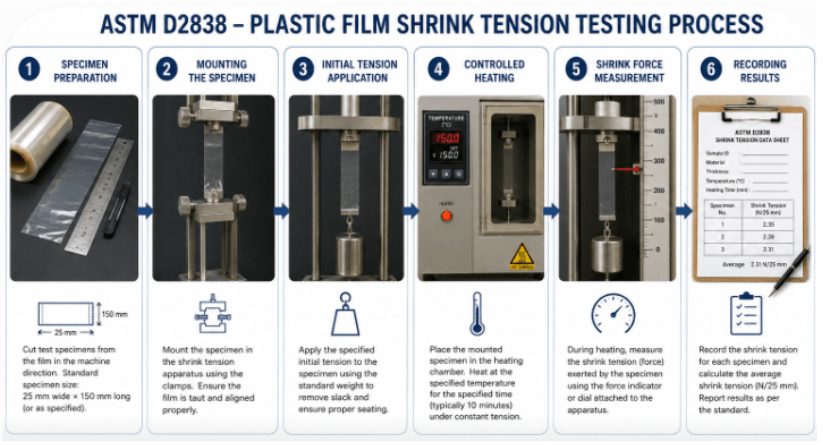
    The image shows an ASTM D2838 testing process showing plastic film specimen preparation, mounting in the shrink tension apparatus, controlled heating, measurement of shrink force, and recording of test results.
    ASTM D2838 Plastic Film Shrink Tension Testing Process

    ASTM D2838 Testing Process and Data Collection

    Technicians begin by identifying the plastic film and preparing representative specimens. They record the specimen dimensions, thickness, orientation, and relevant material information. The technician then mounts the specimen in the force-measuring apparatus. The system heats the specimen under controlled conditions while monitoring the force generated by thermal shrinkage. Technicians record the temperature and force response throughout the test and note any unusual specimen behavior. The laboratory then analyzes the measurements to determine the applicable shrink tension and orientation release stress.

    Common Challenges and Troubleshooting

    The following may influence ASTM D2838 results: specimen orientation, thickness variation, wrinkles, defects, mounting conditions, heating rate, temperature accuracy, and instrument calibration. The technician should collect uniform specimens and use the same specimen orientation for testing. The laboratory should check the temperature control system and force-measuring instruments before testing. Technicians should also prevent unintended movement of specimens while mounting them. When results differ greatly between specimens, the laboratory should investigate specimen preparation, orientation, thickness, heating conditions, and instrument performance.

    Analysis Results and Interpretation

    ASTM D2838 results show how plastic film or thin sheeting responds to controlled heating by releasing shrinkage forces and orientation-related stress. Laboratories should report the measured results with the specimen details and test conditions so engineers can accurately compare materials, production batches, and processing conditions.

    Read more

    • ASTM D2838 provides shrink tension results as the force generated when the specimen attempts to shrink during heating.
    • Laboratories report orientation release stress in the applicable stress unit, such as MPa.
    • Laboratories record the test temperature in °C and specimen thickness in mm.
    • The report identifies the specimen direction, such as machine direction or transverse direction, when applicable.
    • Consistent specimen preparation, controlled heating, proper mounting, and calibrated force-measuring equipment help laboratories produce reliable and comparable results.
    • Engineers use these results to compare film formulations, production batches, and processing conditions. They should interpret the measured values together with specimen orientation, thickness, temperature, and other applicable test conditions.

    Link to ASTM D2838

    FAQ

    Where can I get the astm d2838 tested?
    You can share your astm d2838 testing requirements with MaTestLab. MaTestLab has a vast network of material testing laboratories, spread across the USA and Canada. We support your all material testing needs ranging from specific astm d2838 test to various testing techniques.
    Please contact us for a detailed quote for your astm d2838 testing needs. Cost incurred to carry out different astm d2838 testing methodology depends on the type of raw material; number of samples, coupons, or specimens; test conditions, turn around time etc. Costs of some ASTM testing methods start from $100 and the final value depends upon the factors listed above. Please contact us for the best and latest prices.
    The required number of samples or specimens should comply with the procedure given in the astm d2838 standard. However, the MaTestLab operations team can assist you for your special requirements once you share your testing details with us.
    MaTestLab has a vast testing laboratory network, hence we bring you the best testing facilities in a cost-effective way. We offer considerable discounts (15-20%) to our returning customers based on test volume and frequency.
    The turnaround time for astm d2838 test methodology depends upon the test procedure mentioned in the standard test document. However, we at MaTestLab understand your research requirements and hence try to get your test completed within the least possible time.
    Laraib Hashmi
    About Author
    Laraib Hashmi
    Laraib Hashmi is an aspiring research enthusiast and science content professional with a strong interdisciplinary skill set, holding a postgraduate degree in Applied Microbiology from KIIT Bhubaneshwar, Odisha.
    Testimonials
    Real results
    Engineers trust us with what matters most
    Start Your Testing
    Project Today
    Define your requirements and get access to
    specialized laboratories ready to deliver results
    Partners with us
    Clients
    Vendors
    Process for testing
    • STEP 01

      You share your testing requirements

    • STEP 02

      You share your sample(s)

    • STEP 03

      We deliver your test reports

    Get your testing done

    Let us known your testing requirements and we will be right back with a solution.

      Let us root for each other. Collaborate to grow, expand, and accelerate our businesses.

      Partner with us

        Contact Us

        Discover more from Matestlab Inc

        Subscribe now to keep reading and get access to the full archive.

        Continue reading