ASTM D2647 Standard Specification for Crosslinkable Ethylene Plastics
What Is ASTM D2647?
ASTM D2647 specifies crosslinkable ethylene plastics. The specification defines the conditions for the materials produced by some manufacturers before they are finally crosslinked. The specification guides the identification and evaluation of these materials and helps manufacturers and suppliers ensure consistency across material lots. Manufacturers use crosslinkable ethylene plastics in applications where controlled crosslinking improves performance. Laboratories assess appropriate material properties and compare them to specification requirements. ASTM D2647 (Standard Specification for Crosslinkable Ethylene Plastics) enables manufacturers, suppliers, purchasers, and quality-control laboratories to ensure material consistency and support product qualification.
Get Certified ASTM D2647 Crosslinkable Ethylene Plastics Testing
ASTM D2647 testing allows manufacturers and buyers to assess the crosslinkable ethylene plastic materials against requirements. Analysts take samples of the material being tested, follow the conditioning and testing procedures appropriate to the material, and measure material properties. The laboratory compares the measured results to applicable ASTM D2647 requirements and records the material identification, test conditions, measured values, and compliance status. These results can help qualify materials, conduct quality control, evaluate production lots, and verify suppliers.
What is the scope of ASTM D2647?
ASTM D2647 establishes requirements for crosslinkable ethylene plastics. The specification provides a framework for evaluating material characteristics before and during processing and crosslinking.
Provides data for comparing different material lots.
Helps identify changes in material characteristics.
Supports quality-control programs for crosslinkable ethylene plastics.
Provides information that can support product-development decisions.
Which Materials Can Be Tested According to ASTM D2647?
ASTM D2647 specifically addresses crosslinkable ethylene plastics, not general-purpose plastics. Laboratories should verify the applicable material classification and specification requirements before testing.
Crosslinkable Ethylene Plastics: Evaluates ethylene-based materials designed for subsequent crosslinking.
Crosslinkable Polyethylene Materials: Includes applicable polyethylene-based materials that undergo controlled crosslinking.
Compounded Ethylene Plastics: Evaluates applicable compounds containing additives or other ingredients required for processing and crosslinking.
Processing-Grade Materials: Supports evaluation of materials supplied for manufacturing processes that produce crosslinked products.
Production Materials: Allows manufacturers and purchasers to evaluate material consistency between applicable production lots.
The laboratory should confirm the material formulation, intended application, processing conditions, and applicable specification requirements before beginning testing.
Why Is ASTM D2647 Testing Important?
ASTM D2647 is a standardized specification that helps ensure materials specified by manufacturers and purchasers are consistent. Testing can detect differences between production lots and aid in quality-control decisions. Appropriate test results can also be used in conjunction with other standards that define crosslinked ethylene plastics in the laboratory. For instance, ASTM D2765 covers gel content and swell ratio of crosslinked ethylene plastics and can be used to determine the extent of crosslinking in the final product.
ASTM D2647 Equipment & Sample Preparation Guide
ASTM D2647 does not rely on one specific testing instrument because it is a material specification rather than a single test method. Laboratories select calibrated equipment based on the properties being evaluated and the applicable ASTM test procedures.
Technicians identify the crosslinkable ethylene plastic, formulation, production lot, intended application, and applicable specification requirements.
Sample Preparation
Technicians prepare representative specimens according to the applicable test procedures and maintain consistency between samples.
Specimen Conditioning
Technicians condition specimens under the required environmental or thermal conditions before testing when applicable.
Physical Property Testing
Technicians use suitable calibrated testing equipment to measure the properties required by the applicable specification.
Crosslinking Evaluation
Analysts apply the appropriate procedure when the testing program requires evaluation of material behavior associated with crosslinking.
Data Recording
Analysts record material identification, test conditions, measured properties, and relevant observations.
ASTM D2647 Testing Procedures and Requirements
Technicians first identify the crosslinkable ethylene plastic and review the applicable material requirements. They prepare representative specimens and verify that the testing equipment operates under the required conditions. The laboratory performs the applicable property tests using the procedures and equipment required for the specified material characteristics. Technicians record the measured values, test conditions, specimen information, and relevant observations. The laboratory then compares the measured values with the applicable specification requirements and documents the results.
Technicians identify the material, formulation, production lot, and applicable requirements before testing.
Specimen Preparation
Technicians prepare representative specimens according to the applicable testing procedures.
Specimen Conditioning
Technicians condition specimens under specified conditions, as required.
Property Evaluation
Technicians measure the required physical or material properties using calibrated equipment.
Crosslinking Assessment
Engineers evaluate applicable crosslinking-related characteristics when the testing program requires it.
Data Analysis
The laboratory compares measured values with the applicable specification requirements.
Compliance Evaluation
Technicians document whether the tested material meets the specified requirements.
ASTM D2647 Testing Process and Data Collection
Technicians first identify the crosslinkable ethylene plastic and verify its formulation, production lot, and intended application. They prepare representative specimens and establish the required test conditions. The analysts perform the applicable material-property tests and record the measured values. Technicians document the specimen identification, conditioning conditions, equipment used, test parameters, and observations. Engineers then compare the results with the applicable ASTM D2647 requirements. Manufacturers can use the resulting data to evaluate material consistency, investigate production variations, and support material qualification. When the testing program requires evaluation of the crosslinked material, laboratories can use appropriate complementary procedures. ASTM D2765, for example, determines gel content and swell ratio in crosslinked ethylene plastics and can help evaluate the degree of crosslinking.
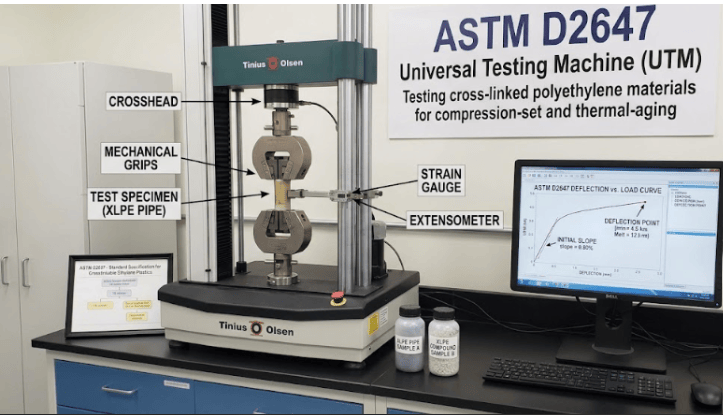
ASTM D2647 Universal Testing Machine (UTM)
Common Challenges and Troubleshooting
The measured properties of crosslinkable ethylene plastics may depend on variations in material formulation, preparation method, conditioning method, processing method, equipment calibration, and test type. Technicians should take representative specimens and follow the same procedures during the testing program. Laboratories should also ensure that the equipment is calibrated prior to testing, and record any deviation from the listed conditions. Variations in raw materials and additive levels, processing parameters, and material storage conditions within different production lots can contribute to differences between them. If unexpected results are found, technicians should check material history and test conditions to determine the cause.
Analysis Results and Interpretation
The laboratory should report the measured properties together with the material identification, test conditions, specimen information, and applicable specification requirements. This information allows engineers to interpret the results and determine material consistency and conformance.
The laboratory report can include material identification, production lot, specimen information, test conditions, measured properties, and relevant observations.
Laboratories report each measured property using the applicable unit, such as MPa for stress or strength, % for elongation or other percentage-based properties, g/cm³ for density, and °C for temperature, where these properties are included in the evaluation.
The results help laboratories evaluate whether the material meets the applicable ASTM D2647 requirements.
Manufacturers can compare material lots and investigate variations in material characteristics.
Purchasers can use test results to support material acceptance and supplier verification.
Engineers can use the data as part of broader material qualification and product-development programs.
Laboratories should interpret results according to the specific requirements and test conditions applicable to the material.
Crosslinking-related results should be distinguished from measurements performed on the uncrosslinked starting material.
When laboratories evaluate the final crosslinked material, they can use appropriate complementary standards such as ASTM D2765 for gel content and swell ratio.
Laraib Hashmi is an aspiring research enthusiast and science content professional with a strong interdisciplinary skill set, holding a postgraduate degree in Applied Microbiology from KIIT Bhubaneshwar, Odisha. Know More
Testimonials
Real results
Engineers trust us with what matters most
“We had a great experience working with this company for our ASTM E84 testing. They were the first company to respond to our inquiry within just a few minutes of submitting it. From start to finish, the communication was excellent, and the entire process was swift, straightforward, and hassle-free.”
Ivars FancyWalls
United States
“Very good communication, testing associates were very patient with delays on our end. Reasonable turnaround time for results and nicely detailed report. Analysts were also quick to answer any follow-up questions. Happy with results.”
Skye Henderson
United States
“Matestlab connected us with an accredited lab within days, cutting weeks off our product validation timeline.”
Rebecca Kozodoy-Pins
United States
Start Your Testing Project Today
Define your requirements and get access to specialized laboratories ready to deliver results