ASTM D2538 Standard Practice for Fusion of Poly(Vinyl Chloride) (PVC) Compounds Using a Torque Rheometer
What Is ASTM D2538?
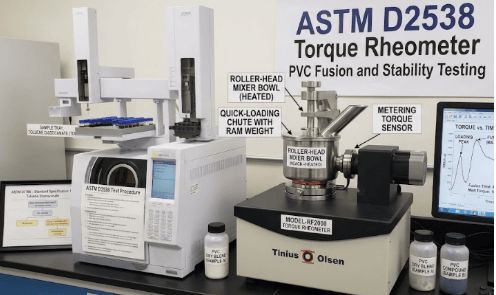
ASTM D2538 is a standard practice for determining the relative fusion characteristics of poly(vinyl chloride) compounds using a torque rheometer. Technicians feed a PVC compound into the rheometer’s heated mixing chamber and apply controlled temperature and shear conditions. The rheometer measures torque, which is plotted over time as the powder mixture turns into a fused mass. ASTM D2538 (Standard Practice for Fusion of Poly(Vinyl Chloride) (PVC) Compounds Using a Torque Rheometer) gives data on fusion time, fusion torque, melt torque, melt viscosity, heat stability, color stability, and shear stability. The resulting torque curve allows assessment of the PVC compound’s fusion characteristics in the laboratory. Practice includes fusion testing and thermal stability, color hold stability, and shear stability testing.
PVC manufacturers, compounders, processors, and quality control laboratories can use ASTM D2538 testing to assess the processing characteristics of PVC compounds. Technicians prepare a representative compound, establish the required rheometer conditions, introduce the material into the heated chamber, and monitor the torque response throughout the test. Laboratories can make comparisons between measurements taken from the experimental and control lots to detect changes in fusion behavior.
What is the scope of ASTM D2538?
ASTM D2538 covers the relative fusion characteristics of poly(vinyl chloride) compounds. The practice organizes the procedures into fusion, thermal stability, color-hold stability, and shear stability tests.
PVC Compounds: Technicians evaluate the processing and fusion behavior of PVC compounds under controlled heat and shear.
Comparative Evaluation: Laboratories compare the torque response of a test compound with a designated control lot to identify differences in fusion and processing behavior.
Fusion Characteristics: The torque rheometer measures changes associated with transforming the PVC powder mix into a fused mass.
Fusion Behavior: Laboratories can determine relative fusion time and evaluate torque behavior during fusion.
Thermal Stability: The practice provides a procedure for evaluating the PVC compound’s stability during thermal exposure.
Color-Hold Stability: Technicians can evaluate changes in color stability under the specified conditions.
Shear Stability: Laboratories can assess the material response to controlled shear conditions.
Relative Comparison: Engineers compare test results with a control lot rather than treating the measurements as universal absolute material properties.
What are the uses of ASTM D2538 testing?
ASTM D2538 testing provides processing and fusion information for PVC compounds and helps manufacturers evaluate consistency and material behavior.
Determines the relative fusion characteristics of PVC compounds.
Evaluates fusion time and fusion torque.
Helps characterize melt torque and melt viscosity.
Supports evaluation of heat and color stability.
Helps assess shear stability.
Compares production lots with a designated control lot.
Supports PVC formulation development and process optimization.
Helps manufacturers investigate changes in processing behavior.
Supports quality-control programs for PVC compounds.
Which Materials Can Be Tested According to ASTM D2538?
ASTM D2538 specifically addresses poly(vinyl chloride) compounds. Laboratories should identify the compound and use a representative sample before comparing its fusion characteristics with a control lot.
PVC Compounds: Evaluates the relative fusion characteristics of PVC compounds.
PVC Powder Blends: Evaluates the fusion behavior of prepared PVC powder mixtures under controlled heat and shear.
PVC Formulations: Compares processing and fusion behavior among different PVC formulations.
Modified PVC Compounds: Compares applicable PVC compounds containing different additives or compounding ingredients.
Why Is ASTM D2538 Testing Important?
PVC compounds change significantly when exposed to heat and shear during processing. The powder mixture develops into a fused mass with characteristic torque and melt behavior. ASTM D2538 provides a controlled practice for evaluating these changes with a torque rheometer. The resulting torque curve can reveal differences in fusion behavior, melt behavior, and stability. Manufacturers can use this data to compare lots, investigate formulation changes, support process development, and track consistency.
ASTM D2538 Equipment & Sample Preparation Guide
The ASTM D2538 test requires a torque rheometer that has a heated mixing chamber as its core equipment. Technicians should develop representative PVC compounds and keep test conditions constant to enable reliable comparisons in the laboratory. Technicians determine the PVC compound, formulation, production lot, and control lot before preparing the test sample.
Technicians identify the PVC compound, formulation, production lot, and control lot before preparing the test sample.
Sample Preparation
Technicians prepare a representative PVC powder mix or compound according to the applicable test requirements and maintain consistency between test and control materials.
Rheometer Setup
Laboratories establish the required chamber temperature, rotor or mixing configuration, and other operating conditions before introducing the material.
Temperature Control
The rheometer maintains the specified temperature during mixing so technicians can evaluate the compound under controlled thermal conditions.
Torque Measurement
The instrument continuously records torque behavior as the PVC compound undergoes fusion and develops its melt characteristics.
Data System
The laboratory records torque-time information and evaluates the resulting curve to determine the applicable fusion and stability characteristics.
ASTM D2538 Testing Procedures and Requirements
Technicians prepare the PVC compound and set up the torque rheometer at the operating conditions. The laboratory preheats the mixing chamber and loads the sample into the rheometer. The instrument applies controlled heat and shear while simultaneously measuring the torque response. Torque varies with time as the PVC compound melts. Technicians examine the torque curve and note the fusion characteristics. Other processes can test for thermal stability, color-hold ability, and shear stability. These procedures are grouped in separate sections of ASTM D2538, which is the practice.
Technicians prepare a representative PVC compound and verify its identity and condition before testing.
Rheometer Conditioning
Technicians establish the required temperature and operating conditions in the torque rheometer before introducing the sample.
Sample Loading
Technicians place the PVC compound into the heated mixing chamber according to the specified procedure.
Controlled Heat and Shear
The rheometer subjects the compound to controlled heat and shear while the instrument records the torque response.
Fusion Evaluation
The laboratory analyzes the torque curve to determine relative fusion characteristics and applicable melt behavior.
Stability Evaluation
When required, technicians perform the thermal, color-hold, and shear stability procedures specified by the practice.
ASTM D2538 Testing Process and Data Collection
The torque-time curve provides the primary dataset for evaluating changes in the compound during fusion. Technicians record the relevant torque characteristics and compare them with the control lot to determine whether the test material shows a meaningful change in processing behavior. The rheometer applies controlled heat and shear as the PVC powder mixture develops into a fused mass. During this process, the instrument records the torque response over time. The laboratory evaluates the torque curve to identify relative fusion characteristics and other applicable melt behavior.
ASTM D2538 Torque Rheometer
Common Challenges and Troubleshooting
Variations in sample preparation, material formulation, temperature control, rheometer condition, loading procedure, and operating conditions can affect torque-rheometer results. Technicians should prepare test and control samples consistently and maintain stable test conditions throughout the procedure. Inadequate temperature control can change the fusion response and produce inconsistent torque curves. Laboratories should therefore verify the rheometer’s temperature system before testing. Technicians should also inspect the mixing chamber and rotor components and ensure that the instrument operates correctly.
Differences between the test lot and control lot should be investigated when the torque curve changes unexpectedly. Laboratories should document formulation, raw-material, processing, or equipment changes that could explain variations in the measured fusion behavior.
Analysis Results and Interpretation
The laboratory should report the measured torque-rheometer response together with the test conditions and control-lot information needed to interpret the relative fusion behavior. ASTM D2538 identifies fusion time, fusion torque, melt torque, melt viscosity, and heat and color stability as characteristics of PVC compound fusion behavior.
The laboratory report can include the PVC compound identification, control-lot identification, test conditions, torque-time data, fusion characteristics, and relevant observations.
The torque curve provides information about the relative fusion behavior of the PVC compound.
Engineers can evaluate fusion time, fusion torque, melt torque, and melt viscosity characteristics.
Laboratories can use the data to investigate heat, color, and shear stability when the applicable procedures are performed.
Manufacturers can compare production lots with a control lot to identify changes in processing behavior.
Engineers can evaluate fusion time, fusion torque, melt torque, and melt-viscosity characteristics under the specified rheometer conditions.
ASTM indicates that test data should be evaluated relative to the control lot used as the reference.
Laboratories should document unusual torque responses or deviations from the expected curve because these observations may indicate changes in material or test conditions.
Davis Scott is an Electrical and Electronics Engineer specializing in multidisciplinary validation, quality assurance, and comprehensive electro-mechanical testing. Know More
Testimonials
Real results
Engineers trust us with what matters most
“We had a great experience working with this company for our ASTM E84 testing. They were the first company to respond to our inquiry within just a few minutes of submitting it. From start to finish, the communication was excellent, and the entire process was swift, straightforward, and hassle-free.”
Ivars FancyWalls
United States
“Very good communication, testing associates were very patient with delays on our end. Reasonable turnaround time for results and nicely detailed report. Analysts were also quick to answer any follow-up questions. Happy with results.”
Skye Henderson
United States
“Matestlab connected us with an accredited lab within days, cutting weeks off our product validation timeline.”
Rebecca Kozodoy-Pins
United States
Why Choose Matestlab?
Matestlab is a unified testing services partner based in the USA. Matestlab offers raw material and product testing services through accredited, expert laboratories primarily based in the USA. Matestlab supports physical, thermal, chemical, electrical, mechanical, environmental, and characterization testing needs through its global network of 2200+ accredited testing laboratories. Matestlab's in-house materials science experts curate and design comprehensive testing programs matched to the sample material and specific testing need, with regulatory requirements and confidentiality in mind.
If you are looking for a managed and trusted testing partner to achieve your research goals, feel free to schedule a meeting with us or send us a request at connect@matestlabs.com to learn more about our services. For a quick quote, call us at (302)244-7710. We are happy to serve you.
Start Your Testing Project Today
Define your requirements and get access to specialized laboratories ready to deliver results