
ASTM D2303: Liquid-Contaminant, Inclined-Plane Tracking and Erosion of Insulating Materials

    What is ASTM D2303? 

    ASTM D2303 is a standard test method for measuring the resistance of electrical insulating materials to surface tracking (conductive leakage path) and erosion when contaminated. This test is also known as the Liquid Contaminant Inclined Plane Tracking and Erosion (IPT) test.  To conduct this test, a high AC voltage is applied between two electrodes, and a conductive liquid contaminant is continually passed over an inclined test specimen throughout the test. This controlled electrical discharge is the cause of the surface degradation, which can take years to occur under service conditions. The ASTM D2303 test is commonly used to evaluate insulating materials intended for power transmission, switchgear, transformers, electrical enclosures, insulators, and other high-voltage applications. 

    Read more

    What is Surface Tracking in Electrical Engineering?

    Surface tracking is irreversible damage and degradation caused by leakage current flowing over an electrical insulator’s surface, leading to possible electrical failure. This electrical or current leakage happens due to the deposition or accumulation of dirt, salt, moisture, etc., on the surface of the component or equipment. This leakage causes sparks on the surface, generating heat that burns the material and leaving burnt carbon trails on the component. This is also known as carbonization. The carbon trail eventually spreads over the entire instrument, causing big fire episodes.

    Get Certified ASTM D2303 Testing for Reliable Electrical Insulation Performance

    ASTM D2303 testing evaluates the resistance of insulating materials to tracking and erosion under controlled liquid-contaminant conditions. Manufacturers use ASTM D2303 testing to evaluate insulation performance, optimize material formulations, reduce the risk of premature electrical failure, and demonstrate compliance with applicable engineering specifications. The test provides an option for quality control, product development, material selection, and long-term performance testing in the field of electrical insulation for use indoors and outdoors.
    What is the Scope of ASTM D2303?

    • Assesses the anti-tracking and anti-erosion performance of solid electrical insulating materials. 
    • Applies to a wide range of solid electrical insulating materials, including epoxy resins, silicone rubber, polymer composites, and other insulating materials.
    • Polymer insulators, phenolic laminates, glass-reinforced materials, porcelain-coated materials, and other systems for electrical insulation. 
    • Provides test procedures using defined voltage conditions and test durations to evaluate tracking and erosion resistance.
    • Measures erosion resistance following a standard inclined plane procedure. 
    • Supports material qualification, product development, and quality assurance. 

    What are the Uses of ASTM D2303 Test Standard?

    • Measures electrical insulation tracking resistance. 
    • Evaluates protection against erosion under contaminated conditions.
    • Supports insulation material selection. 
    • Ensures that product quality and durability are checked. 
    • Supports the design, qualification, and performance evaluation of electrical insulation systems.

    Why are tracking and erosion testing important?

    If moisture and contaminants create conductive paths on the surface of the electrical insulation, it may start to deteriorate over time. ASTM D2303 accelerates this process under controlled laboratory conditions, allowing engineers to assess insulation performance and evaluate the risk of electrical breakdown in service.

    Read more

    What Properties Does ASTM D2303 Measure?

    ASTM D2303 evaluates tracking resistance, time to tracking or failure, erosion resistance, and surface degradation characteristics of solid electrical insulating materials.

    Common Challenges and Troubleshooting

    Errors in contaminant flow, electrode spacing, voltage supply, specimen surface contamination, or specimen preparation can impact the results of the tests. Calibrating equipment, controlling the environment, and using routine testing procedures are ways technicians enhance repeatability.

    ASTM D2303 Testing Technique, Process, and Data Collection

    The technician places the insulating sample on an inclined plane apparatus and connects the electrodes to the sample. The system continuously feeds a conductive liquid contaminant over the specimen surface while applying a high AC voltage. Operators monitor electrical discharges, tracking formation, erosion, and specimen failure throughout the test. Finally, they take voltage readings and time-to-track readings and monitor erosion and failure observations for analysis.

    ASTM D2303 Equipment and Sample Preparation

    Specimen DetailsTechnicians test epoxy resin, silicone rubber, polymer composite insulators, glass fiber-reinforced composites, phenolic laminates, electrical insulation boards, and other solid insulating materials.
    Specimen PreparationOperators machine, clean, and condition flat specimens before mounting them on the inclined-plane apparatus.
    Specimen DimensionsSpecimen dimensions follow ASTM D2303 requirements to ensure uniform contaminant flow and electrical discharge conditions.

    Testing Procedures and Requirements for Tracking and Erosion Resistance

    The technician sets up the insulating sample on an inclined-plane apparatus with the electrodes connected to the sample. A conductive liquid contaminant is continuously supplied to the specimen while an AC test voltage is applied between the electrodes. Operators monitor electrical discharges, track formation, erosion, and specimen failure throughout the test. Finally, they collect voltage readings, time-to-track readings, and perform erosion and failure observations for analysis. 

    Read more

    Specimen PreparationTechnicians prepare flat insulating material specimens with smooth, clean surfaces and mount them on the inclined-plane test fixture.
    Electrode InstallationOperators position standardized electrodes at the specified spacing and apply the required AC test voltage.
    Contaminant ApplicationA conductive liquid contaminant flows continuously over the specimen surface at a controlled rate to maintain electrical discharge.
    Tracking and Erosion EvaluationTechnicians monitor the specimen for tracking, erosion, leakage current, and electrical failure throughout the test period.
    Data RecordingOperators record the specified test voltage, time to tracking or failure, erosion characteristics, and specimen failure observations according to the selected ASTM D2303 procedure.
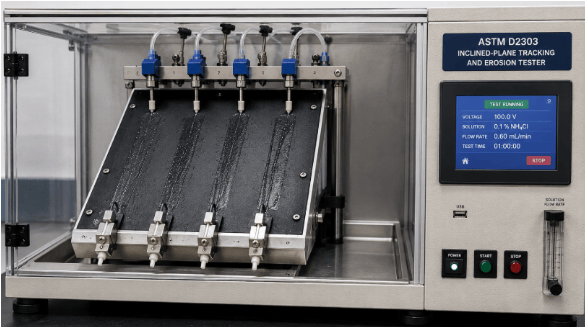
    The image shows an ASTM D2303 inclined-plane tracking tester used to evaluate the tracking and erosion resistance of solid electrical insulating materials.
    ASTM D2303 Inclined-Plane Tracking and Erosion Tester

    Analysis Results and Interpretation

    ASTM D2303 reports the tracking and erosion performance of insulating materials under specified test conditions, including observations such as tracking voltage (kV), time to track (minutes or hours), erosion depth (mm), and erosion mass loss (mg) for each procedure. The greater the tracking voltage, the greater the time to track and the smaller the erosion; the more resistant the material is to electrical degradation of the surface. The lower the value, the lower the insulation properties and the higher the tendency to tracking and erosion in contaminated operating conditions. 

    Read more

    FAQ

    Where can I get the astm d2303 tested?
    You can share your astm d2303 testing requirements with MaTestLab. MaTestLab has a vast network of material testing laboratories, spread across the USA and Canada. We support your all material testing needs ranging from specific astm d2303 test to various testing techniques.
    Please contact us for a detailed quote for your astm d2303 testing needs. Cost incurred to carry out different astm d2303 testing methodology depends on the type of raw material; number of samples, coupons, or specimens; test conditions, turn around time etc. Costs of some ASTM testing methods start from $100 and the final value depends upon the factors listed above. Please contact us for the best and latest prices.
    The required number of samples or specimens should comply with the procedure given in the astm d2303 standard. However, the MaTestLab operations team can assist you for your special requirements once you share your testing details with us.
    MaTestLab has a vast testing laboratory network, hence we bring you the best testing facilities in a cost-effective way. We offer considerable discounts (15-20%) to our returning customers based on test volume and frequency.
    The turnaround time for astm d2303 test methodology depends upon the test procedure mentioned in the standard test document. However, we at MaTestLab understand your research requirements and hence try to get your test completed within the least possible time.
    Gokula Srinivasan Selvam
    About Author
    Gokula Srinivasan Selvam
    Gokula Srinivasan Selvam is a Material Testing Associate at MaTestLab Inc. and holds a postgraduate degree in Ceramic Engineering from IIT (BHU), Varanasi.
    Testimonials
    Real results
    Engineers trust us with what matters most
    Start Your Testing
    Project Today
    Define your requirements and get access to
    specialized laboratories ready to deliver results
    Partners with us
    Clients
    Vendors
    Process for testing
    • STEP 01

      You share your testing requirements

    • STEP 02

      You share your sample(s)

    • STEP 03

      We deliver your test reports

    Get your testing done

    Let us known your testing requirements and we will be right back with a solution.

      Let us root for each other. Collaborate to grow, expand, and accelerate our businesses.

      Partner with us

        Contact Us

        Discover more from MaTestLab

        Subscribe now to keep reading and get access to the full archive.

        Continue reading