
ASTM D2294 Standard Test Method for Creep Properties of Adhesives in Shear by Tension Loading (Metal-to-Metal)

    What is ASTM D2294?

    ASTM D2294 describes a standard test method to determine the creep characteristics of adhesive for metal-to-metal bonding under tensile loading. This technique assesses adhesive creep on a standard specimen under specified load, time, and temperature conditions using a spring-loaded testing apparatus. This method applies to temperature ranges from −55 to +260 °C and helps manufacturers to compare adhesive creep behavior as formulation, temperature, moisture level, and loading duration change. Technicians apply a tensile load to a standard bonded specimen and record the time-dependent deformation under a controlled temperature. The method utilizes a creep test machine with a spring-loading mechanism and a standard tension lap shear type specimen. ASTM D2294 (Standard Test Method for Creep Properties of Adhesives in Shear by Tension Loading (Metal-to-Metal)) also uses a calibrated microscope with 100× magnification to measure creep deflection during testing. 

    Read more

    Get Certified ASTM D2294 Testing for Reliable Metal-to-Metal Adhesive Bonds

    Metal-to-metal adhesive joints can undergo time-dependent deformation under constant loading. This ASTM standard offers a controlled test method for assessing this behavior and comparing adhesive joints under specified service conditions. Engineers use this method to compare creep properties under temperature changes, moisture levels, and loading duration. The relatively simple spring-loaded apparatus also allows laboratories to replicate creep tests at comparatively low cost.
    What is the scope of the ASTM D2294 test standard?

    ASTM D2294 assesses the creep characteristics of metal bonding adhesives. Standard specimens are subjected to tensile stress and controlled temperature in a spring-loaded testing apparatus. This standard-

    Read more

    • Tests creep properties of metal-to-metal adhesive bonds. 
    • Uses tensile loading to produce shear stress in the adhesive joint. 
    • Uses standard test specimens, such as tension lap-shear specimens. 
    • Applies specified conditions of load, time, and temperature using a spring-loaded testing apparatus.
    • Applies to temperatures from −55 to +260°C. 
    • Measures deformation of joints over time during the test.

    What are the uses of ASTM D2294 testing?

    ASTM D2294 testing helps laboratories identify the behavior of adhesive joints under constant loading over time. Manufacturers can use the results to compare formulations and assess the effects of expected service conditions. This standard-

    • Determines adhesive creep under tensile loading in metal-to-metal adhesive joints, and compares different adhesive formulations. 
    • Examines the effect of temperature and moisture level on adhesive creep and the effect of loading duration on creep. 
    • Supports adhesive research and development, evaluates adhesive performance for long-term applications, and supports comparative adhesive testing.

    Which materials can be tested under ASTM D2294?

    ASTM D2294 is applicable to adhesives for metal substrate bonding. Laboratories prepare metal-to-metal bonded specimens using the standard specimen, following a specific method and ASTM requirements. The method primarily focuses on adhesive-joint performance rather than testing a particular metal grade as a standalone material.

    Why is ASTM D2294 important?

    ASTM D2294 is a standard procedure for measuring time-dependent deformations of adhesive joints under sustained tensile loading. Engineers can use these results to compare adhesives and to test formulations in order to assess their impact on creep.

    ASTM D2294 Equipment and Sample Preparation Guide

    The result depends on obtaining a standard metal-to-metal adhesion specimen, using a tensile creep apparatus, and measuring creep deformation per ASTM D2294.

    Read more

    Sample and Specimen DetailsLaboratories prepare metal-to-metal adhesive specimens similar to tension lap-shear specimens.
    Specimen PreparationThen, technicians prepare bonded specimens and polish the edges of the bonded area for measuring creep. 
    Specimen DimensionsLaboratories prepare the bonded area edges with a 12.7 mm (1/2 in.) polished section for creep measurements.
    Instrumentation Tension creep test apparatus, high-temperature-resistant spring, calibrated microscope (100×), specimen fixtures, and temperature conditioning equipment.

    Testing Procedures and Requirements for ASTM D2294

    Technicians condition the apparatus at a specific temperature, place specimens, apply tensile load, and measure creep deformation over a specific time as per ASTM D2294. The ASTM D2294 test method comprises the following test procedure-

    Read more

    Specimen Preparation and Marking Technicians first prepare metal-to-metal bonded specimens and polish the edges for creep measurement as per ASTM D2294.
    Temperature Conditioning and Specimens Installation Then, laboratories preheat the apparatus at the desired test temperature and place specimens in the loading chamber.
    Load Application and Creep MeasurementNext, they apply the specified tensile load to the bonded specimens and use a calibrated microscope to measure the specimen deformation at specific times.
    Test ObservationLaboratories record creep displacement, test conditions, and any failure characteristics.
    Result ReportingLastly, they report the measured creep behavior together with specimen, load, time, and temperature information.

    ASTM D2294 Testing Process and Data Collection

    Technicians first prepare metal-to-metal adhesive specimens, set the required load, time, and temperature conditions, preheat at the desired temperature using a spring-loaded apparatus, and place the specimens in it.  Then, they apply tensile loads to the specimens, observe them using calibrated microscopes to determine the creep deformation at certain times, and measure temperature and load. Manufacturers use these results to compare adhesive creep behavior under different formulations and expected service conditions.

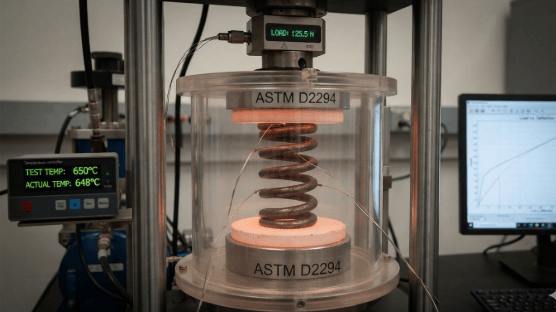
    This image depicts a high-temperature-resistant spring used for mechanical testing according to ASTM D2294.
    ASTM D2294 High-temperature Spring Tester

    Common Challenges and Troubleshooting

    Consistent preparation, controlled temperature, stable load, and accurate deformation measurement are all necessary for reliable and accurate creep measurements. Typical problems include inconsistent adhesive-bond preparation, specimen dimensions, specimen marking, unstable test temperature, incorrect applied load, specimen misalignment, inaccurate creep-deflection measurement, and inconsistent measurement intervals. Prior to testing, technicians should check the apparatus, the alignment of the specimen, the temperature, applied load, and equipment used to measure the load.

    ASTM D2294 Analysis Results and Interpretation

    • Laboratories report ASTM D2294 results according to the applied load, test temperature, test duration, specimen configuration, and measured creep deformation.
    • The method examines the time-dependent creep behavior of metal-to-metal adhesive joints under tensile loading.
    • Laboratories report temperature in ºC, dimensions and deformation in mm, and applied force in N. 
    • Manufacturers can document deformation versus time data to compare the creep behavior of different adhesive formulations under equivalent test conditions.

    Link to ASTM D2294

    Read more

    FAQ

    Where can I get the astm d2294 tested?
    You can share your astm d2294 testing requirements with MaTestLab. MaTestLab has a vast network of material testing laboratories, spread across the USA and Canada. We support your all material testing needs ranging from specific astm d2294 test to various testing techniques.
    Please contact us for a detailed quote for your astm d2294 testing needs. Cost incurred to carry out different astm d2294 testing methodology depends on the type of raw material; number of samples, coupons, or specimens; test conditions, turn around time etc. Costs of some ASTM testing methods start from $100 and the final value depends upon the factors listed above. Please contact us for the best and latest prices.
    The required number of samples or specimens should comply with the procedure given in the astm d2294 standard. However, the MaTestLab operations team can assist you for your special requirements once you share your testing details with us.
    MaTestLab has a vast testing laboratory network, hence we bring you the best testing facilities in a cost-effective way. We offer considerable discounts (15-20%) to our returning customers based on test volume and frequency.
    The turnaround time for astm d2294 test methodology depends upon the test procedure mentioned in the standard test document. However, we at MaTestLab understand your research requirements and hence try to get your test completed within the least possible time.
    Gokula Srinivasan Selvam
    About Author
    Gokula Srinivasan Selvam
    Gokula Srinivasan Selvam is a Material Testing Associate at MaTestLab Inc. and holds a postgraduate degree in Ceramic Engineering from IIT (BHU), Varanasi.
    Testimonials
    Real results
    Engineers trust us with what matters most
    Start Your Testing
    Project Today
    Define your requirements and get access to
    specialized laboratories ready to deliver results
    Partners with us
    Clients
    Vendors
    Process for testing
    • STEP 01

      You share your testing requirements

    • STEP 02

      You share your sample(s)

    • STEP 03

      We deliver your test reports

    Get your testing done

    Let us known your testing requirements and we will be right back with a solution.

      Let us root for each other. Collaborate to grow, expand, and accelerate our businesses.

      Partner with us

        Contact Us

        Discover more from Matestlab Inc

        Subscribe now to keep reading and get access to the full archive.

        Continue reading