
ASTM D1945 is a standard test method for determining the chemical composition of natural gas and other gaseous mixtures via gas chromatography. It analyzes hydrocarbons, helium, hydrogen, oxygen, nitrogen, carbon dioxide, and hydrogen sulfide. The sensitivities for most of the components listed in ASTM D1945 (Standard Test Method for Analysis of Natural Gas by Gas Chromatography) are 0.01% mole and 0.3% mole for hydrogen sulfide. The technique helps laboratories accurately measure gas composition to calculate physical properties and monitor gas components.
ASTM D1945 Analysis of Natural Gas by Gas Chromatography
What is ASTM D1945?
What is the Scope of ASTM D1945?
ASTM D1945: Standard Test Method for Chemical Composition of Natural Gases and Related Gaseous Mixtures by Gas Chromatography determines the chemical composition of natural gases and other gaseous mixtures. This current ASTM D1945-25 edition includes hydrocarbons, helium, hydrogen, oxygen, nitrogen, carbon dioxide, and hydrogen sulfide. The method offers upper limits of 1 – 100 mole % depending on the component(s). Technicians may shorten the method if necessary for lean natural gases or for selected components. The scope of ASTM D1945 includes-
- Material type: Natural gases and similar gaseous mixtures.
- Purpose: Determining chemical composition for quality control, custody transfer, and process monitoring.
- Properties evaluated: Concentration of hydrocarbon components (C1 through C6+) and non-hydrocarbon gases (N₂, CO₂, H₂S, He, O₂, H₂).
- Testing method: Gas chromatographic separation and detection using appropriate columns and detectors.
- Result: Component concentrations reported in mole percent (% by mole) with recorded test conditions.
- Test limitations: May be used for lean natural gases containing negligible amounts of hexanes and higher hydrocarbons, or for determination of one or more specific components as required.
- Use conditions: The method is of significance for providing data for calculating physical properties of the sample, or for monitoring the concentrations of one or more of the components in a mixture.
- Applications: Natural gas custody transfer, pipeline quality monitoring, LNG and CNG composition verification, gas processing plant operations, refinery gas analysis, utility and distribution companies, and research and development
What are the Uses of ASTM D1945 Testing?
ASTM D1945 testing provides a way for laboratories to evaluate the composition of natural gas samples. Engineers thereafter use the results to determine the purity of the gas, compute the fuel characteristics, and estimate the performance of the gas during processing. This standard-
- Determines the exact chemical composition of natural gas and similar gaseous mixtures.
- Ensures proper handling of custody transfers, streamlines pipelines, and maintains billing accuracy.
- Evaluates pipeline gas quality and pipeline safety requirements.
- Allows engineers to determine important gas properties like heat value, Wobbe index, relative density, and compressibility factor from the gas composition data.
- Helps engineers compare various types of gas sources and formulations.
- Supports Product Development and Quality Control during batch runs.
- Helps engineers select gas supplies for particular applications and end uses.
What Materials Can Be Tested Under ASTM D1945?
It is a standard test method primarily for natural gases and other gaseous mixtures used in energy production and distribution. Typical substrates for ASTM D1945 testing include lean gas, rich gas, and gas mixtures from various sources. These gases provide key compositional data that is crucial for custody transfer, pipeline quality monitoring, LNG or CNG verification, and gas plant operations.
Why is ASTM D1945 Important?
Gas composition directly affects the heating value, combustion characteristics, and quality of natural gas that suppliers provide to consumers. This may cause processing equipment problems, including problems with fuel performance, pipeline integrity, custody transfer, or safety. Gas composition testing, as specified by ASTM D1945, enables manufacturers and operators to confirm that natural gas products meet end-use and regulatory requirements and to eliminate expensive operational problems before they enter the distribution system.
ASTM D1945 Equipment and Sample Preparation Guide
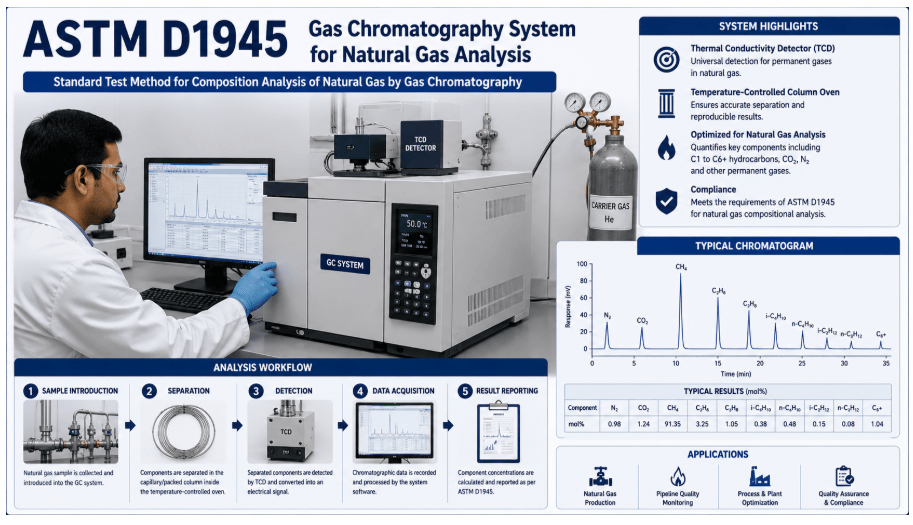
According to ASTM D1945, a gas chromatograph equipped with appropriate columns and detectors to separate and quantify gas mixture components is required. The instrumentation typically includes a thermal conductivity detector (TCD) or flame ionization detector (FID), certified reference gas standards for calibration, sampling cylinders and valves, data acquisition and integration software, pressure regulators and flow controllers, and a temperature-controlled column oven
| Sample and Specimen Details | Representative natural gas samples intended for compositional analysis. Samples may be collected in appropriate containers such as stainless steel Summa canisters or Tedlar bags, with specific requirements for pressure and handling. |
| Specimen Preparation | Technicians handle, condition, and prepare specimens as per requirements, avoiding contamination, moisture ingress, and ensuring representative sampling. Samples requiring quantified nitrogen results must be pressurized with helium. |
| Specimen Dimensions | ASTM D1945 uses a representative natural-gas sample rather than a dimensioned solid specimen. |
| Instrumentation | Gas chromatograph (e.g., HP 6890 with FID/dual TCD), appropriate chromatographic columns (packed and capillary columns of specified dimensions), certified calibration blends (NIST-traceable), sampling containers (Summa canisters or Tedlar bags), pressure regulators, syringes, and data integration software. |
Testing Procedures and Requirements for ASTM D1945
This test standard uses a precisely controlled analytical system to apply gas chromatographic separation to natural gas samples. Technicians set the required instrument parameters, including column temperature, carrier gas flow rate, and detector settings, and the apparatus completes the test. The ASTM D1945 test method comprises the following test procedure.
| Instrument Setup | Technicians prepare representative gas samples, choose the appropriate columns and detectors based on target components, and set up the gas chromatograph. |
| Instrument Calibration | The GC is calibrated with certified reference gas standards at various concentrations in percent mole in high-pressure cylinder blends. These primary standards are NIST-traceable with a vendor-supplied certificate of analysis. |
| Sample Injection and Separation | The sample is injected, and components are separated on chromatographic columns. The analytical system is designed to load sample containers at atmospheric or positive pressure. |
| Component Identification and Quantification | Components are identified by their retention time and quantified by peak area or peak height relative to calibration standards. |
| Result Reporting | Laboratories report composition values in mole percent, test conditions, column configuration, and relevant sample observations. |
ASTM D1945 Testing Process and Data Collection
The analyst selects representative gas samples and establishes the test parameters. After evaluating the specimens’ condition, the technicians insert the samples into the gas chromatograph. The operator maintains consistent temperature and flow parameters during the analysis. Finally, the analysts convert chromatographic peak data into composition values and compare the batch results with gas quality standards.
Common Challenges and Troubleshooting
The sensitivity drift of detectors, contamination of the column and non-complete separation of gas components is a problem in testing. Sample handling and preparation protocols limit contamination and pressure variations, while troubleshooting – such as calibration, ensuring proper column conditions, and ensuring system leak integrity.
ASTM D1945 Analysis Results and Interpretation
The report summarizes the chemical makeup and computed characteristics of the natural gas samples.
- The analyst contrasts the measured values with the limitations that regulatory requirements and gas quality standards set.
- The lab records the particular test conditions and reports the gas’s composition in conventional SI units (mole percent).
- The analyst notes retention times, peak regions, detector response, chromatographic problems, and temperature sensitivity.
- The laboratory uses the gas’s determined composition to determine processing implications such as density, heating value, and combustion characteristics.
- Instead of giving the material a single overall performance value, the report describes observed differences and evaluates several gas batches against specification limits.
Get Certified ASTM D1945 for Reliable Gas Quality Analysis
ASTM D1945 provides a standardized method for analyzing natural gas composition by gas chromatography in a laboratory. Qualified technicians can prepare the gas sample, manipulate the chromatographic system, analyze chromatograms, and report the measured composition. Laboratories should maintain appropriate equipment, calibration procedures, staffing, and documented quality assurance procedures to ensure reliable results. These laboratory practices can also support specialized applications, including Hydrogen-rich Polymers Testing, when laboratories use suitable analytical techniques and equipment for polymer characterization.
FAQ
What is the ASTM D1945 test?
ASTM D1945 determines the chemical composition of natural gas and similar gaseous mixtures using gas chromatography. The method covers hydrocarbons, helium, hydrogen, oxygen, nitrogen, carbon dioxide, and hydrogen sulfide.
What are the results of ASTM D1945 reported as?
SI units are the method’s standard units according to ASTM D1945-25. Within the relevant measurement ranges, the method expresses component concentrations on a mole-percent scale.
What instruments are used in ASTM D1945 testing?
The test uses a gas chromatograph equipped with appropriate columns and detectors (typically TCD or FID) to separate and quantify gas mixture components.
Updated on September 10, 2026

Testimonials
Real results
Engineers trust us with what matters most
“We had a great experience working with this company for our ASTM E84 testing. They were the first company to respond to our inquiry within just a few minutes of submitting it. From start to finish, the communication was excellent, and the entire process was swift, straightforward, and hassle-free.”

“Very good communication, testing associates were very patient with delays on our end. Reasonable turnaround time for results and nicely detailed report. Analysts were also quick to answer any follow-up questions. Happy with results.”
“Matestlab connected us with an accredited lab within days, cutting weeks off our product validation timeline.”
Why Choose Matestlab?
Matestlab is a unified testing services partner based in the USA. Matestlab offers raw material and product testing services through accredited, expert laboratories primarily based in the USA. Matestlab supports physical, thermal, chemical, electrical, mechanical, environmental, and characterization testing needs through its global network of 2200+ accredited testing laboratories. Matestlab's in-house materials science experts curate and design comprehensive testing programs matched to the sample material and specific testing need, with regulatory requirements and confidentiality in mind.
If you are looking for a managed and trusted testing partner to achieve your research goals, feel free to schedule a meeting with us or send us a request at connect@matestlabs.com to learn more about our services. For a quick quote, call us at (302)244-7710. We are happy to serve you.
If you are looking for a managed and trusted testing partner to achieve your research goals, feel free to schedule a meeting with us or send us a request at connect@matestlabs.com to learn more about our services. For a quick quote, call us at (302)244-7710. We are happy to serve you.
Start Your Testing
Project Today
Project Today
Define your requirements and get access to
specialized laboratories ready to deliver results
specialized laboratories ready to deliver results
Start Testing
Partners with us
Clients
Vendors