ASTM D1755 Standard Specification for Poly(Vinyl Chloride) Resins

    What is ASTM D1755?

    ASTM D1755 is a standard specification that sets requirements for PVC homopolymer resins for use in thermoplastics. The specification includes a classification system that guides manufacturers in classifying PVC resin based on its properties and expected processing performance. ASTM D1755 (Standard Specification for Poly(Vinyl Chloride) Resins) covers PVC homopolymer resins in powder form and distinguishes between general-purpose and dispersion grades according to their processing behavior. 

    Read more

    Get Certified ASTM D1755 Poly(Vinyl Chloride) Resin Testing

    ASTM D1755 testing helps manufacturers and suppliers assess PVC resin batches for compliance with requirements. Laboratories test the resin’s relevant properties and compare the results to resin requirements based on the chosen resin type and grade to support material qualification and quality control.

    What is the scope of ASTM D1755?

    ASTM D1755 outlines specifications for powdered poly(vinyl chloride) (PVC) resins intended for use in formulating thermoplastic compositions. It categorizes PVC resins by specified physical and processing-related properties and sets requirements for assessing these properties to measure quality and consistency. ASTM D1755 provides a classification system that lets manufacturers and users select PVC resin grades based on specified combinations of properties. This system supports consistent material selection for different processing requirements and end-use applications. 

    Read more

    This standard covers PVC homopolymer resins supplied in powder form for subsequent mixing and processing into thermoplastic compositions. The ASTM D1755 test standard-

    • Evaluates PVC homopolymer resins by measuring the applicable physical and processing properties required to classify the resin according to its specified grade. 
    • Evaluates general-purpose PVC resins by measuring the applicable resin properties and comparing the results with the requirements established for the selected classification. 
    • Evaluates dispersion PVC resins by measuring their applicable viscosity characteristics to determine whether the resin meets the requirements for its specified grade and processing use. 
    • Classifies PVC resin grades by using measured property values to assign the appropriate resin type and classification. 
    • Assesses PVC resin consistency by comparing measured properties between production batches and against the specified requirements. 
    • Supports quality control of PVC resin by providing standardized property requirements that manufacturers and users can use to evaluate resin quality before further processing. 

    What are the applications of ASTM D1755 testing?

    ASTM D1755 is a standard specification that classifies and evaluates poly(vinyl chloride) (PVC) homopolymer powders. It is primarily used to detect raw resin characteristics such as particle size, apparent density, and plasticizer absorption, which are critical for maintaining a consistent manufacturing performance.

    • Evaluates PVC resin quality by measuring the applicable properties and determining whether the resin meets its specified classification requirements. 
    • Supports resin selection by providing standardized property information that helps manufacturers select PVC grades suitable for their processing requirements. 
    • Supports formulation development by helping engineers evaluate resin characteristics before incorporating PVC into thermoplastic compositions. 
    • Supports production quality control by allowing manufacturers to compare resin properties between production batches and identify variations. 
    • Supports supplier evaluation by providing standardized property data that manufacturers can use to compare PVC resin from different suppliers. 

    What properties does ASTM D1755 evaluate?

    The ASTM D1755 test standard evaluates the following properties-

    • Dilute-Solution Viscosity: Measures the viscosity behavior of PVC resin in solution and helps classify the resin according to its specified grade. 
    • Particle-Size Characteristics: Determines the distribution of PVC resin particles and helps evaluate the powder characteristics required for classification. 
    • Apparent Bulk Density: Determines the mass of PVC resin occupying a specified bulk volume and helps characterize the handling and processing behavior of the powder. 
    • Plasticizer Sorption: Determines the amount of plasticizer absorbed by the PVC resin and helps evaluate its interaction with plasticizers during formulation. 
    • Dry Flow: Evaluates the flow behavior of PVC resin powder under specified conditions to support classification and processing assessment. 
    • Conductivity: Measures the electrical conductivity of the PVC resin under specified conditions when the property applies to the selected grade. 

    What Materials can be Tested According to ASTM D1755?

    The following materials can be tested using the ASTM D1755 method-

    • General-Purpose PVC Resins: Evaluates PVC homopolymer powders intended for general thermoplastic processing by measuring the properties required for their specified classification. 
    • Dispersion PVC Resins: Tests the grade of PVC homopolymer powders for dispersion-based process applications and determines the viscosity and flow characteristics applicable for the grade. 
    •  PVC Resin Grades: Tests various PVC resin grades to determine their specified properties and compares the test results to the classification requirements. 

    Why is ASTM D1755 Testing Important?

    ASTM D1755 testing assists manufacturers in deciding if PVC resin complies with the requirements prior to utilizing it to manufacture thermoplastic compositions. Stable resin characteristics support stable processing and help maintain product quality. Engineers and manufacturers rely on the results to choose resin grades, compare production batches, evaluate suppliers, and control quality in PVC processing.

    How Does ASTM D1755 Work?

    Technicians take one representative sample of PVC resin powder and test the appropriate properties of a given resin type and grade. They measure these properties and check how each measurement matches the classification properties. The measured values are then used in the laboratory for classification of the resin and reporting for quality assessment and comparison.

    ASTM D1755 Equipment and Sample Preparation Guide

    Laboratories get consistent and reliable PVC resin test results with proper equipment and representative sample preparation. Select suitable tests based on the required resin type and grade. They protect the powder against contamination and moisture exposure during sample handling, as well as against changes in powder condition.

    Read more

    Sample DetailsTechnicians use a representative PVC resin sample supplied in powder form and identify the applicable resin type and grade before testing.
    Sample PreparationThe technician collects and prepares a representative resin sample while preventing contamination or changes in the powder properties before testing.
    Sample ConfigurationDivide the prepared PVC resin into suitable portions for the individual property tests required for the specified resin type and grade.
    InstrumentationThe laboratory uses the applicable calibrated equipment for measuring PVC resin properties such as viscosity, particle size, apparent bulk density, plasticizer sorption, flow, and conductivity.

    Testing Procedures and Requirements

    The laboratory should follow the specified procedures for each PVC resin property and maintain consistent test conditions throughout the evaluation. Technicians should prepare representative powder samples, use the appropriate apparatus, and record each measured value accurately. This document contains other specifications as ISO 1264. The ASTM D1755 testing procedure comprises of the following-

    Read more

    Sample Preparation and ConditioningTechnicians prepare representative PVC resin powder samples and establish the required conditions before measuring the specified resin properties.
    Property TestingTechnicians measure the applicable PVC resin properties, such as dilute-solution viscosity, particle-size characteristics, apparent bulk density, plasticizer sorption, dry flow, and conductivity, according to the specified requirements.
    Grade ClassificationTechnicians compare the measured property values with the applicable classification ranges and assign the corresponding resin type and grade.
    Result EvaluationThe technician records the measured properties, compares them with the specification requirements, and determines whether the PVC resin meets the specified classification and quality requirements.

    ASTM D1755 Testing Process and Data Collection

    Technicians collect a representative PVC resin sample and prepare portions for the applicable property evaluations. They measure the required resin properties and record each result with the relevant test conditions and specimen information. The laboratory compares the measured values with the applicable requirements for the selected resin type and grade. Technicians then record the classification and supporting test results for quality assessment and material comparison.

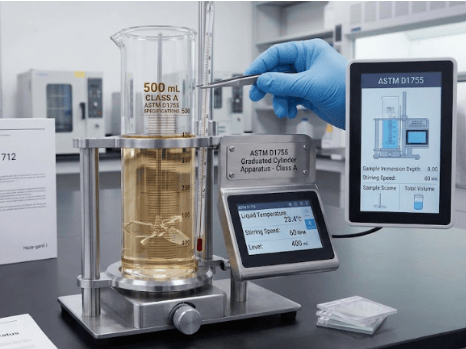
     The image shows a graduated cylinder apparatus used to measure the apparent bulk density of poly(vinyl chloride) resin powder according to ASTM D1755.
    ASTM D1755 Graduated Cylinder Apparatus 

    Common Challenges and Troubleshooting

    Variations in sampling, powder handling, contamination, moisture, equipment condition, and test conditions can affect PVC resin measurements. Consistent use of representative samples, clean equipment, and procedures in the laboratory. Powder handling conditions must also be monitored by technicians, as conditions of the physical state of the resin may affect measurements such as bulk density, particle-size characteristics, and flow behavior.

    Analysis Results and Interpretation

    • The laboratory report includes dilute-solution (inherent) viscosity, sieve analysis (% through the No. 200 (75 µm) sieve, apparent bulk density (g/1000 cm³), plasticizer sorption % DOP, dry flow (s/140 g), conductivity (µS/cm·g), Brookfield viscosity (poise), or Severs viscosity (poise), as applicable to the specified PVC resin type and grade.
    • The specification determines whether the measured PVC resin properties meet the applicable requirements for the specified Type GP or Type D resin grade.
    • Engineers evaluate the measured property values to compare PVC resin grades, suppliers, production batches, and manufacturing processes for material consistency and quality assessment.
    • Manufacturers and engineers use the results for material qualification, quality assurance, resin selection, formulation development, process control, and product development.
    • Engineers interpret the results together with resin type, grade, sampling procedure, powder condition, and applicable test methods because the required properties and classification limits differ between general-purpose and dispersion PVC resins.

    Link to ASTM D1755 

    Read more

    Updated on August 21, 2026

    Gokula Srinivasan Selvam
    About Author
    Gokula Srinivasan Selvam is a Material Testing Associate at Matestlab Inc. and holds a postgraduate degree in Ceramic Engineering from IIT (BHU), Varanasi. His academic background and professional experience are centered on advanced ceramic materials, their processing, characterization, and performance evaluation.
    Know More
    Testimonials
    Real results
    Engineers trust us with what matters most
    Start Your Testing
    Project Today
    Define your requirements and get access to
    specialized laboratories ready to deliver results
    Partners with us
    Clients
    Vendors
    Process for testing
    • STEP 01

      You share your testing requirements

    • STEP 02

      You share your sample(s)

    • STEP 03

      We deliver your test reports

    Get your testing done

    Let us know your testing requirements and we will be right back with a solution.

      Let us root for each other. Collaborate to grow, expand, and accelerate our businesses.

      Partner with us

        Discover more from Matestlab

        Subscribe now to keep reading and get access to the full archive.

        Continue reading