ASTM D1712 Standard Practice for Resistance of Plastics to Sulfide Staining

    What is ASTM D1712?

    ASTM D1712 is a standard practice that measures plastic resistance to sulfide-induced staining. The practice exposes plastic specimens to sulfides and compares the exposed and unexposed portions to estimate the relative susceptibility of the plastic composition to sulfide staining.  If salts of lead, cadmium, copper, antimony, and some other metals are present in plastic, the composition may react with external sources of sulfides to form metallic sulfides. Such sources may be liquid, solid, or gas, such as rubber, industrial fumes, foods, or kraft paper. 

    Read more

    Get Certified ASTM D1712 Sulfide Staining Testing

    The ASTM D1712 test provides manufacturers with ways to determine if their plastic composition is likely to retain its appearance upon contact with sulfide materials or environments. The results help in material comparison, formulation development, quality control, and product selection for applications where the surface discoloration may impact product appearance.

    What is the Scope of ASTM D1712?

    ASTM D1712 outlines a standard practice for measuring the resistance of plastics to staining in the presence of sulfides. The practice indicates the relative susceptibility of plastic compositions to sulfide staining on contact with external sulfide-containing material. Plastic compositions containing salts of lead, cadmium, copper, antimony, and certain other metals as stabilizers, pigments, driers, or fillers may stain because of metallic sulfide formation when they contact external materials containing sulfide. 

    Read more

    This standard covers determining plastic resistance to staining in the presence of sulfides. It provides a comparative approach for evaluating the susceptibility of plastic compositions to sulfide staining. The ASTM D1712 standard-

    • Evaluates plastic compositions exposed to sulfides by placing representative specimens in a controlled sulfide environment and observing whether the material develops visible staining. 
    • Evaluates the relative susceptibility of plastic compositions to sulfide staining by exposing representative specimens to sulfides and observing the resulting staining. 
    • Checks for the presence of lead, cadmium, copper, and antimony salts in plastics to determine whether sulfide exposure produces sulfides and visible discoloration. 
    • Evaluates the impact of external sulfide sources on plastic surfaces by emulating contact with sulfide-containing materials that may be encountered during service and/or storage. 
    • Compares plastic formulations to the relative sulfide-staining susceptibility by exposing different formulations to the same controlled conditions and comparing the staining behavior observed. 
    • Analyses plastics that could come into contact with sulfide-containing solids, liquids, or gases and determines if the plastics will not change appearance when contacted by such a possible source of staining. 
    • Assists in selection and quality control of materials and offers comparative data on the tendency to develop sulfide-related discoloration of a plastic composition. 

    What Properties Does ASTM D1712 Evaluate?

    ASTM D1712 primarily evaluates a plastic composition’s visual resistance to sulfide staining rather than measuring a mechanical or chemical property such as tensile strength or hardness.

    • Sulfide Staining Resistance: Determines how effectively the plastic resists visible discoloration after exposure to sulfides. 
    • Surface Discoloration: Assesses visible changes that occur on the surface of exposed plastic following contact with sulfides. 
    • Relative Staining Susceptibility: Assesses whether the plastic will retain its desired surface appearance when treated with a material containing sulfur. 
    • Appearance Retention: Helps determine whether the plastic can maintain its intended surface appearance when exposed to sulfide-containing materials. 

    What Materials Can Be Tested According to ASTM D1712?

    ASTM D1712 evaluates plastic compositions that may be susceptible to sulfide staining, particularly compositions containing metallic compounds that can form metallic sulfides when exposed to external sulfide sources.  In this practice, specifically the following constituents are identified as relevant: lead, cadmium, copper, antimony, and certain other metals. 

    • Pigmented Plastics: Evaluates pigmented plastic formulations containing metal-based pigments to determine whether sulfide exposure causes visible discoloration. 
    • Stabilized Plastics: Evaluates plastic compositions containing metal-based stabilizers to determine their susceptibility to sulfide-related staining. 
    • Plastic Compositions Containing Driers: Evaluates formulations containing metallic driers to determine whether sulfide exposure promotes staining. 
    • Plastic Compositions Containing Fillers: Evaluates filled plastic formulations containing susceptible metallic compounds to determine their resistance to sulfide staining. 
    • Other Plastic Formulations: Compares plastic compositions that contain metals capable of forming metallic sulfides when exposed to external sulfide sources. 

    What Causes Sulfide Staining in Plastics?

    Sulfide staining occurs when certain metallic compounds in a plastic composition react with external sulfide sources to form metallic sulfides.  The reaction results in an observable surface discoloration on the plastic. Rubber, industrial fumes, foods, and kraft paper are examples of external sources of sulfides.

    How Does ASTM D1712 Evaluate Sulfide Staining Resistance?

    Technicians expose approximately half of each plastic sample to a freshly prepared saturated solution of hydrogen sulfide (Hâ‚‚S) in a controlled environment. They also compare the exposed part to the unexposed part and record the staining reaction that they see. These observations are used in practice to estimate the relative susceptibility of the plastic composition to sulfide staining. 

    What are the Applications of ASTM D1712 Testing?

    ASTM D1712 testing supports plastic formulation and quality evaluation when products may encounter sulfide-containing materials or environments. This standard-

    • Evaluates plastic formulations for appearance-sensitive applications by determining whether sulfide exposure can produce visible staining on the finished material. 
    • Supports plastic formulation development by helping manufacturers compare formulations and identify compositions with lower susceptibility to sulfide staining. 
    • Provides comparative information to support material selection for applications in which plastics may contact sulfide-containing rubber, paper, food, or industrial fuel. 
    • Facilitates quality control by enabling manufacturers to compare the sulfide-staining properties of the various formulations, suppliers, and production batches. 
    • Provides comparative data that engineers use during product development to select plastic compositions with lower susceptibility to sulfide staining.  

    ASTM D1712 Equipment and Sample Preparation Guide

    Technicians prepare representative plastic specimens and expose them to a freshly prepared saturated hydrogen sulfide solution under the specified conditions. Hydrogen sulfide is also very toxic , so there are safety measures that need to be implemented in the practice. 

    Read more

    Sample DetailsRepresentative plastic specimens prepared from the material or plastic composition being evaluated for resistance to sulfide staining.
    Sample PreparationTechnicians prepare clean specimens with appropriate size and condition, and condition them under laboratory conditions before exposure.
    Sample ConfigurationTechnicians position approximately half of each specimen in contact with the sulfide solution so that they can compare the exposed and unexposed portions for visible staining.
    InstrumentationTechnicians use suitable glassware such as a 250-mL beaker, a watch glass or aluminum foil cover, specimen-handling equipment, and appropriate laboratory safety and ventilation equipment. 

    Testing Procedures and Requirements

    This test method evaluates the visible staining of plastic compositions after controlled exposure to sulfides.  The procedure calls for a freshly prepared saturated hydrogen sulfide solution and places about ½ of each specimen in the solution for a specified exposure period. The ASTM D1712 test procedure comprises the following steps-

    Read more

    Specimen Preparation and ConditioningTechnicians prepare representative plastic specimens and condition them under appropriate laboratory conditions to ensure consistent starting conditions before sulfide exposure.
    Hydrogen Sulfide Solution PreparationTechnicians prepare a fresh saturated hydrogen sulfide solution and handle it under appropriate ventilation and safety controls because hydrogen sulfide is highly toxic. 
    Controlled Sulfide ExposureTechnicians immerse approximately half of each specimen in the hydrogen sulfide solution for the specified exposure period while covering the container to control the test environment. 
    Staining Evaluation and ReportingTechnicians compare the exposed and unexposed portions of the specimens, document visible staining, and use the observations to estimate the plastic composition’s relative susceptibility to sulfide staining.

    ASTM D1712 Testing Process and Data Collection

    Technicians prepare and condition representative plastic specimens before exposing them to a freshly prepared saturated hydrogen sulfide solution. They immerse approximately half of each specimen for the specified period while controlling the test environment. After exposure, technicians examine the specimens for visible staining and compare the exposed and unexposed portions. They record the specimen identification, exposure conditions, observed staining, and comparative response for reporting. 

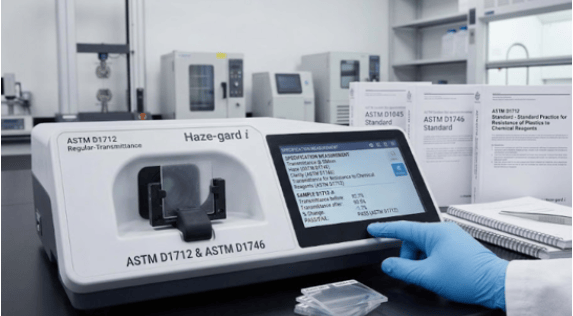
    The image shows an ASTM D1712 spectrophotometer used to evaluate the sulfide staining resistance of plastic specimens. 
    ASTM D1712 spectrophotometer

    Common Challenges and Troubleshooting

    Comparison results can be affected by inconsistent specimen preparation, contaminated surfaces, changes in sulfide solution conditions, uncontrolled exposure conditions, and subjective staining evaluation. Laboratories should prepare representative specimens, use a new solution, keep exposure conditions the same, and make sure to compare exposed and unexposed areas carefully. Hydrogen sulfide is a highly toxic gas, so the procedure should be carried out in a laboratory hood, and safety procedures should be in place. 

    Analysis Results and Interpretation

    • The laboratory report includes specimen identification, plastic composition information, exposure conditions, observed staining, and the relative sulfide-staining response of the tested material. 
    • The practice estimates a plastic composition’s relative susceptibility to sulfide staining by comparing the visible response after controlled sulfide exposure.  
    • Engineers evaluate the results to compare plastic formulations, metallic additives, suppliers, manufacturing processes, and production batches for appearance retention and material quality assessment. 
    • Manufacturers and engineers use the results for material qualification, formulation development, quality assurance, product selection, and product development where sulfide exposure could affect plastic appearance. 
    • Results are interpreted together with the plastic formulation, metallic additives, specimen condition, sulfide exposure conditions, and observed staining response because these factors can influence the material’s apparent resistance to sulfide staining. 

    Link to ASTM D1712

    Read more

    Updated on August 20, 2026

    Suyog Kamble
    About Author
    Suyog Kamble is an Operations Associate at Matestlab Inc. Suyog holds a postgraduate degree in organic chemistry and is trained in material science topics.
    Know More
    Testimonials
    Real results
    Engineers trust us with what matters most
    Start Your Testing
    Project Today
    Define your requirements and get access to
    specialized laboratories ready to deliver results
    Partners with us
    Clients
    Vendors
    Process for testing
    • STEP 01

      You share your testing requirements

    • STEP 02

      You share your sample(s)

    • STEP 03

      We deliver your test reports

    Get your testing done

    Let us know your testing requirements and we will be right back with a solution.

      Let us root for each other. Collaborate to grow, expand, and accelerate our businesses.

      Partner with us

        Discover more from Matestlab

        Subscribe now to keep reading and get access to the full archive.

        Continue reading