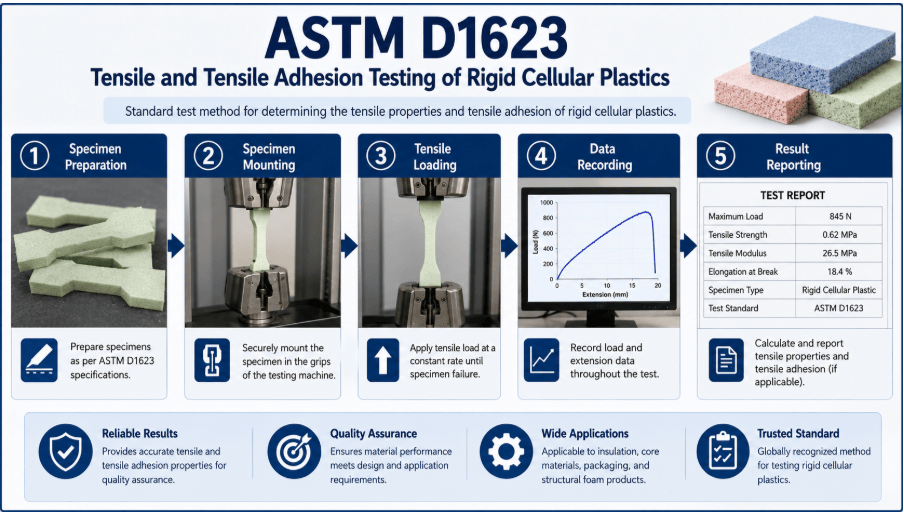
ASTM D1623 is the standard for tensile and tensile adhesion properties of rigid cellular materials using standard-shaped test specimens. The method regulates the testing-machine speed, humidity, and temperature during the test. There are three specimen types depending on the availability of the samples and the intended evaluation. Type C specifically tests the tensile adhesive properties of cellular plastics bonded to a substrate, such as in a sandwich-panel arrangement and on a single-substrate assembly. SI units are the standard units. The scope of ASTM D1623 includes:
- Material type: Rigid cellular plastics including polyurethane, polystyrene, polyisocyanurate, phenolic, and PVC foams used in construction, aerospace, automotive, insulation, and packaging applications.
- Purpose: Determination of tensile strength and elongation (Method A) and tensile adhesion strength of foam-to-facing bond (Method B) for structural design, material specifications, research and development, and quality assurance.
- Properties measured: Tensile strength and elongation at break of foam substrate (Method A) and tensile adhesion strength of foam-to-facing bond (Method B).
- Testing Method: Constant-rate-of-crosshead-movement type testing machine with self-aligning grips, extension indicator, and lathe specimen cutter.
- Specimen types: Type A for bulk foam materials, Type B for smaller specimens from sandwich panels, and Type C for tensile adhesion properties of cellular plastic to a substrate.
- Test limitations: Does not apply to flexible or semi-rigid cellular materials; no known ISO equivalent.
- Result: Tensile strength and elongation at break (Method A), tensile adhesion strength and failure mode (Method B), cell orientation and density records, and failure location description.
- Use conditions: Specimens must be cut from defined orientations relative to the foam rise direction, and cell orientation must be reported with results. Testing is performed under defined conditions of temperature, humidity, and testing machine speed.
- Applications: Building insulation panel core qualification, refrigeration and cryogenic panel characterization, marine and boat hull sandwich core evaluation, aerospace thermal protection systems, industrial insulated pipe assessment, and foam formulation research and development
What are the Uses of AASTM D1623 Testing?
ASTM C1549 testing helps the laboratory assess the solar (reflectivity) ability of flat opaque materials with a portable solar reflectometer. Manufacturers, building designers, and urban planners use the results to check quality, choose materials, or for energy efficiency evaluation. This standard-
- Calculates solar reflectance of roofing materials and cool roof systems.
- Assesses pavements and urban infrastructure surfaces for heat management.
- Assesses coatings and surface finishes for energy-efficient building design.
- Assists in city planning and heat island mitigation.
- Allows surfaces to be periodically tested in the field or lab to track variations in solar reflectance as surfaces age and are exposed to the elements.
- Provides fast, non-destructive solar reflectance measurement.
- Helps lower cooling loads and surface temperature.
What Materials Can Be Tested Under ASTM D1623?
It evaluates rigid cellular plastics such as EPS, XPS, PU, and phenolic foam to assess tensile strength, adhesion properties, and structural integrity for industry standards of mechanical performance and durability.
Why is ASTM D1623 Important?
It is a widely used standard in the automotive, construction, and packaging industries. It tests the tensile strength, adhesion properties, mechanical properties, and lightweight properties of foam-based materials to ensure reliability and safety in critical applications.