ASTM D1489 Standard Test Method for Nonvolatile Content of Aqueous Adhesives 

    What is ASTM D1489?

    ASTM D1489 specifies a standard test method for determining the nonvolatile content of aqueous adhesives, such as dextrin, starch, casein, and animal gelatin. This standard specifies the percentage of adhesive that will not evaporate from the product under specified laboratory conditions. It helps laboratories compare the nonvolatile material of various adhesives for selection and product uniformity. Moreover, the method can also support quality control and research by providing consistent data on adhesive solids content. The results may help manufacturers analyze formulation consistency or assess adhesive performance when solids content is a key factor in product selection and cost. 

    Read more

    Get Certified ASTM D1489 Testing for Reliable Adhesive Quality Assessment

    Reliable ASTM D1489 (Standard Test Method for Nonvolatile Content of Aqueous Adhesives) testing helps manufacturers evaluate the solids content of their aqueous adhesive products in a standard testing environment. Laboratories also compare formulations and batches using the same methods. The test can help select materials when the manufacturer requires an adhesive with the correct solids content for a particular use. 

    What is the Scope of the ASTM D1489 Test Standard?

    ASTM D1489 establishes a method for measuring the nonvolatile content of dextrin, starch, casein, animal gelatin, and other types of aqueous adhesives. The standard provides a way to test the amount of solids left after the adhesive’s volatile constituents have been evaporated. The method is used in the laboratory to compare and select different adhesives and to maintain product uniformity. ASTM D1489 also applies to quality control and research where reproducible nonvolatile-content measurements are essential. This standard-

    Read more

    • Determines the nonvolatile content of aqueous adhesives.
    • Applicable for glues like dextrin, starch, casein, and animal gelatine.
    • Measures the solids level remaining after volatile components are removed.
    • Supports comparison of the nonvolatile content of different adhesives.
    • Assists laboratories in the evaluation of selection and uniformity of adhesives and products.
    • Performs quality-control testing of adhesive (aqueous) products.
    • Provides a standardized method for research and adhesive evaluation.
    • Works with standard units (SI units).

    What is ASTM D1489 Testing used for?

    ASTM D1489 testing determines the nonvolatile content of aqueous adhesives. Manufacturers then use the results to compare adhesive formulations and test product uniformity. The test is also useful for quality-control programs and research in which uniform adhesive composition is desirable. This standard-

    • Determines the nonvolatile content of aqueous adhesives.
    • Tests dextrin, starch, casein, and animal gelatin adhesives.
    • Assists with comparisons between nonvolatile components of various adhesive formulations.
    • Aids in the assessment of uniformity of adhesive products.
    • Assists manufacturers with quality-control testing.
    • Supports research and development of formulations of aqueous adhesives.
    • Gives quantitative results for evaluation of adhesives that do not require the destruction of the material being tested.
    • Aids in the selection of adhesives where solid content plays a critical role. 

    Which materials can be tested under ASTM D1489?

    The standard ASTM D1489 covers dextrin, starch, casein, and animal gelatin adhesives. The method is for the determination of the material that remains after the removal of volatile materials under controlled conditions. In laboratories, the procedure is employed to test the quality of adhesive samples and to compare the nonvolatile content of adhesive samples in quality control and research. 

    Why is ASTM D1489 Important?

    ASTM D1489 provides a standardized method for determining the nonvolatile content of aqueous adhesives. Adhesive formulations vary in solids content, which can affect product uniformity, material comparison, and manufacturing quality. The test measures the material remaining after volatile components are removed under controlled drying conditions. The results assist manufacturers and laboratories in comparing adhesive formulations, evaluating product uniformity, and supporting quality-control and research activities. The method applies to aqueous adhesives such as dextrin, starch, casein, and animal gelatin.

    ASTM D1489 Equipment and Sample Preparation Guide

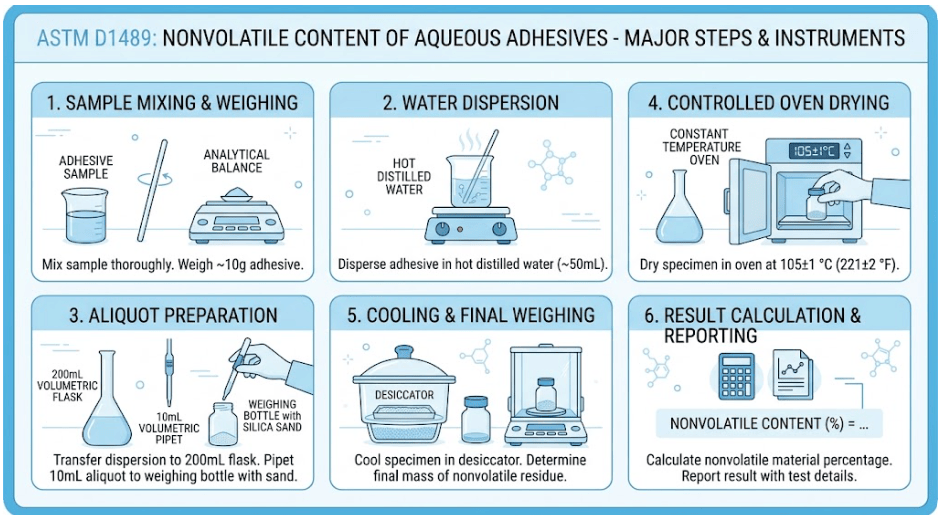
    ASTM D1489 requires representative adhesive samples, accurate weighing equipment, controlled-temperature drying equipment, and suitable laboratory glassware. Technicians prepare the adhesive sample, disperse a measured portion in hot distilled water, and transfer the prepared dispersion for controlled drying. They then cool the dried material in a desiccator and determine its final mass for calculating nonvolatile content. The method uses a controlled oven temperature of 105 ± 1 °C (221 ± 2 °F) and reports the final result as a percentage.

    Read more

    Sample and Specimen DetailsRepresentative aqueous adhesive samples, such as dextrin, starch, casein, animal gelatin, etc., are made for the determination of the nonvolatile material which remains after controlled drying.
    Specimen PreparationTechnicians thoroughly mix the adhesive sample, measure the desired test sample, pour it into hot distilled water, and prepare the dispersion for further drying and weighing. 
    Specimen DimensionsThe test portion is around 10 g of adhesive, and a defined 10 mL sample of the prepared dispersion is transferred to the weighing bottle. 
    InstrumentationThe analytical balance, constant temperature oven at 105 ± 1 °C, weighing bottles, 200 mL volumetric flask, 10 mL volumetric pipette, desiccator, silica sand, beaker, hot plate, and appropriate laboratory glassware are used in the test. 

    Testing Procedures and Requirements for ASTM D1489

    This test standard determines the nonvolatile content of aqueous adhesives by removing volatile components under controlled drying conditions. Technicians prepare the adhesive specimen, disperse it in hot distilled water, and transfer a measured portion into a prepared weighing bottle. The ASTM D1489 test procedure comprises the following steps:

    Read more

    Initial Sample PreparationTechnicians thoroughly mix the representative adhesive sample, then weigh about 10 g of adhesive for the test portion. 
    Water DispersionTechnicians prepare the adhesive specimen in about 50 mL of hot distilled water and prepare the dispersion for testing. 
    Aliquot PreparationAnalysts transfer the prepared dispersion into a 200 mL volumetric flask, then transfer a 10 mL aliquot into a prepared weighing bottle containing silica sand. 
    Controlled Oven DryingThe technicians place the weighing bottle in a constant-temperature oven at 105 ± 1 °C (221 ± 2 °F) to dry the volatile components of the adhesive. 
    Cooling and WeighingThe dried specimen is placed in a desiccator, and the technicians carefully weigh it to find out how much of the nonvolatile part of the specimen remains.
    Result Calculation and ReportingEngineers measure the nonvolatile content and report it as a percentage, along with other sample and test details.

    ASTM D1489 Testing Process and Data Collection

    An analyst takes a representative sample of the aqueous adhesive and thoroughly mixes it to achieve uniform consistency. The analyst then weighs about 10 g of the adhesive and scatters it in hot distilled water. The analyst transfers the prepared dispersion to a 200 mL volumetric flask and then transfers 10 mL of the dispersion into a prepared weighing bottle containing silica sand. The analyst dries the specimen at 105 ± 1 °C (221 ± 2 °F), cools it in a desiccator, and determines the final mass. Finally, the analyst calculates and records the nonvolatile content as a percentage for evaluation and reporting purposes.

    The image shows a sample of an aqueous adhesive being prepared, dried in a controlled-temperature oven, cooled in a desiccator, and weighed to determine the nonvolatile content per ASTM D1489. 
    ASTM D1489 Nonvolatile Content Testing of Aqueous Adhesives

    Common Challenges and Troubleshooting

    ASTM D1489 results are accurate when specimen preparation, test temperature, moisture conditions, and exposure or conditioning procedures specified in the test method are carefully monitored. Measurement results may vary depending on specimen thickness, surface, equipment settings, or environment. Before testing, the technician must inspect the testing equipment, measurement instrumentation, and specimen condition. Engineers obtain consistent and repeatable results if the same procedures are used to prepare, condition, test, and evaluate their specimens. 

    ASTM D1489 Analysis Results and Interpretation

    The report summarizes the changes or measurements of the plastic specimens during or after the tests performed under ASTM D1489. Specimens are tested using the appropriate measurement procedure, and the results are compared to the requirements or reference condition. 

    Read more

    • The laboratory reports the test duration and applicable test conditions, including time in hours (h) and temperature in degrees Celsius (°C).
    • The analyst records the measured specimen characteristics using the applicable measurement techniques and reports each property in its specified unit, such as mm, %, or mass units, as applicable.
    • The technician documents visible or physical changes that occur during testing, including discoloration, cracking, deformation, and surface deterioration, when applicable to the material.
    • The laboratory compares the measured results among specimens or against reference conditions and reports the observed differences rather than assigning a single overall performance value to the material.

    Link to ASTM D1489

    FAQ

    Why is ASTM D1489 important?
    ASTM D1489 is significant because it supports standardized testing, helping laboratories consistently produce comparable test results for the specified characteristics of plastic materials under controlled laboratory conditions.
    The test method and conditions outlined in ASTM D1489 are used to evaluate plastic materials. It provides laboratories with valuable parameters related to material properties for quality control, product development, and material evaluation.
    The characteristics measured by the test procedure are specified in ASTM D1489 and reported by the measurement technique and units that are specified. The assessment can involve appropriate physical or performance attributes of the material, depending on the material and the assessment method.
    Laraib Hashmi
    About Author
    Laraib Hashmi
    Laraib Hashmi is an aspiring research enthusiast and science content professional with a strong interdisciplinary skill set, holding a postgraduate degree in Applied Microbiology from KIIT Bhubaneshwar, Odisha.
    Testimonials
    Real results
    Engineers trust us with what matters most
    Start Your Testing
    Project Today
    Define your requirements and get access to
    specialized laboratories ready to deliver results
    Partners with us
    Clients
    Vendors
    Process for testing
    • STEP 01

      You share your testing requirements

    • STEP 02

      You share your sample(s)

    • STEP 03

      We deliver your test reports

    Get your testing done

    Let us known your testing requirements and we will be right back with a solution.

      Let us root for each other. Collaborate to grow, expand, and accelerate our businesses.

      Partner with us

        Contact Us

        Discover more from MaTestLab

        Subscribe now to keep reading and get access to the full archive.

        Continue reading