ASTM D1435 Standard Practice for Outdoor Weathering of Plastics

    What is ASTM D1435?

    ASTM D1435 is a standard practice for outdoor weathering of plastics under natural environmental conditions. Technicians mount plastic specimens on outdoor exposure racks and expose them to sunlight, temperature changes, precipitation, humidity, and other atmospheric conditions. They inspect the specimens at specified exposure intervals and evaluate changes in appearance or physical properties using applicable test methods. ASTM D1435 (Standard Practice for Outdoor Weathering of Plastics) provides guidance for conducting and reporting outdoor weathering exposures so laboratories can compare the behavior of plastics after exposure.

    Read more

    Get Certified ASTM D1435 Testing for Reliable Plastic Weathering Evaluation

    ASTM D1435 testing gives a standard method of assessing plastics’ reactions to long-term weathering. Laboratory and field testing help you understand changes in appearance and performance after natural weathering. ASTM D1435 is used to qualify materials, for quality assurance, to develop products, compare formulations, to ensure manufacturing control, and to meet customer specifications. Manufacturers can also use the results to choose plastics for long-term outdoor applications.

    What is the Scope of ASTM D1435 Test Standard?

    ASTM D1435 outlines a standard practice for natural weathering testing of plastics in the outdoor environment. The practice offers a uniform method for exposing plastic products to the elements of sun, temperature, moisture, and other environmental conditions that impact product performance. It is used for plastic weathering testing, material qualification, product development, quality control, and durability testing in the plastics, automotive, construction, packaging, and coatings manufacturing sectors. This standard-

    Read more

    • Tests the natural outdoor weathering resistance of plastic.
    • Exposes plastic samples to the sun and environmental conditions.
    • Supplies long-term durability testing.
    • Aids in the recognition of changes in the properties of plastic caused by weathering.
    • Helps compare materials and develop products.
    • Supports Quality Control and Material Qualification.

    What is the Use of ASTM D1435 Testing?

    ASTM D1435 is used to aid manufacturers in the prediction of the responses of plastic materials to extended outdoor exposure. These results are valuable for determining durability, comparing formulations, choosing materials to use, and product development for outdoor use.

    • Manufacturers of plastic test their susceptibility to degradation in the environment.
    • Automotive manufacturers evaluate exterior plastic parts.
    • Construction companies assess plastics for use in outdoor buildings.
    • Packaging producers evaluate materials when subjected to sunlight and weather.
    • Coating manufacturers test the weathering characteristics of plastic products.
    • Quality control laboratories monitor changes in plastic performance after exposure.

    What Materials Can Be Tested Under ASTM D1435?

    ASTM D1435 covers suitable plastic materials or products for outdoor use. Materials that can be tested include polyethylene, polypropylene, polyvinyl chloride, acrylics, polycarbonate, polystyrene, engineering plastics, plastic films and sheets, molded products, and other materials that need evaluation for outdoor durability.

    Why is ASTM D1435 Important for Plastic Weathering Evaluation?

    ASTM D1435 provides a standardized methodology to investigate the impact of natural outdoor exposure on plastics. Weathering can cause discoloration, surface cracking, chalking, gloss loss, embrittlement, and reduced mechanical performance. Accurate outdoor exposure data can aid manufacturers in formulating better products, choosing materials that can endure the environment, minimizing product failure due to premature exposure, and estimating the product’s performance in its intended environment.

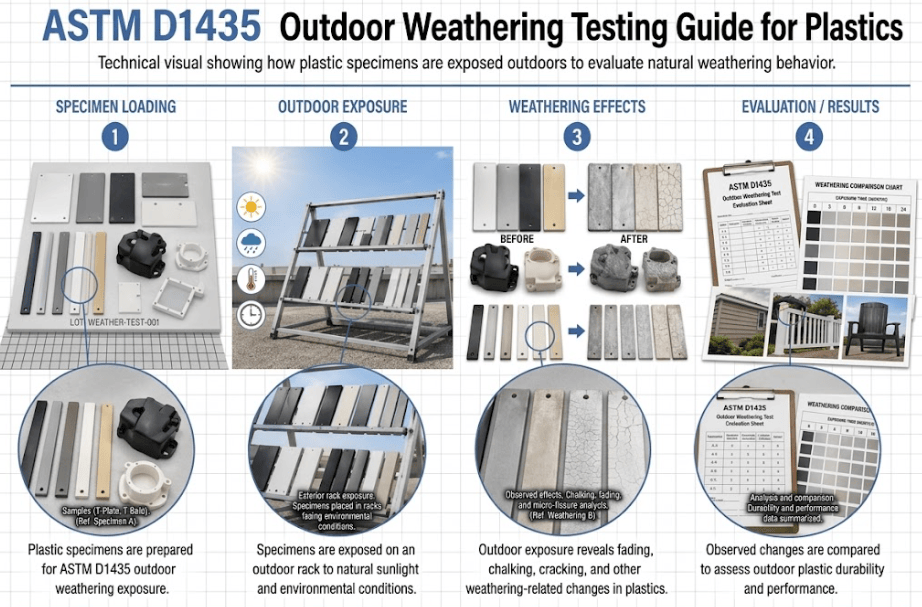
    ASTM D1435 Equipment and Sample Preparation Guide

    To evaluate outdoor properties, representative plastic specimen(s), an appropriate exposure rack, controlled placement of specimen(s), and accurate environmental monitoring are necessary to get reliable results. If exposure conditions vary during the evaluation, prepare specimens accordingly.

    Read more

    Specimen DetailsCommon materials used are plastic sheets, molded plastics, films, profiles, coatings, and other plastic products for outdoor use.
    Specimen PreparationTechnicians prepare representative, clean specimens with appropriate surfaces and dimensions. They record the first sightings of these and other relevant characteristics and then move the specimens outside.
    Specimen DimensionsThe number and size of specimens vary depending on the form, design, and properties of the product to be tested. Laboratories provide adequate visual and physical exposure areas.
    InstrumentationTypical equipment includes outdoor weathering exposure racks, solar radiation monitoring equipment, temperature sensors, humidity monitoring equipment, rain gauges, colorimeters, gloss meters, tensile testing machines, dimensional measurement instruments, and other instruments needed for property evaluation.

    Testing Procedures and Requirements for Outdoor Weathering Evaluation

    In ASTM D1435, plastic test specimens are left in natural outdoor environments, and changes in these specimens over a specified exposure time are recorded. Proper specimen preparation, exposure arrangement, environmental record, and consistent evaluation improve result reliability.

    Read more

    Specimen SelectionTechnicians select representative plastic materials and prepare specimens that reflect the product or formulation being tested.
    Specimen PreparationSpecimens are made in the laboratory to the appropriate size and surface. Prior to exposure, they check for scratches, contamination, cracks, manufacturing errors, etc.
    Exposure SetupThe specimens are mounted on appropriate outdoor exposure racks with the appropriate orientation at the proper location. They make sure that the environment is applied to each specimen without any unnecessary hindrances.
    Environmental MonitoringEmployees record pertinent conditions of exposure, including sunlight, temperature, precipitation, humidity, and other environmental factors that may affect weathering.
    Exposure PeriodSpecimens are left outside for the designated amount of time. The specimens are examined at regular time intervals by technicians, and exposure records are kept.
    Property EvaluationAnalysts examine changes in appearance and physical performance after exposure. Evaluation may be done considering color, gloss, cracking, chalking, embrittlement, tensile properties, or other properties appropriate for the application and material.
    Data Collection and Result AnalysisPersonnel record specimen identification, exposure location/orientation, exposure time, environmental data, evaluation results, and changes to the specimens. Analysts compare the effects of outdoor weathering with suitable unexposed and/or baseline specimens.
    Documentation and ReportingLaboratory reports usually contain specimen identification, material data, exposure conditions, duration of exposure, and environmental observations, property measurements, visual changes, and details of evaluation according to ASTM D1435.

    ASTM D1435 Testing Process and Data Collection

    The initial testing steps are to select representative plastic specimens and record their initial appearance and related properties. Analysts place the specimens on outdoor exposure racks and record the exposure site, orientation, and environmental conditions. After the specified exposure period, workers examine and test the specimens for changes in appearance and performance. The laboratory will take and match up with baseline measurements and record the impact of outdoor weathering conditions.

    The image shows plastic specimens mounted on an outdoor weathering exposure rack for evaluation according to ASTM D1435.
    ASTM D1435 Outdoor Weathering Testing of Plastic Specimens

    Common Challenges and Troubleshooting

    Weathering results can vary depending on the location, specimen orientation, and exposure environment. Contamination, shading, mounting, inconsistent inspection periods, and poor environmental records may also affect the evaluation. To increase reliability, the technician should use the proper specimen placement, ensure accurate exposure records, conduct routine inspections, maintain the same evaluation procedures, and use appropriate control specimens.

    Analysis Results and Interpretation

    • The laboratory reports changes in properties such as color, gloss, tensile strength, elongation, mass, and dimensions using the applicable units, such as MPa for tensile strength, % for elongation, and mm for dimensions.
    • The analyst records visible surface changes, including cracking, chalking, discoloration, and other forms of deterioration, to assess changes in weathering performance.
    • Analysts compare the measured properties of exposed and unexposed specimens to determine the extent of material degradation after outdoor exposure.
    • The analyst evaluates the results in relation to the exposure environment and intended application, rather than using a single result to predict overall service life.
    • The manufacturer uses the weathering results, along with material specifications and expected service conditions, to evaluate the material’s suitability for its intended application.

    Link to ASTM D1435

    Read more

    FAQ

    What is ASTM D1435 used for?
    ASTM D1435 is a natural outdoor weathering test that is applied to plastic materials and products.
    Plastic performance during outdoor exposure can be influenced by sunlight, solar radiation, temperature changes, moisture, precipitation, humidity, and other environmental factors.
    ASTM D1435 can aid the manufacturer in testing the durability of plastic under natural outdoor conditions and can assist in material selection, product development, quality control, and long-term testing of material durability.

    Updated on September 1, 2026

    Gokula Srinivasan Selvam
    About Author
    Gokula Srinivasan Selvam is a Material Testing Associate at Matestlab Inc. and holds a postgraduate degree in Ceramic Engineering from IIT (BHU), Varanasi. His academic background and professional experience are centered on advanced ceramic materials, their processing, characterization, and performance evaluation.
    Know More
    Testimonials
    Real results
    Engineers trust us with what matters most
    Start Your Testing
    Project Today
    Define your requirements and get access to
    specialized laboratories ready to deliver results
    Partners with us
    Clients
    Vendors
    Process for testing
    • STEP 01

      You share your testing requirements

    • STEP 02

      You share your sample(s)

    • STEP 03

      We deliver your test reports

    Get your testing done

    Let us know your testing requirements and we will be right back with a solution.

      Let us root for each other. Collaborate to grow, expand, and accelerate our businesses.

      Partner with us

        Discover more from Matestlab

        Subscribe now to keep reading and get access to the full archive.

        Continue reading