
ASTM D1125 describes standard test methods for measuring water electrical conductivity and resistivity. The test method involves introducing an electrical current into the water sample in a conductivity cell and measuring the sample’s resistance to determine its conductivity and resistivity. ASTM D1125 (Standard Test Methods for Electrical Conductivity and Resistivity of Water) provides two distinct procedures: two test methods: Test Method A is for the measurement of electrical conductivity and resistivity of non-flowing samples or water from field measurements, and Test Method B is for continuous, in-line measurement of water in process streams, in a range of 10 to 200,000 µS/cm, to inspect water quality of natural, treated, industrial, boiler, cooling, brackish, and saline water. Engineers compare the measured conductivity and resistivity to purity requirements for drinking water, boiler feed water, and process water applications.
ASTM D1125 Standard Test Methods for Electrical Conductivity and Resistivity of Water
What is ASTM D1125?
What is the Scope of ASTM D1125?
ASTM D1125 covers two test methods for measuring electrical conductivity and water resistivity. It tests water conductivity in natural, treated, industrial, boiler, cooling, brackish, and saline water. This standard provides a standard test method for measuring water purity under controlled cell conductivity conditions, either with static or continuous in-line measurement equipment. This test is applied to quality control, process monitoring, and detecting contamination in industries.
The scope of ASTM D1125 includes
- Material type: Natural, Treated, Industrial, Boiler, Cooling, Brackish, Saline waters.
- Purpose: Measurement of conductivity and resistivity of water.
- Properties evaluated: Electrical conductivity (µS/cm), Electrical resistivity (ohm·cm).
- Testing Method: Testing involves passing an electrical current through a water sample using a conductivity cell. Test Method A is a static test, and Test Method B is a continuous in-line flow test.
- Result: The measure of conductivity is in units of µS/cm; the measure of resistivity is in units of ohm·cm.
- Test Limitations: Test Method A is suitable for use from 10 to 200,000 µS/cm; Test Method B is suitable for use from 5 to 200,000 µS/cm.
- Use conditions: Sample temperature significantly affects measured conductivity and requires correction to a standard reference temperature.
- Applications: Drinking water quality monitoring, monitoring of boiler and steam purity, industrial process water control, evaluation of water treatment systems.
What are the Uses of ASTM D1125 Testing?
ASTM D1125 is a test that measures the conductivity and resistivity of water to evaluate the purity of the water in the laboratory or facility. Engineers then use the findings to track water treatment processes and identify contaminants in various water sources. This standard-
- Tests the conductivity and resistivity of water samples.
- Artificially applies a controlled electrical current through a conductivity cell.
- Analyzes ion content in natural, treated, industrial, and saline waters.
- Helps to keep track of steam and condensate quality in power generation.
- Helps to confirm the results of water analysis for a variety of sample types.
- Supports quality control in water treatment and in industrial processes.
- Helps select a static or continuous measuring system appropriate to the application
What Materials Can Be Tested Under ASTM D1125?
ASTM D1125 is used for natural, treated, industrial, boiler, cooling, brackish, saline waters, and reagent water for calibration verification purposes. Applications are primarily for drinking water quality checks, boiler feed water monitoring, and process stream evaluation in process facilities of power generation or industrial plants. Technicians choose Test Method A for static samples taken in the field or lab and Test Method B for continuous monitoring of flowing process samples.
Why is ASTM D1125 Important?
ASTM D1125 provides the standardization of a quick and non-destructive electrical measurement used to identify impurities and measure the ionic constituents of water. This test method measures conductivity and resistivity values to confirm water quality meets the requirements of its intended use, whether for drinking, industrial processing, or power generation.
ASTM D1125 Equipment and Sample Preparation Guide
ASTM D1125 passes a controlled electrical current through a water sample and measures the resistance. Technicians use a dip-type or pipet-type cell for static samples under Test Method A, or a flow-through cell for continuous monitoring under Test Method B. The standard also includes the temperature control and correction procedures because the conductivity readings can be significantly different depending on the temperature of the sample.
| Sample and Specimen Details | Technicians use representative water samples including natural and treated waters, boiler water, cooling water, and pure water. |
| Specimen Preparation | Technicians collect samples following applicable sampling practices. They protect samples from atmospheric exposure to prevent changes in dissolved gas content. |
| Specimen Dimensions | Static samples require enough volume to fully immerse dip cells. Flow-through cells require continuous sample flow at manufacturer-specified rates. |
| Instrumentation | Technicians use conductivity cells (dip-type, pipet-type, or flow-through) with a known cell constant calibrated at 25 °C, and conductivity meters with temperature compensation capability. |
Testing Procedures and Requirements for ASTM D1125
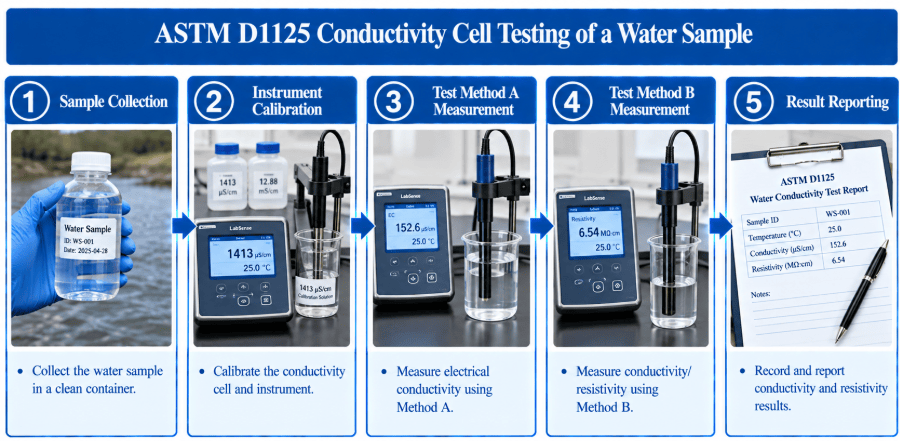
Under Test Method A, the technician places the conductivity cell in a static water sample and measures electrical resistance; under Test Method B, the technician sets up a flow-through conductivity cell in a process line and measures the water’s electrical resistance as it passes through the cell. They then use the cell constant and temperature correction to determine the conductivity in µS/cm or resistivity in ohm·cm at the standard reference temperature of 25°C.
| Sample Collection | Technicians collect representative water samples following applicable sampling practices. They protect samples from atmospheric exposure to prevent changes in dissolved gas content. |
| Instrument Calibration | Technicians calibrate the conductivity cell and meter using certified reference materials. They verify the cell constant at the specified temperature. |
| Test Method A Measurement | Technicians immerse dip-type or pipet-type cells in static samples with conductivities greater than 10 μS/cm. They control and correct for temperature. |
| Test Method B Measurement | Technicians use flow-through cells for continuous in-line measurement of flowing samples with conductivities from 5 to 200,000 μS/cm. |
| Result Reporting | Analysts calculate conductivity and resistivity from the measured resistance and the cell constant, and they record the corrected values. Laboratories report conductivity in μS/cm or resistivity in Ω·cm at 25 °C in SI units. |
ASTM D1125 Testing Process and Data Collection
Testing starts when the technician takes a static water sample using the appropriate sample collection practice, or mounts a flow-through cell within a continuous process stream. The technician then puts the calibrated conductivity cell into the sample and passes a known quantity of electricity through the sample, measuring the conductivity in response. The technician takes a sample temperature measurement and applies the correct temperature calibration because conductivity is very sensitive to temperature. The instrument/technician then measures conductivity in the units of microSiemens per cm and the resistivity in the units of ohm per cm based upon the cell constant and temperature-corrected resistance. Last, the analyst notes the correct conductivity and resistivity measurements at the standard temperature of 25°C.
Common Challenges and Troubleshooting
When technicians use an unshielded cell on high-resistivity water, electrical pickup frequently distorts readings; low-conductivity samples are especially susceptible to interference. If technicians do not platinize or condition the cell properly for the sample type, contaminated or improperly prepared electrodes result in inaccurate readings due to the sharp increase in the temperature coefficient as conductivity decreases below 5 µS/cm. Laboratories overcome these problems with the use of shielded cells for high-purity water, with accurate temperature correction, and with conditioning electrodes prior to testing based on material.
ASTM D1125 Analysis Results and Interpretation
The laboratory reports summarize the measured electrical conductivity (EC) and resistivity (R) of the sample of tested water. ASTM D1125 covers the ionic content and water purity rather than a general overall material-performance rating.
- The conductivity is reported in units of µS/cm with the resistivity reported in ohm·cm. Both are at a standard reference temperature of 25°C.
- The technician determines the type of water being tested, such as natural, treated, industrial, boiler, cooling, brackish, or saline water.
- The analyst takes note of the resistance value for the cell under the conditions of cell and temperature and then compares the result to the tested water and the purpose of the water.
- The engineer takes into account sample temperature, cell type, and electrode preparation when analyzing conductivity and resistivity data.
- Engineers use the measured conductivity and resistivity values to aid in water quality monitoring and contamination detection decisions.
Get Certified ASTM D1125 Testing for Reliable Water Purity Analysis
Certification verifies adherence to ASTM D1125 standards, which outline acceptable conductivity and resistivity for the sample of water in its intended application. ASTM D1125-certified testing determines the ionic content and purity levels of a water sample before facilities accept it for drinking water distribution, boiler feedwater, or industrial process applications. Testing and certification confirm compliance with the requirements of ASTM D1125 and help to reduce the risk of contamination failures in the system.
FAQ
Updated on September 16, 2026


Project Today
specialized laboratories ready to deliver results