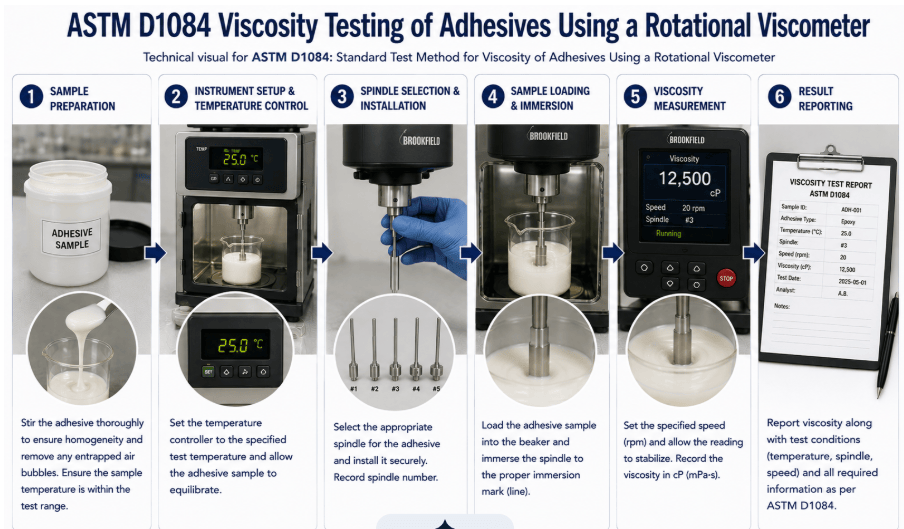
This ASTM D1084 standard defines the viscosity of free-flowing adhesives through four different related methods. It measures the flow characteristics of a self-leveling, Newtonian or near-Newtonian adhesive under controlled shear or flow. This standard outlines a test method for determining the viscosity of an adhesive measured from a flow cup or a rotational viscometer, depending on the adhesive’s expected flow range. The main use of ASTM D1084 is to determine the viscosity of free-flowing adhesives to obtain repeatable and comparable results from different batches. Industries use this test for quality control, formulation tuning, application-method selection, and supplier qualification. The scope of ASTM D1084 includes:
- Product category: Free-flowing, self-leveling adhesives having Newtonian or near-Newtonian flow.
- Applications: For quality control and formulation, adhesive viscosity must be quantified.
- Property measured: Viscosity (resistance to flow) of the adhesive.
- Methods: Testing consists of conditioning an adhesive sample and measuring its flow through a calibrated flow cup (Method A), or its resistance to controlled shear in a rotational viscometer (Methods B, C and D).
- Result: Viscosity is reported in Pa·s or mPa·s (SI units)
- Test Limitations: The standard excludes thixotropic and plastic adhesives, but ASTM D2556 includes them.
- Environmental conditions: The sample temperature has an effect on the measured viscosity and is to be controlled during the test.
- Applications: Adhesive quality control, formulation and additive comparison, application-equipment selection, supplier qualification.
What are the Uses of ASTM D1084 Testing?
ASTM D1084 testing can assist manufacturers in ensuring the flow behavior of an adhesive is appropriate for the intended application (brush, roller, spray, or automatic dispensing). In addition, uniform viscosity measurements facilitate formulation and incoming material quality control. This standard –
- Assists with quality control between production batches.
- Helps formulators make comparisons between viscosity modifiers and additives.
- Assesses a product’s conformance to purchase order specifications.
- Helps select suitable application equipment for a given viscosity range.
- Provides written proof of supplier qualification.
What Materials Can Be Tested Under ASTM D1084?
ASTM D1084 applies to free-flowing, self-leveling adhesives with Newtonian or near-Newtonian flow. Solvent-based, water-based, and synthetic resin adhesives in laminate, sealant, and structural bonding are common types of adhesives tested in laboratories.
Why is ASTM D1084 Important?
ASTM D1084 provides manufacturers with a method to assure that an adhesive is compatible with the intended application method-whether by brush, roller, spray, or automated dispensing. Viscosity variation may lead to inadequate substrate wetting, coating uniformity, or weak bonding, and undetected batch-to-batch viscosity variation poses a true production risk. ASTM D1084 testing allows laboratories to protect bonding performance before the batch reaches a customer, minimize rework, and aid formulation decisions for packaging, construction, and automotive applications.