
ASTM D1076 Standard Specification for Rubber-Concentrated, Ammonia Stabilized, Creamed, and Centrifuged Natural Latex

    What is ASTM D1076? 

    ASTM D1076 outlines a standard specification for concentrated, ammonia-stabilized, creamed, and centrifuged natural rubber latex. It specifies the requirements for first-grade concentrated natural rubber latex and defines five categories based on latex type, stabilization method, and treatment. 

    Read more

    Category 1 refers to centrifuged Hevea natural latex stabilized only with ammonia. Category 2 covers creamed Hevea natural latex stabilized only with ammonia. Category 3 is centrifuged Hevea natural latex stabilized with low ammonia. Category 4 covers centrifuged or centrifuged-and-creamed guayule latex, or other natural rubber latex, containing less than 200 μg of total protein per gram of dry weight of latex, when treated with ammonia or another hydroxide. Category 5 covers centrifuged Hevea natural latex treated with aluminum hydroxide or by other means, and stabilized with ammonia only, containing less than 0.5% non-rubber content. The specification also identifies analytical procedures for the specified properties. These procedures cover sampling, total solids, dry rubber content, protein content, total alkalinity, viscosity, sludge content, coagulum content, KOH number, pH, mechanical stability, copper and manganese, density, volatile fatty acids, boric acid, and dry films.

    Get Certified ASTM D1076 Testing for Natural Latex Quality

    Natural latex manufacturers require uniformity in material properties to manufacture and control the product. ASTM D1076 (Standard Specification for Rubber—Concentrated, Ammonia Stabilized, Creamed, and Centrifuged Natural Latex) establishes requirements and analytical procedures for laboratories to assess concentrated natural latex. The standard identifies specified analytical procedures that laboratories may use for production control or referee purposes. Testing helps manufacturers monitor important latex characteristics and compare results with the applicable requirements.
    What is the scope of ASTM D1076?

    ASTM D1076 specifies requirements for first-grade concentrated natural rubber latex in five categories. 

    Read more

    • Covers creamed Hevea natural latex stabilized with ammonia only. 
    • Covers centrifuged Hevea natural latex stabilized with low ammonia.
    • Covers centrifuged or centrifuged-and-creamed guayule latex or other natural rubber latex containing less than 200 μg of total protein per gram of dry weight of latex with ammonia or other hydroxide.
    • Covers centrifuged Hevea natural latex treated with aluminum hydroxide or by other means stabilized with ammonia only, containing less than 0.5 % non-rubber content.
    • Applies to natural latex sources other than Hevea brasiliensis but does not apply to compounded latex concentrates.

    What are the Uses of ASTM D1076 Testing? 

    ASTM D1076 provides requirements and analytical procedures for assessing concentrated natural rubber latex and controlling key material properties. The standard identifies analytical procedures that laboratories can use for production control or referee purposes. 

    • Evaluates concentrated natural rubber latex. 
    • Supports production quality control. 
    • Helps manufacturers compare latex batches. 
    • Evaluates chemical and physical properties. 
    • Supports raw-material quality evaluation. 
    • Helps identify variations in latex properties. 
    • Provides standardized analytical procedures.

    What Materials Can Be Tested Under ASTM D1076? 

    ASTM D1076 applies to first-grade concentrated natural rubber latex that meets one of the five categories defined in the specification. These are Hevea natural latex, specified guayule latex, and other natural rubber latex included in the requirements.

    Why is ASTM D1076 Important? 

    ASTM D1076 provides uniform specifications for concentrated natural rubber latex. Laboratories can use their analytical procedures to evaluate multiple chemical and physical properties. Manufacturers can compare their test results with the applicable requirements and monitor production quality.

    ASTM D1076 Equipment and Sample Preparation Guide

    ASTM D1076 documents several analytical methods, and laboratories select equipment based on the property being measured. Analytical equipment and procedures to be employed by technicians should be suitable for each property.

    Read more

    Sample and Specimen DetailsTechnicians collect representative concentrated natural latex samples for the required analyses.
    Specimen PreparationTechnicians prepare representative latex samples according to the applicable analytical procedure for the property being evaluated.
    Specimen DimensionsASTM D1076 evaluates liquid latex concentrates rather than fixed-size solid specimens.
    InstrumentationAnalysts use appropriate equipment for the applicable analytical procedures, including measurements of total solids, dry rubber content, viscosity, pH, density, mechanical stability, copper and manganese, volatile fatty acids, boric acid, and other specified properties.

    ASTM D1076 Testing Procedure and Requirements 

    ASTM D1076 provides guidelines for five categories of first-grade concentrated natural rubber latex. The specification also identifies the analytical procedures that laboratories use to evaluate the specified properties. ASTM D1076 includes analytical procedures for sampling, total solids, dry rubber content, protein content, total alkalinity, viscosity, sludge content, coagulum content, KOH number, pH, mechanical stability, copper and manganese, density, volatile fatty acids, boric acid, and dry films. 

    Read more

    PropertyPurpose of Evaluation
    Total SolidsAnalysts determine the total solids content of the latex.
    Dry Rubber ContentDetermines the dry rubber content of the latex.
    Protein ContentDetermines the protein content.
    Total AlkalinityEvaluates the total alkalinity of the latex.
    ViscosityDetermines latex viscosity.
    Sludge ContentDetermines the sludge content.
    Coagulum ContentDetermines the coagulum content.
    KOH NumberDetermines the KOH number.
    pHDetermines the pH of the latex.
    Mechanical StabilityEvaluates latex stability during mechanical action.
    Copper and ManganeseDetermines copper and manganese content.
    DensityEvaluates latex density.
    Volatile Fatty AcidsDetermines volatile fatty acid content.
    Boric AcidDetermines boric acid content (if applicable).
    Dry FilmsEvaluates specified properties of dry latex films

    ASTM D1076 Testing Process and Data Collection

    Technicians first take representative specimens of concentrated natural latex, then select appropriate analytical methods based on the properties being evaluated. Technicians measure the required characteristics and record the results. Technicians then compare the measured values with the applicable requirements for the relevant latex category.  

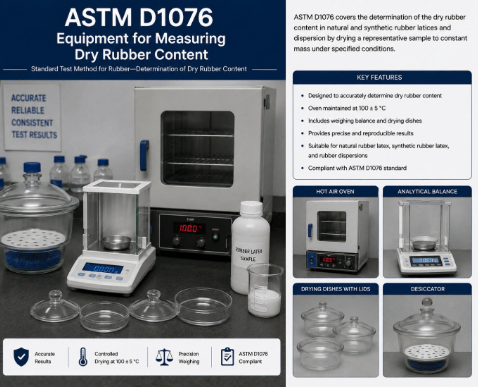
    This image shows laboratory equipment used to determine dry rubber content in natural and synthetic rubber latex as per ASTM D1076.
    ASTM D1076 Analytical Balance

    ASTM D1076 Common Challenges and Troubleshooting

    Natural latex may contain variations in solids, rubber content, viscosity, pH, coagulum, sludge, and mechanical stability. Technicians can reduce sampling errors by collecting representative samples and following the applicable analytical procedure. Laboratories can also maintain their equipment and investigate unusual results before making quality-control decisions.

    ASTM D1076 Analysis Results and Interpretation

    • ASTM D1076 specifies analytical procedures for determining multiple latex characteristics rather than a single property. 
    • Laboratories report each property using the appropriate measurement units and compare the results with the applicable requirements.
    • The content of total solids, dry rubber, protein, viscosity, pH, mechanical stability, sludge, coagulum, density, copper, manganese, volatile fatty acids, boric acid, and dry-film properties can be evaluated. 
    • Manufacturers use these results to compare production batches, identify material variations, and determine whether the latex meets the applicable specification requirements.  

    Link to ASTM D1076

    Read more

    Updated on August 18, 2026

    Laraib Hashmi
    About Author
    Laraib Hashmi is an aspiring research enthusiast and science content professional with a strong interdisciplinary skill set, holding a postgraduate degree in Applied Microbiology from KIIT Bhubaneshwar, Odisha.
    Know More
    Testimonials
    Real results
    Engineers trust us with what matters most
    Start Your Testing
    Project Today
    Define your requirements and get access to
    specialized laboratories ready to deliver results
    Partners with us
    Clients
    Vendors
    Process for testing
    • STEP 01

      You share your testing requirements

    • STEP 02

      You share your sample(s)

    • STEP 03

      We deliver your test reports

    Get your testing done

    Let us know your testing requirements and we will be right back with a solution.

      Let us root for each other. Collaborate to grow, expand, and accelerate our businesses.

      Partner with us

        Discover more from Matestlab

        Subscribe now to keep reading and get access to the full archive.

        Continue reading