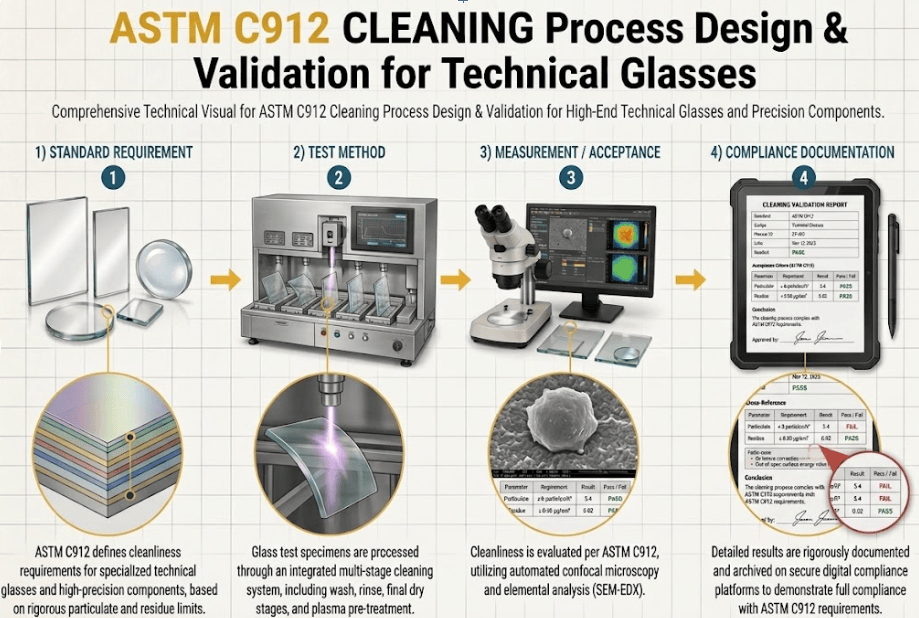
ASTM C912 outlines a standard practice for designing a rational cleaning process for technical glasses that can react with many aqueous chemical solutions. Technical glass products sometimes require controlled surface cleanliness because residues, particles, oils, or other contaminants can affect subsequent manufacturing processes or product performance. The practice considers contaminant type, glass composition, and the cleaning agent, temperature, mechanical action, rinsing, and drying. Manufacturers can use these factors to define a cleaning process that eliminates contaminants without damaging the glass surface. ASTM C912 (Standard Practice for Designing a Process for Cleaning Technical Glasses) recognizes that many technical glasses contain soluble or reactive oxides that can react with aqueous cleaning chemicals. Therefore, the practice helps users develop cleaning processes that leave the glass suitable for its intended application.
Get Certified ASTM C912 Testing for Reliable Technical Glass Cleaning Evaluation
ASTM C912 provides a systematic procedure for creating and testing cleaning methods for technical glass products. Laboratory and production evaluations may assist manufacturers in selecting the appropriate cleaning chemical, operating parameters, and cleaning method for specific glass applications. ASTM C912 process development aids in quality assurance, process optimization, contamination control, product qualification, and manufacturing consistency. The method can also be applied to develop clean-up processes for special glass parts and precision applications.