
ASTM C867 Standard Test Method for Soluble Sulfate in Ceramic Whiteware Clays (Photometric Method)

    What is ASTM C867?

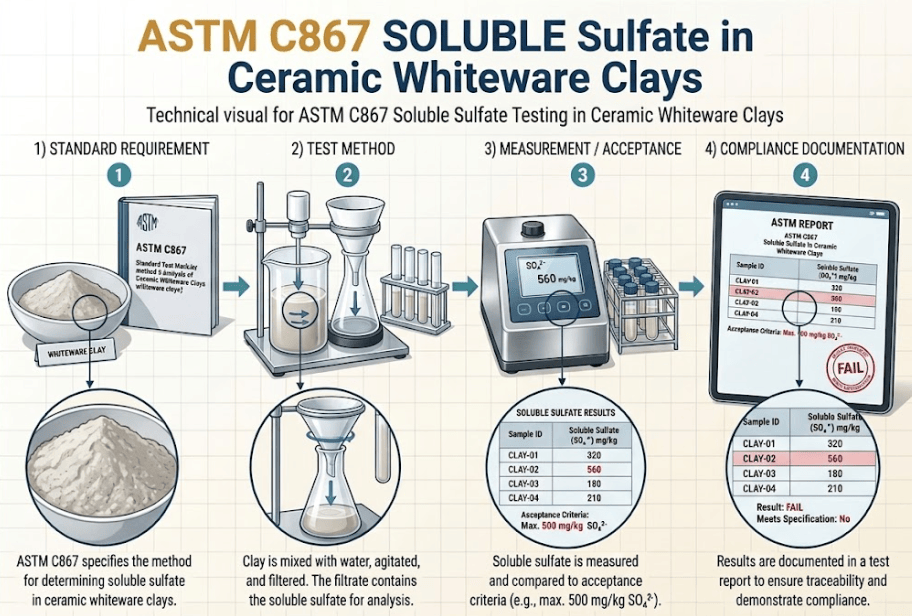
    ASTM C867 describes a standard test method for determining soluble sulfate ions in ceramic whiteware clays using a photometric method. This test determines soluble sulfate by measuring the turbidity produced by precipitated barium sulfate. Technicians mix the clay following a prescribed procedure and leach soluble sulfate out with water during mixing. Afterward, they apply the filter-pressing method to obtain the appropriate filtrate and then measure the photocurrent. ASTM C867 provides a standardized procedure for determining and comparing soluble sulfate in ceramic whiteware clays under controlled laboratory conditions. ASTM C867 (Standard Test Method for Soluble Sulfate in Ceramic Whiteware Clays (Photometric Method) is a standard test method for determining soluble sulfate ions in ceramic whiteware clays using a photometric method. ASTM C867 testing provides quantitative control data for soluble sulfate by a controlled photometric method.

    Read more

    Get Certified ASTM C867 Testing for Reliable Soluble Sulfate Evaluation

    ASTM C867 tests provide control data for evaluating soluble sulfate in ceramic whiteware clays. A laboratory test may help manufacturers track clay processing characteristics and compare materials under the same test conditions. Where relevant to ceramic whiteware clay operations, ASTM C867 testing can support quality control and process monitoring. The results assist laboratories in determining differences in ammonium sulfate content of clay and processing methods.
    What is the Scope of ASTM C867 Test Standard?

    ASTM C867 determines soluble sulfate ions present in water or filtrate by measuring the turbidity produced by precipitated barium sulfate with a photometer. This standard-

    Read more

    • Determines soluble sulfate ions present in water or filtrate from ceramic whiteware clays.
    • Measures turbidity produced by precipitated barium sulfate.
    • Provides a procedure for standardizing the photometer used during testing.
    • Assesses the amount of soluble sulfate that is removed from a clay or clay-water material by leaching with water and filtering.
    • Assists with control testing of soluble sulfate in ceramic whiteware clays.
    • Does not provide a complete quantitative analysis of all sulfate ions in the clay.

    What is the Use of ASTM C867 Testing?

    ASTM C867 helps ceramic manufacturers monitor soluble sulfate associated with ceramic whiteware clays. The test provides control data that help laboratories compare clay materials and monitor soluble sulfate during clay processing. The findings can be used by the manufacturers to detect differences in soluble sulfate when the conditions in a laboratory remain the same.

    • Ceramic manufacturers can use soluble sulfate data to monitor whiteware clay-processing characteristics.
    • Sanitaryware manufacturers can test the soluble sulfate characteristics of ceramic clay raw materials.
    • Tableware manufacturers can compare the soluble sulfate properties of clay materials.
    • Research laboratories can study soluble sulfate behavior during clay-water processing.
    • Clay suppliers can track the soluble sulfate properties of clay batches.
    • Quality control laboratories can use soluble sulfate measurements for process monitoring and material comparison.

    What Materials Can Be Tested Under ASTM C867?

    ASTM C867 is used to test ceramic whiteware clays and clay-water mixtures from which soluble sulfate can be leached into water. The method determines the quality of the resulting water or filtrate by a photometric method using turbidity formed by precipitated barium sulfate.

    Why is ASTM C867 Important for Soluble Sulfate Evaluation?

    ASTM C867 provides a standardized approach to assessing the soluble sulfate content of ceramic whiteware clays. Data from reliable control tests can be used to compare clay characteristics and detect changes in soluble sulfate content during processing. A standardized photometric procedure also facilitates the consistency of the testing conditions in the laboratories.

    ASTM C867 Equipment and Sample Preparation Guide

    Engineers use representative ceramic whiteware clay samples and suitable equipment for sample preparation, filtration, and photometric measurement. Controlled test conditions and standardized sample preparation increase the reliability of the results for soluble sulfate.

    Read more

    Specimen DetailsCeramic whiteware clays prepared for water leaching, filtration, and subsequent photometric determination of soluble sulfate.
    Specimen PreparationTechnicians prepare representative clay samples according to the specified procedure, then mix them with reagent-grade water.
    Specimen DimensionsASTM C867 tests the soluble sulfate content of water or filtrate, not a standard, dimensioned solid sample.
    InstrumentationThe test apparatus includes a balance, high-speed mixer, filter press, glass beakers or Erlenmeyer flasks, transfer pipettes, spectrophotometer and accessories, measuring spoon, and other laboratory equipment.

    Testing Procedures and Requirements for Soluble Sulfate Evaluation

    ASTM C867 is a photometric test method for determining soluble sulfate in ceramic whiteware clays. Reliable and comparable results are achieved with proper sample preparation, controlled leaching and filtration, suitable reagents, and accurate photometric measurements.

    Read more

    Specimen PreparationTechnicians take representative samples of clay used in the production of ceramic whitewares and prepare the sample to meet the requirements of the test procedure.
    Sample ConditioningAnalysts mix the prepared clay with reagent-grade water to leach out soluble sulfate from the clay into the aqueous phase.
    Test Apparatus SetupTechnicians set up the high-speed mixer, filter press, glassware, pipettes, and photometric equipment before testing.
    Filtration ProcedureAnalysts prepare a clay-water slurry, feed it into the filter press, and apply the desired filtration conditions to obtain the filtrate.
    Soluble Sulfate ReactionThey then treat the filtrate with the specified reagents to precipitate barium sulfate.
    Photometric MeasurementThe operator uses the photometric equipment to determine the turbidity that is created by the precipitated barium sulfate.
    Data Collection and Result AnalysisEngineers document the specimen identification, sample preparation, filtration conditions, photometric measurements, and other observations that are needed to assess the test results. Analysts use the collected photometric data to measure soluble sulfate based on ASTM C867.
    Documentation and ReportingLaboratory reports contain the specimen identification, sample preparation, test conditions, photometric measurements, soluble sulfate result, equipment information, and ASTM C867 test details.

    ASTM C867 Testing Process and Data Collection

    The first step in testing is to select an appropriate representative sample of ceramic whiteware clay and prepare it according to the set procedure. Technicians adjust the prepared clay to dissolve only soluble sulfate, which is soluble in water. They then filter out the clay-water material and obtain the relevant filtrate for photometric analysis. Analysts add the specified reagents to the filtrate and measure the turbidity caused by the precipitated barium sulfate.

    The image shows laboratory equipment used to extract and analyze soluble sulfate from a ceramic whiteware clay sample according to ASTM C867.
    ASTM C867 Soluble Sulfate Testing of Ceramic Whiteware Clay

    Common Challenges and Troubleshooting

    Inaccuracies can arise from inconsistent clay preparation, inadequate mixing, contamination, unsuitable reagents, filtration errors, or inaccurate color measurement. Repeatability can be improved by using appropriate samples, clean equipment, handling of the reagents, consistent filtration, and controlled photometric measurements.

    Analysis Results and Interpretation

    • The laboratory reports the soluble sulfate concentration in mg/L, based on the turbidity produced by precipitated barium sulfate and the applicable calibration or control procedure.
    • The analyst measures turbidity photometrically, with higher turbidity indicating more barium sulfate formed under the same test conditions.
    • The laboratory evaluates the soluble sulfate released into the water or filtrate and uses the result to indicate the sulfate extracted from the clay by the specified leaching procedure.
    • The analyst considers factors such as clay composition, water leaching, mixing, filtration, reagent conditions, and photometer operation when interpreting variations in the results.
    • Engineers compare results under controlled conditions to support evaluation of ceramic whiteware clay materials and their suitability for specific processing requirements.

    Link to ASTM C867

    Read more

    FAQ

    Why is ASTM C867 important?
    ASTM C867 is important because it provides a standard way to test the soluble sulfate content of ceramic whiteware clays. The method is used for comparison of clay materials in the laboratory and for the monitoring of soluble sulfate under controlled conditions.
    ASTM C867 is a test method used to determine the presence of soluble sulfate ions in water or filtrate from ceramic whiteware clays. The method is based on the turbidity caused by barium sulfate precipitation, measured with a photometer.
    ASTM C867 determines turbidity from precipitated barium sulfate in the prepared water or filtrate. The data from the photometric measurement is used to assess soluble sulfate from ceramic whiteware clays.

    Updated on September 1, 2026

    Gokula Srinivasan Selvam
    About Author
    Gokula Srinivasan Selvam is a Material Testing Associate at Matestlab Inc. and holds a postgraduate degree in Ceramic Engineering from IIT (BHU), Varanasi. His academic background and professional experience are centered on advanced ceramic materials, their processing, characterization, and performance evaluation.
    Know More
    Testimonials
    Real results
    Engineers trust us with what matters most
    Start Your Testing
    Project Today
    Define your requirements and get access to
    specialized laboratories ready to deliver results
    Partners with us
    Clients
    Vendors
    Process for testing
    • STEP 01

      You share your testing requirements

    • STEP 02

      You share your sample(s)

    • STEP 03

      We deliver your test reports

    Get your testing done

    Let us know your testing requirements and we will be right back with a solution.

      Let us root for each other. Collaborate to grow, expand, and accelerate our businesses.

      Partner with us

        Discover more from Matestlab

        Subscribe now to keep reading and get access to the full archive.

        Continue reading