MaTestLab > ASTM Methods > Ceramics > ASTM C67 Standard Test Methods for Sampling and Testing Brick and Structural Clay Tile
Last updated 19th October 2025
ASTM C67 Standard Test Methods for Sampling and Testing Brick and Structural Clay Tile
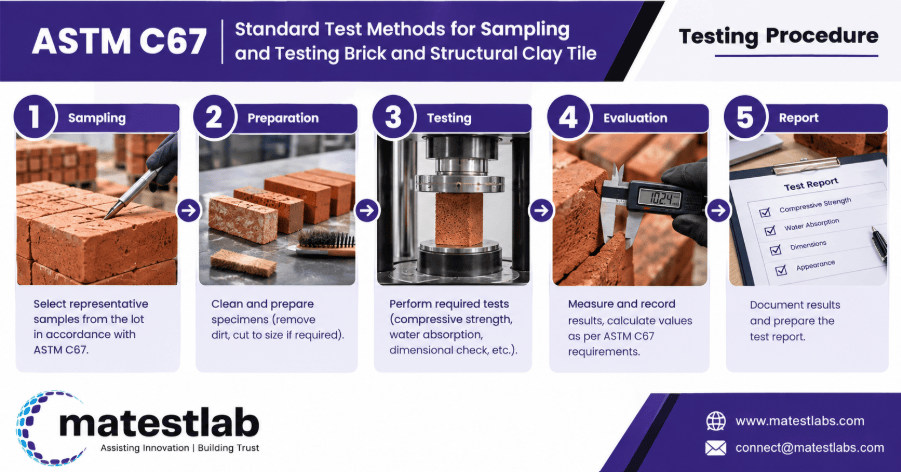
The standard might in principle encompass various ways for testing the physical properties of brick and structural clay tile. This, therefore, incorporates a whole array of materials, testing procedures, and properties considered for assessing compressive strength and absorption, efflorescence, and freeze-thaw resistance. The evaluations mentioned are very much required for the acceptance or rejection of a given material based on the accepted construction standards for the envelope, pavements, and lodging walls. The use of the standard by manufacturers, engineers, and construction professionals is primarily to determine compliance with project specifications and building codes.
Read More
GET STARTED
ASTM C67 Introduction
Indeed, the actions that are performed according to this article play a significant role in the quality control aspect of masonry products, for standardized procedures for testing bricks and structural clay tiles. The significance of these materials in structural and aesthetic construction elements invites stringent performance criteria that consider safety and durability. The performance criteria that should be encompassed under this method continue the appraisal of several properties for their direct applicability to use performance that has been developed there including moisture absorption, compressive behavior, and dimensional uniformity assessment.
ASTM C67 Test Method
Water Absorption
Evaluates the amount of water absorbed by a dry brick after immersion.
Efflorescence
Detects the presence of soluble salts that can discolor brick surfaces.
Saturation Coefficient
Compares absorption under boiling and 24 hour cold water immersion.
Freeze Thaw Resistance
Assesses the durability of bricks in environments with freeze thaw cycles.
ASTM C67 Equipment and Sample Preparation
Specimen Details
Bricks or structural clay tiles must be representative of production batches.
Specimen Dimensions
Standard brick size units or as specified in the purchase order for special shapes.
Specimen Preparation
Clean, dry units conditioned at standard laboratory humidity and temperature before testing.
ASTM C67 Results and Interpretation
These results yield a comprehensive overview of the brick’s structural integrity and environmental performance. High compressive strength naturally denotes great load-bearing capacity, while low water absorption implies better freeze-thaw durability and weather resistance. Negations for efflorescence mean little salt migration, therefore enhancing long-term visual appeal. Variations in dimensional uniformity may affect construction precision and aesthetics. Therefore, the cumulative interpretation of these parameters guides the acceptance and suitability of the material for specific applications. All these strengthening, absorption, and efflorescence data help enable the engineers, architects, and quality inspectors to determine the applicability of the material in the area in which it is intended to be used.
Service Name
Remarks
ASTM C67 Testing
Contact US
ASTM C67 Related Tested Methods
ASTM C216 determines facing brick specifications. ASTM C652 performs the classification and performance of hollow brick. ASTM C140 also describes parallel testing methods for concrete masonry units, and therefore, products made of clay and concrete can be compared. Other related standards, including those of ASTM C126 of ceramic glazed facing units and ASTM C902 of paving brick, are also related.
ASTM C67 Applications and Industry Use
It is an essential test method for civil engineering, building construction, and architectural design. It supports specification conformance under residential and commercial masonry walls, facades, paving, and fire-rated construction. Public infrastructure projects, such as bridges and historical preservation designs, depend on this test to evaluate legacy and new materials. This method is used by manufacturers in developing products and in routine quality control. Regulatory agencies also reference it in code compliance reviews. Government agencies and regulatory bodies also use ASTM C67 as a reference in building code compliance and purchase specifications.
Materials Commonly Tested
ASTM C67 test procedures are applied to a massive range of fired-clay masonry units, including ordinary building bricks, face bricks, pavers, hollow clay tiles, and structural clay blocks. These are composed of natural clay, shale, or other earthen matter, which is fired under high temperature. The methods also apply to clay in the form of hand-molded units, machine-molded units, and extruded and pressed units of clay used in construction and architectural projects.
ASTM C67 Common Challenges and Troubleshooting
Differences in brick composition, poor curing, or inconsistent selection of test samples may lead to anomalies in testing. Conditioning also can affect the absorption results. Specimens that have misalignments or cracks will affect the results of the compression tests. Therefore, sample uniformity and calibration of test machines help to minimize such variations that are detrimental to the reliability of results.
ASTM C67 Safety and Best Practices
Operators should observe standard laboratory safety practices when using mechanical compression machines and water immersion processes. This includes wearing protective eyewear and gloves. Special care should be exercised when handling heavy or irregularly shaped bricks. Test equipment must be subject to regular maintenance and calibration to ensure the machine’s accuracy and proper functioning.
ASTM C67 Importance
This method serves to safeguard construction quality by defining the critical physical and mechanical properties of masonry materials. Not only does it assure architects and engineers regarding the reliability of the materials chosen, but it also helps manufacturers maintain performance standards. Moreover, this is indispensable for the building industry as it makes it part of safety compliance codes, especially load-bearing and exposed structures.
Related
FAQ's
Where can I get the astm c67 tested?
You can share your astm c67 testing requirements with MaTestLab. MaTestLab has a vast network of material testing laboratories, spread across the USA and Canada. We support your all material testing needs ranging from specific astm c67 test to various testing techniques.
How much do I need to pay for the astm c67 test?
Please contact us for a detailed quote for your astm c67 testing needs. Cost incurred to carry out different astm c67 testing methodology depends on the type of raw material; number of samples, coupons, or specimens; test conditions, turn around time etc. Costs of some ASTM testing methods start from $100 and the final value depends upon the factors listed above. Please contact us for the best and latest prices.
How many samples are required for astm c67?
The required number of samples or specimens should comply with the procedure given in the astm c67 standard. However, the MaTestLab operations team can assist you for your special requirements once you share your testing details with us.
How much discount can I get on the astm c67 test?
MaTestLab has a vast testing laboratory network, hence we bring you the best testing facilities in a cost-effective way. We offer considerable discounts (15-20%) to our returning customers based on test volume and frequency.
How many days will it take to complete the astm c67 test?
The turnaround time for astm c67 test methodology depends upon the test procedure mentioned in the standard test document. However, we at MaTestLab understand your research requirements and hence try to get your test completed within the least possible time.
Where can I get the astm c67 tested?
You can share your astm c67 testing requirements with MaTestLab. MaTestLab has a vast network of material testing laboratories, spread across the USA and Canada. We support your all material testing needs ranging from specific astm c67 test to various testing techniques.
MaTestLab Inc. offers accessible, quick, and affordable material testing, product testing, and failure analysis services. We support your on-demand testing and expert consultation needs with the help of our extensive network of material testing laboratories situated in the US and other parts of the world.
MATERIAL TESTING
We offer destructive and non-destructive tests over a range of mechanical, electrical, chemical, thermal, optical, corrosion, radiation, and biological testing methodologies defined by ASTM, ISO and other organizations.
PRODUCT TESTING
We help you evaluate and ensure your product quality and performance with standard and custom-made testing solutions. All the tests are done at well-equipped testing laboratories using standard testing methods for best output and satisfaction.
FAILURE ANALYSIS
Failure analysis ensures high levels of quality in every manufacturing process. We help you with getting the best failure or root cause analysis to determine the cause of the failure. The results help you identify means to prevent failure recurrences.