ASTM C657 Standard Test Method for D-C Volume Resistivity of Glass
What is ASTM C657?
ASTM C657 is a standard test method for determining the direct-current (d-c) volume resistivity of smooth, preferably polished glass. The method determines the resistance of glass under a small direct current under steady-state conditions and applies a voltage that is adequate for measurement sensitivity. In a controlled heating chamber, analysts test the glass from roughly room temperature until the glass melts at the annealing point. This method reduces space-charge accumulation, polarization effects, and surface-conductance errors. ASTM C657 (Standard Test Method for D-C Volume Resistivity of Glass) provides resistivity values below 10¹⁶ ohm cm and applies to the electrical characterization of glass for insulating and electrical applications.
Get Certified ASTM C657 Testing for Reliable Volume Resistivity Evaluation
The ASTM C657 test method measures the d-volume resistivity of glass under specified electrical and temperature conditions. Technicians prepare a smooth specimen of glass and mount it in a controlled heating chamber with appropriate electrical shielding and insulation. Technicians measure a steady-state current, resistance, and volume resistivity of the specimen. Accurate resistance measurement, stable temperature control, correct specimen geometry, and surface conductance and polarization control are essential for reliable results.
What is the scope of ASTM C657?
ASTM C657 covers the determination of d-c volume resistivity of smooth, preferably polished glass by measuring its resistance to the passage of a small direct current. The test uses a voltage high enough to provide adequate measurement sensitivity and requires measurement under steady-state conditions. The method applies to volume resistivities below 10¹⁶ Ω·cm over a temperature range from 25°C to the annealing point of the glass. The scope of ASTM C657 includes:
Material: Smooth, preferably polished glass specimens for electrical resistance measurement.
Objective: To measure the d-volume resistance of glass under controlled electrical and temperature conditions.
Property measurement: D-volume resistivity (Ω·cm)
Method: Measure the steady-state direct current through the glass at an appropriate applied voltage and find the volume resistivity from the measured resistance and specimen geometry.
Result: Provides the volume resistivity of the glass at the specified test temperature.
Test limitations: The method applies to resistivities less than 10¹⁶ Ω·cm, and polarization, space-charge effects, surface conductance, specimen condition, and temperature are all controlled.
Environmental conditions: Technicians adjust the temperature of the specimens to about 25°C and up to the annealing point while providing proper electrical shielding, insulation, and temperature stability.
Applications: Electrical insulation evaluation, glass material characterization, research, quality control, and assessment of glass for electrical applications.
What are the uses of ASTM C657 testing?
ASTM C657 testing allows laboratories to measure the electrical insulating properties of glass over a determined temperature range. Engineers can use these results to compare various glass compositions and estimate the effect of temperature on electrical resistivity. This standard-
Determines the d-c volume resistivity of glass.
Provides support for electrical and insulating material characterization.
Helps compare the electrical behavior of different glass compositions.
Evaluates resistivity as a function of temperature.
Supports research and development of glass for electrical applications.
Provides data for quality control and material-performance studies.
ASTM C657 applies to a smooth glass specimen, preferably polished, and suitable for the electrical contacts and measurement arrangement required. The specimen should have suitable dimensions and a controlled surface condition so analysts can obtain reliable resistance measurements. Technicians should minimize surface contamination and other conditions that can introduce surface-conductance effects.
Why is ASTM C657 important?
ASTM C657 specifies a controlled method for determining d-volume resistivity of glass beyond just electrical measurements taken at room temperature. The method uses temperature control and electrical shielding to minimize space-charge, polarization, and surface-conductance effects.
ASTM C657 Equipment and Sample Preparation Guide
ASTM C657 calls for a controlled heating chamber and electrical resistance measuring equipment. Skilled personnel should prepare the glass surface carefully and ensure that the specimen remains stable during heating and electrical measurement.
Sample and Specimen Details
Analysts use smooth, preferably polished glass specimens suitable for volume-resistance measurement.
Sample Preparation
Technicians clean and prepare the glass surface and establish suitable electrical contact while minimizing surface-conductance effects.
Specimen Dimension
The specimen geometry must support calculation of volume resistivity. The applicable dimensions depend on the test configuration and specimen arrangement.
Instrumentation
Resistance-measuring device/electrometer, controlled heating chamber or electric furnace, electrical shielding, insulated specimen leads, and suitable temperature-control equipment.
Testing Procedures and Requirements for ASTM C657
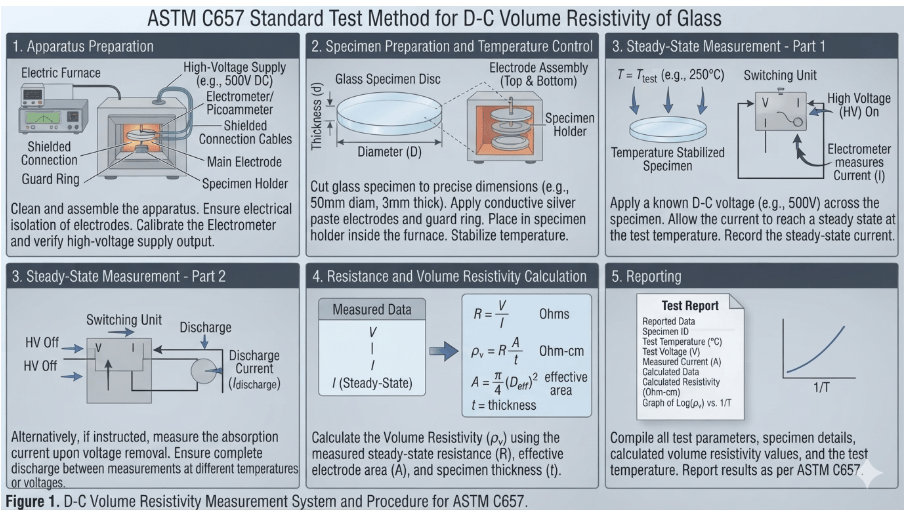
ASTM C657 is used to test the DC volume resistance of glass under a controlled heating environment. After applying the test voltage, skilled experts set up the electrical measurement system, specimen temperature, and shielding. Analysts measure the current only after the electrical response reaches the required steady-state condition. Other reference ASTM documents include D257, D374, and D1711. The complete procedure for ASTM C657 is given below:
Skilled personnel inspect the resistance-measuring system, heating chamber, electrical shielding, specimen leads, and insulation before testing.
Specimen Preparation and Temperature Control
Technicians prepare a smooth, preferably polished glass specimen and establish the required electrical connections. Analysts place the specimen in the heating chamber and establish the required test temperature between approximately 25°C and the annealing point.
Steady-State Measurement
Technicians allow the electrical response to stabilize and measure the current under steady-state conditions rather than during charging or polarization effects.
Resistance and Volume Resistivity Calculation
Analysts determine the d-c volume resistance from the measured electrical response. Skilled personnel use measured resistance and specimen geometry to determine volume resistivity in Ω·cm.
Reporting
Analysts record specimen identification, temperature, electrical measurement conditions, specimen dimensions, resistance, calculated volume resistivity, and relevant observations.
ASTM C657 Testing Process and Data Collection
Technicians set up the glass sample and the electrical measurement system inside the controlled heating chamber, place specimens at the selected temperature, and apply the required d-c voltage. Technicians record the steady-state current, and the apparatus minimizes electrical shielding, polarization, and surface-conductance effects. Analysts determine resistance from the electrical measurements and calculate volume resistivity using the specimen geometry. The laboratory maintains a record of temperature, resistance, specimen dimensions, electrical conditions, and calculated resistivity for interpretation and comparison.
ASTM C657 Testing Procedure Using Electric Furnace
Common Challenges and Troubleshooting
Accurate and reproducible results require stable temperature control, proper electrical connections, suitable specimen preparation, and reliable steady-state current measurement. The measured resistance may be influenced by surface conductance, space-charge buildup, polarization, temperature fluctuations, and inadequate electrical insulation. Technicians should ensure a clean specimen surface, check the measurement circuit, reduce electrical leakage, and ensure that the specimen is in a stable test condition before taking the measurement.
ASTM C657 Analysis Results and Interpretation
The report summarizes the d-c volume resistivity of the tested glass at the specified temperature and electrical measurement conditions. Engineers use these results to evaluate the electrical insulating behavior of the glass and compare its resistivity across temperatures, compositions, or applicable material requirements.
The laboratory records the volume resistivity in ohm·cm and the test temperature in °C.
Technicians record the measured electrical resistance or current together with the specimen dimensions and applied electrical conditions used for the calculation.
The specimen identification, test temperature, measurement configuration, and observations pertinent to the electrical measurement are documented by analysts.
Engineers compare the volume resistivity measured to the requirements of the material or product to determine the electrical insulation properties of the tested glass.
Gokula Srinivasan Selvam is a Material Testing Associate at Matestlab Inc. and holds a postgraduate degree in Ceramic Engineering from IIT (BHU), Varanasi. His academic background and professional experience are centered on advanced ceramic materials, their processing, characterization, and performance evaluation. Know More
Testimonials
Real results
Engineers trust us with what matters most
“We had a great experience working with this company for our ASTM E84 testing. They were the first company to respond to our inquiry within just a few minutes of submitting it. From start to finish, the communication was excellent, and the entire process was swift, straightforward, and hassle-free.”
Ivars FancyWalls
United States
“Very good communication, testing associates were very patient with delays on our end. Reasonable turnaround time for results and nicely detailed report. Analysts were also quick to answer any follow-up questions. Happy with results.”
Skye Henderson
United States
“Matestlab connected us with an accredited lab within days, cutting weeks off our product validation timeline.”
Rebecca Kozodoy-Pins
United States
Start Your Testing Project Today
Define your requirements and get access to specialized laboratories ready to deliver results