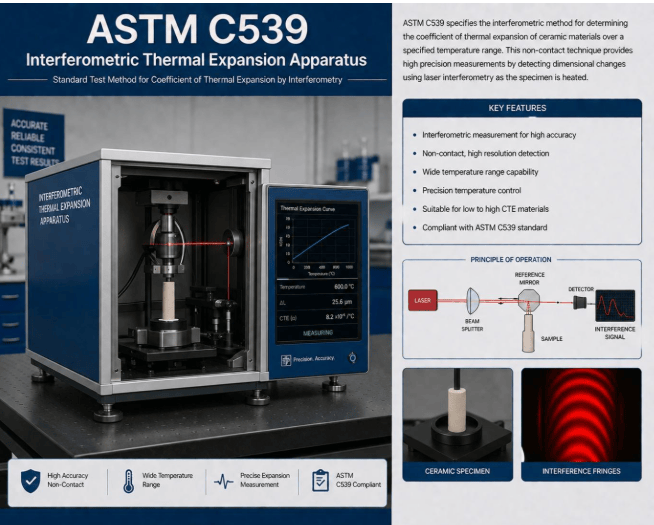
ASTM C539 provides an interferometric method for determining the linear thermal expansion of premelted porcelain enamel and glaze frits and fired ceramic whiteware materials at temperatures below 1000 °C (1830 °F). The test determines the coefficient of linear thermal expansion under controlled temperature and measures dimensional changes over controlled heating.
- Determines the linear thermal expansion of premelted porcelain enamel and glaze frits.
- Determines the linear thermal expansion of fired ceramic whiteware materials.
- Uses an interferometric method to determine linear thermal expansion.
- Determines the coefficient of linear thermal expansion.
- Supports glaze-body compatibility evaluation.
- Assists material development and quality control.
- Provides a standardized thermal expansion testing procedure.
What are the Uses of ASTM C539 Testing?
ASTM C539 helps manufacturers determine the linear thermal expansion of applicable ceramic materials during controlled heating. Manufacturers use this test for material selection, glaze formulation, quality assurance, and product development for accurate thermal expansion data.
- Determines the coefficient of linear thermal expansion.
- Supports evaluation of glaze-body thermal expansion compatibility.
- Supports porcelain enamel product development.
- Assists quality control during manufacturing.
- Compares different ceramic material formulations.
- Helps manufacturers reduce the risk of thermal stress-related failures by evaluating thermal expansion compatibility.
- Improves long-term product performance.
Which Materials Can Be Tested Under ASTM C539?
ASTM C539 covers premelted porcelain enamel and glaze frits and fired ceramic whiteware materials suitable for interferometric determination of linear thermal expansion.
Why is ASTM C539 Important?
ASTM C539 provides a standardized method to determine the linear thermal expansion of ceramic materials. The test helps manufacturers evaluate glaze-body thermal expansion compatibility and reduce defects from mismatched expansion.
Common Challenges and Troubleshooting
Proper specimen preparation, precise temperature control, and calibrated interferometric equipment are required for accurate thermal expansion testing. Common problems include rough specimen surfaces, uneven heating, alignment issues, specimen contamination, and instrument calibration errors. Technicians prepare specimens with suitable surfaces, maintain stable heating conditions, and calibrate the equipment as required to improve measurement reliability.