
ASTM C469/C469M Standard Test Method for Static Modulus of Elasticity and Poisson’s Ratio of Concrete in Compression

    What is ASTM C469? 

    ASTM C469 is a standard test method for determining the chord modulus of elasticity and Poisson’s ratio of hardened concrete under longitudinal compression. The method subjects a molded concrete cylinder or diamond-drilled core to a controlled compressive load while measuring devices record the specimen’s decrease in length and outward bulging at the sides to determine the stress and strain ratios. Contractors and technicians conduct ASTM C469 (Standard Test Method for Static Modulus of Elasticity and Poisson’s Ratio of Concrete in Compression) to obtain data on the static modulus of elasticity and Poisson’s ratio used by engineers to proportion reinforced and nonreinforced members and calculate stresses from strains. Analysts calculate the results for the age of the specimen and the curing conditions instructed by the contractor since the standard lacks a requirement for a specified age of the sample for testing.

    Read more

    Get Certified ASTM C469 Testing for Reliable Concrete Stiffness Data 

    The structural engineer must have good estimates of the stiffness of the reinforced and nonreinforced concrete members in order to make accurate size computations, as strength alone is not a good indicator of how the concrete mix will deform under load. ASTM C469 directly measures the deformation property of the concrete mix used in a project, rather than relying on an assumed value, and provides broad concrete material testing support for structural and civil engineering quality control. The ASTM C469 results are used by engineers to determine the amount of reinforcement, to calculate stress when strain is measured in the field, and to verify the behavior of a concrete mix as per design.
    What is the Scope of the ASTM C469 Test Standard?

    ASTM C469 is a test method that determines the chord modulus of elasticity and Poisson’s ratio of hardened concrete in compression. It requires subjecting a concrete specimen to a controlled compressive load while measuring devices track the reduction in height and expansion on the sides of the specimen and determining the stress and strain ratios. The main purpose of ASTM C469 is to evaluate the stiffness and deformation characteristics of concrete for the calculation of structural performance and engineering calculations. The standard includes procedures for specimen preparation, compressive loading, strain measurement, stress-strain analysis, and calculation of the chord modulus of elasticity and Poisson’s ratio. The scope of ASTM C469 includes:

    Read more

    • Material type: Hardened concrete in the form of molded cylinders and diamond-drilled cores.
    • Purpose: Determination of the chord modulus of elasticity and Poisson’s ratio of concrete under longitudinal compression.
    • Properties evaluated: Chord modulus of elasticity and Poisson’s ratio based on longitudinal and lateral strain measurements.
    • Testing method: Subjects concrete specimens to controlled longitudinal compression while measuring load, longitudinal strain, and lateral strain.
    • Results: Results include the calculated chord modulus of elasticity and Poisson’s ratio, along with relevant specimen and testing information.
    • Test limitations: ASTM C469 determines stiffness properties under the specified test conditions and does not establish a universal modulus or Poisson’s ratio value for all concrete.
    • Use conditions: Technicians conduct ASTM C469 at the specified age and curing condition instructed by the project or research plan.
    • Applications: Structural design, concrete evaluation, mix development, quality control, research, and comparison of concrete stiffness.

    What are the Uses of ASTM C469 Testing?

    ASTM C469 testing enables engineers to obtain stiffness data required to size concrete structures appropriately. Analysts use ASTM C469 data within the concrete’s working stress range to support structural property calculations. This standard-

    • Determines the modulus of elasticity and Poisson’s ratio of concrete within a working range of 0% to 40% of the ultimate strength of concrete.
    • Supports the sizing of reinforced and nonreinforced structural members.
    • Assists engineers in establishing the quantity of reinforcement a structural member requires.
    • Helps compute stress in a concrete member from field-measured strain readings.
    • Assists researchers and mix designers in comparing the stiffness of different concrete formulations.

    Which Materials Can Be Tested Under ASTM C469? 

    ASTM C469 applies to hardened concrete in the form of molded cylinders and diamond-drilled cores tested at an age and curing conditions as instructed by the project or research plan. The test method is suitable for concrete designated for structural applications since a concrete’s stiffness and strength govern the sizing of structural members. Prior to testing, the technician confirms that the specimen meets dimensional and end condition requirements and that strain measuring devices are mounted on opposite sides of the specimen to measure longitudinal and lateral deformation.

    Why is ASTM C469 Important? 

    ASTM C469 provides structural engineers with a measured value of the stiffness of concrete rather than an assumed value based on the relationship between strength and stiffness. Modulus of elasticity and Poisson’s ratio influence the manner in which a structural member deflects, cracks, and carries a load; therefore, an inaccurate assumption leads to a design that fails to respond as intended. ASTM C469 operates within a working range of 0% to 40% of the ultimate strength of concrete as a way of maintaining the accuracy of calculations of concrete stiffness.

    ASTM C469 Equipment and Sample Preparation Guide 

    ASTM C469 specifies a compression testing machine and strain measuring devices that can measure both longitudinal and lateral deformation of a concrete specimen.

    Read more

    Sample and Specimen DetailsTechnicians test hardened concrete specimens in the form of molded cylinders or diamond-drilled cores.
    Specimen PreparationTechnicians cap or grind the specimen ends flat and mount strain gauges or a compressometer-extensometer assembly on opposite sides.
    Specimen DimensionsTechnicians select a cylinder or core with a length-to-diameter ratio suited to the compression testing machine and the method’s requirements.
    InstrumentationThe system uses a compression testing machine, a load cell, strain gauges or a compressometer-extensometer device, and a data acquisition system.

    Testing Procedures and Requirements for ASTM C469 

    This test standard subjects a concrete specimen to longitudinal compression while recording strains and calculating the modulus of elasticity and Poisson’s ratio. The ASTM C469 test method comprises the following procedure-

    Read more

    Specimen PreparationTechnicians cap or grind the specimen ends and attach strain-measuring devices to opposite sides.
    Machine SetupTechnicians center the specimen in the compression testing machine and zero the strain-measuring instruments.
    Load ApplicationThe compression testing machine applies a longitudinal compressive load to the specimen at a controlled rate.
    Strain RecordingThe strain-measuring devices record longitudinal and lateral strain as the load increases.
    Stress-Strain CalculationTechnicians plot the stress-strain data and calculate the chord modulus of elasticity from two defined points on the curve.
    Poisson’s Ratio CalculationTechnicians calculate Poisson’s ratio from the ratio of lateral strain to longitudinal strain at the same defined points.
    Result ReportingThe analyst records the modulus of elasticity and Poisson’s ratio along with the specimen’s age, curing condition, and dimensions.

    ASTM C469 Testing Process and Data Collection 

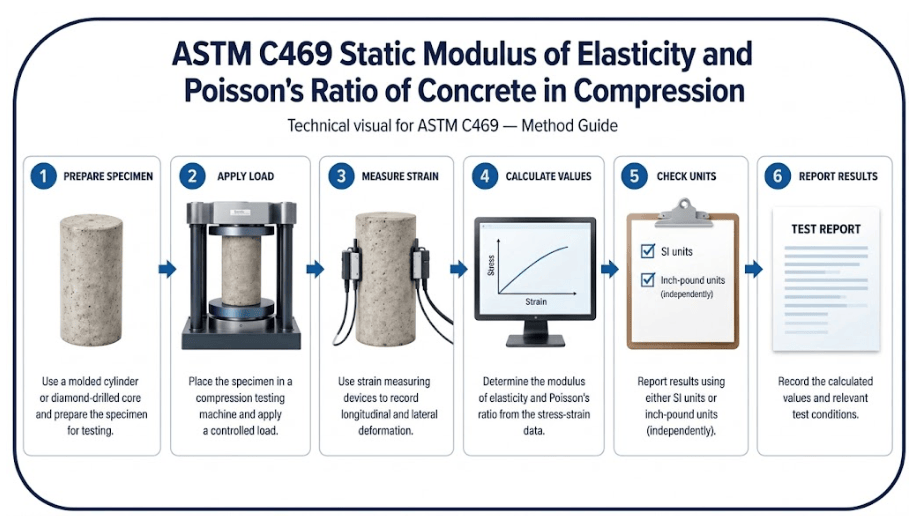
    Technicians prepare a concrete cylinder or core by capping or grinding its ends flat and attaching strain-measuring devices to opposite sides of the specimen. The technician centers the specimen in the compression testing machine, zeroes the instruments, and applies a longitudinal compressive load at a controlled rate while the strain-measuring devices record both longitudinal and lateral strain. From the resulting stress-strain data, the technician calculates the chord modulus of elasticity and Poisson’s ratio at two defined points on the curve. The analyst records both values along with the specimen’s age, curing condition, and dimensions.

     The image shows the ASTM C469 sequence, from mounting strain gauges on a concrete cylinder through compressive loading and calculation of modulus of elasticity and Poisson’s ratio.
    ASTM C469 Static Modulus of Elasticity Testing Sequence for Concrete

    Common Challenges and Troubleshooting 

    The ASTM C469 test is dependent on correctly capped or ground ends of specimens, correct mounting of strain gauges onto specimens, and the application of load at a controlled and steady rate by a compression testing machine. Strain readings may not be evenly distributed if specimens are not aligned or strain-measuring devices are loose, which would lead to an incorrect modulus calculation. Prior to loading, technicians inspect specimen alignment and gauge attachment and load in a smooth manner to ensure that the recorded stress-strain curve is reliable.

    ASTM C469 Analysis Results and Interpretation

    The report interprets the stiffness of a tested concrete specimen by quoting the modulus of elasticity and Poisson’s ratio.

    Read more

    • The analyst reports modulus of elasticity in gigapascals (GPa) or pounds per square inch (psi), depending on which unit system the project specifies as standard.
    • The report denotes Poisson’s ratio as a dimensionless value since it is a ratio of lateral to longitudinal strain.
    • The analyst calculates both values from data within the concrete’s customary working stress range of 0% to 40% of ultimate strength.
    • The report records the specimen’s age and curing condition along with the results, since these factors affect the measured stiffness.

    Link to ASTM C469

    FAQ

    What is ASTM C469 used for?
    ASTM C469 determines the modulus of elasticity and Poisson’s ratio of hardened concrete under compressive load. Engineers use these values for structural sizing and design verification.
    ASTM C469 applies to molded concrete cylinders and diamond-drilled concrete cores. Both specimen types must meet the method’s dimensional requirements.
    ASTM C469 measures modulus of elasticity and Poisson’s ratio within the concrete’s customary working stress range of 0% to 40% of ultimate strength. This range reflects typical in-service loading conditions.
    ASTM C469 results are reported in either SI units or inch-pound units. The standard treats the two unit systems as independently standard, and you should not combine values from each.

    Updated on September 9, 2026

    Laraib Hashmi
    About Author
    Laraib Hashmi is an aspiring research enthusiast and science content professional with a strong interdisciplinary skill set, holding a postgraduate degree in Applied Microbiology from KIIT Bhubaneshwar, Odisha.
    Know More
    Testimonials
    Real results
    Engineers trust us with what matters most
    Start Your Testing
    Project Today
    Define your requirements and get access to
    specialized laboratories ready to deliver results
    Partners with us
    Clients
    Vendors
    Process for testing
    • STEP 01

      You share your testing requirements

    • STEP 02

      You share your sample(s)

    • STEP 03

      We deliver your test reports

    Get your testing done

    Let us know your testing requirements and we will be right back with a solution.

      Let us root for each other. Collaborate to grow, expand, and accelerate our businesses.

      Partner with us

        Discover more from Matestlab

        Subscribe now to keep reading and get access to the full archive.

        Continue reading