
ASTM C384 Impedance and Absorption of Acoustical Materials by Impedance Tube Method

    What is ASTM C384?

    ASTM C384 is a laboratory test method that has been standardized to determine the acoustic impedance and normal-incidence sound absorption of acoustical materials using an impedance tube. The technique involves studying the interaction of sound waves with a material surface to find out the amount of sound energy that is absorbed rather than reflected. During the testing, a specimen is inserted in one end of an impedance tube, and a loudspeaker produces sound waves over a given frequency range. Precision microphones measure the incident and reflected sound waves; the sound absorption coefficient and acoustic impedance are then calculated through specially designed software. ASTM C384 (Standard Test Method for Impedance and Absorption of Acoustical Materials by Impedance Tube Method) offers objective and repeatable measurements of sound, as opposed to subjective evaluations of sound. These results enable manufacturers to optimize material design. 

    Read more

    Get Certified ASTM C384 Testing for Reliable Acoustic Performance Evaluation

    ASTM C384 is a standard to certify the acoustic characteristics of materials by applying a set of standardized impedance tube testing procedures, namely: acoustic impedance and sound absorption. Accredited laboratories evaluate acoustic properties to help manufacturers verify customer, regulatory, and industry requirements. ASTM C384 testing is used for product qualification, research and development, manufacturing consistency, quality assurance, and performance validation of materials for noise control applications.
    What is the Scope of the ASTM C384 Test Standard?

    ASTM C384 describes a standard procedure for measuring the acoustic impedance and normal-incidence sound absorption of acoustical materials by the impedance tube method.

    Read more

    • Measures normal-incidence sound absorption.
    • Determines acoustic impedance characteristics.
    • Uses a standardized impedance tube method to evaluate acoustic properties.
    • Measures the acoustical properties of materials in a controlled laboratory environment.
    • Assists with product qualification, quality assurance, and acoustic performance testing.

    What are the Uses of ASTM C384 Testing?

    ASTM C384 enables manufacturers to test the sound absorption characteristics and acoustic impedance of materials in a laboratory setting. The test yields reliable acoustic data, which can be used for product development, material selection, and quality assurance. The results further assist engineers in designing products optimized for noise reduction and sound control applications. This standard is applied in-

    • Acoustic panels for indoor noise control are assessed by building material manufacturers.
    • Sound-absorbing materials in the automotive interior are evaluated.
    • Aerospace companies verify the acoustic properties of cabin insulation materials.
    • Industrial equipment manufacturers evaluate insulation materials used in machinery and equipment.
    • Research laboratories study the acoustic properties of new materials.
    • Quality control laboratories verify acoustic performance.

    What Materials Can Be Tested Under ASTM C384?

    ASTM C384 is applicable to acoustic foams, fiberglass insulation, mineral wool, porous absorbers, ceiling tiles, wall panels, textile composites, automotive insulation, and even acoustic materials for use in aerospace applications.

    Why is ASTM C384 Important for Acoustic Performance Evaluation?

    The ASTM C384 test reliably and accurately measures the sound absorption and acoustic impedance characteristics of a material with a standardized procedure. Standardized testing ensures that manufacturers can enhance acoustic performance, optimize product designs, minimize unwanted sound, and achieve consistent product quality and performance in a variety of applications.

    Common Challenges and Troubleshooting

    The following factors can cause an error in test accuracy: improper specimen dimensions, poor sealing within the impedance tube, microphone calibration error, background noise, equipment misalignment, and environmental variations. The results are reliable and repeatable when the specimens are prepared correctly, the testing machine is calibrated regularly, the test environment is closely controlled, and standardized testing procedures are used.

    ASTM C384 Testing Process and Data Collection

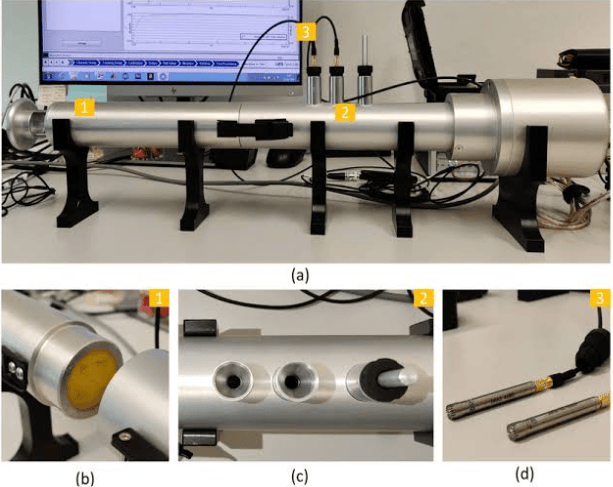
    The testing process starts with preparing specimens and then calibrating the impedance tube system. The technician positions the specimen in the impedance tube, and the loudspeaker produces sound waves throughout the desired frequency range. The microphones record the incident and reflected sound waves, and the software analyzes the recorded acoustic data.

    ASTM C384 Equipment and Sample Preparation Guide

    Proper sample preparation and a calibrated acoustic system are necessary to achieve reliable and repeatable sound absorption measurements.

    Read more

    Specimen DetailsSome representative examples are acoustical insulation, sound-absorbing foams, fibrous materials, composite acoustic panels, ceiling materials, and products for noise control.
    Specimen PreparationTechnicians prepare the specimen with smooth edges and the required dimensions. They check each sample to make sure it is clean, undamaged, and acceptable for testing.
    Specimen DimensionsTechnicians cut the specimens to the required dimensions according to ASTM C384 specifications to fit inside the impedance tube and to produce accurate acoustic measurements.
    InstrumentationThe laboratory uses the following instruments: an impedance tube, precision microphones, loudspeaker, signal generator, power amplifier, data acquisition system, frequency analyzer, calibration equipment, and acoustic analysis software.

    Testing Procedures and Requirements for Acoustic Evaluation

    ASTM C384 sets the standard for laboratory methods for sound absorption and acoustic impedance measurements at normal incidence. Technicians perform testing in controlled lab environments to produce consistent, reproducible, similar results.

    Read more

    Specimen PreparationTechnicians prepare representative specimens, following specified dimensions. All specimens are checked for flatness, thickness, and for any apparent damage or contamination.
    Instrument CalibrationThe testing team calibrates the impedance tube, microphones, signal generator, and data acquisition system before testing to obtain accurate acoustical measurements.
    Specimen InstallationThe operator installs the specimen securely at the end of the impedance tube to prevent sound leakage during testing and tightens it properly.
    Acoustic MeasurementThe loudspeaker produces sound waves within the frequency range of interest, and the microphones measure the incident and reflected sound pressures within the impedance tube.
    Data CollectionEngineers document the sound pressure values, frequency range, specimen identification, environmental conditions, and test parameters during the evaluation.
    Result AnalysisSpecialists analyze the recorded acoustic data to determine the normal-incidence sound absorption coefficient, acoustic impedance, and reflection characteristics.
    DocumentationThe laboratory report generally includes the following information: specimen identification, specimen dimensions, frequency range, SA Coefficient values, acoustic impedance data, environment, equipment information, and ASTM C384 compliance.
    The image shows a laboratory impedance tube system with microphones and a sound source used to measure the acoustic impedance and sound absorption of acoustical materials according to ASTM C384.
    ASTM C384 Impedance Tube Acoustic Testing Equipment

    Analysis Results and Interpretation

    • The sound absorption coefficient for normal incidence is generally reported in the laboratory as a dimensionless coefficient.
    • Laboratories report acoustic impedance using the units specified in ASTM C384.
    • Laboratories often present results as frequency-dependent curves showing sound absorption coefficient and normalized acoustic impedance across the tested frequency range.
    • The higher the sound absorption coefficient, the better the acoustic performance.
    • Frequency-dependent results help engineers identify the frequency range in which the material provides the best acoustic performance.
    • Engineers use these data to compare the acoustic performance of different materials under identical laboratory conditions.
    • Standardized measurements provide consistent quality of manufacturing and product performance.

    Link to ASTM C384

    Read more

    Updated on August 11, 2026

    Gokula Srinivasan Selvam
    About Author
    Gokula Srinivasan Selvam is a Material Testing Associate at Matestlab Inc. and holds a postgraduate degree in Ceramic Engineering from IIT (BHU), Varanasi. His academic background and professional experience are centered on advanced ceramic materials, their processing, characterization, and performance evaluation.
    Know More
    Testimonials
    Real results
    Engineers trust us with what matters most
    Start Your Testing
    Project Today
    Define your requirements and get access to
    specialized laboratories ready to deliver results
    Partners with us
    Clients
    Vendors
    Process for testing
    • STEP 01

      You share your testing requirements

    • STEP 02

      You share your sample(s)

    • STEP 03

      We deliver your test reports

    Get your testing done

    Let us know your testing requirements and we will be right back with a solution.

      Let us root for each other. Collaborate to grow, expand, and accelerate our businesses.

      Partner with us

        Discover more from Matestlab

        Subscribe now to keep reading and get access to the full archive.

        Continue reading