
ASTM C271 Standard Test Method for Density of Sandwich Core Materials

    What is ASTM C271?

    ASTM C271 describes a standard test method for the density of sandwich core materials. The method measures the mass and volume of a prepared core specimen to determine density. The procedure applies to various sandwich core materials and helps engineers determine whether the material has the desired density. Regular density readings also help detect density differences that could affect the effectiveness of sandwich constructions. Measure the mass and volume of a representative core sample, then calculate the sample density from those measurements. ASTM C271 is used in laboratories to characterize materials like foam, honeycomb, and other sandwich cores and to support material comparison, quality control, manufacturing control, and structural design.

    Read more

    Get Certified ASTM C271 Testing for Reliable Sandwich Core Density

    Sandwich core density can affect the weight, stiffness, strength, and other properties of a sandwich construction. Thus, the precise measurement of density allows an engineer to assess the consistency of a core material. ASTM C271 (Standard Test Method for Density of Sandwich Core Materials) specifies how to measure core density. These results can be used for material selection, quality control, production monitoring, and comparisons between various types of sandwich core materials.
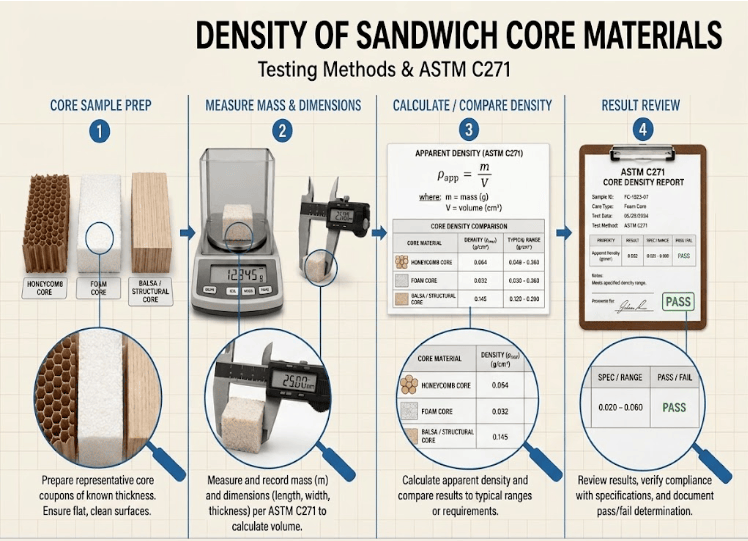

    What is the Scope of the ASTM C271 Test Standard?

    This standard provides a method for measuring the density of sandwich core materials. The method involves measuring the mass and volume of a representative sample and then calculating the density. The ASTM C271 standard-

    Read more

    • Measures core density of sandwiches.
    • Weigh representative core samples.
    • Calculates the volume of specimens based on measurements.
    • Applicable to various kinds of sandwich material.
    • Facilitates comparison of densities of core materials.
    • Assists in the assessment of uniformity of material.
    • Assists quality control and manufacturing control.

    What are the Uses of ASTM C271 Testing?

    ASTM C271 testing helps laboratories determine the density of sandwich core materials. The characteristics of the cores are determined by the engineers and are used to assess consistency in the manufacture of the cores. This standard-

    • Calculates the density of the material at the core.
    • Aids in sandwich material characterization.
    • Assists with comparing various core materials.
    • Evaluates density consistency.
    • Assists in manufacturing quality control.
    • Assists in checking material specifications.
    • Provides density parameters to design sandwich construction.

    Which materials can be tested under ASTM C271?

    ASTM C271 is used for “sandwich core materials for sandwich constructions. These materials can comprise foam cores, honeycombs, and other light core geometry specimens. The laboratory should determine the basic material type, thickness, surface condition, and expected density before preparing specimens for testing.

    Why is ASTM C271 Important?

    The density of the sandwich core materials can be measured using the ASTM C271 standard. Repeated density measurements enable the engineer to assess the quality of the core material and to gain insight into differences between the production batches. The results are also useful for material selection and for engineers to determine if the core material has the necessary density for a specific sandwich construction.

    ASTM C271 Equipment and Sample Preparation Guide

    ASTM C271 requires a balance to determine the specimen mass and dimensional measurement equipment to determine the specimen volume. Representative core specimens are taken in the laboratories and are cut to regular sizes for accurate calculation of volume.

    Read more

    Sample and Specimen DetailsLaboratories take samples of the sandwich core material and test specimens with dimensions that can be accurately measured in terms of mass and volume.
    Specimen PreparationTechnicians cut and prepare the core specimen with clean, defined surfaces and measure its dimensions accurately.
    Specimen DimensionsSpecimen dimensions depend on the type of core material and the requirements of ASTM C271 applicable to the material, and shall be such as to yield a representative specimen volume.
    InstrumentationA calibrated balance, dimensional measurement equipment such as calipers or micrometers, and suitable specimen preparation tools support the test.

    Testing Procedures and Requirements for ASTM C271

    This test standard specifies density as the mass per unit volume of the sandwich core. The specimen is prepared, its size is measured, and its mass is measured on a calibrated balance. Here is the procedure outlined in the ASTM C271 test method-

    Read more

    Specimen PreparationThe representative core specimen is prepared, and the surfaces and edges are made ready for an accurate dimensional reading.
    Dimensional MeasurementTechnicians measure the specimen’s length, width, and thickness to determine its volume.
    Mass MeasurementThe operator places the specimen on a calibrated balance and reads the mass.
    Density CalculationAnalysts determine the specimen density based on the measured mass and volume.
    Result ReportingThe laboratory reports the calculated density along with specimen dimensions, mass, material identification, and pertinent test information.

    ASTM C271 Testing Process and Data Collection

    Using the applicable ASTM C271 procedure, analysts choose a representative sandwich core material and prepare specimens. Next, the dimensions of the specimen are measured, and the balance is checked before weighing. Next, the operator writes down the mass of the specimen, and the technicians calculate the volume of the specimen based on the measurements. Analysts use these measurements to determine the density of the core material. Lastly, the results of the density are recorded in the laboratory along with the relevant data of the specimen. Several specimens can provide more information about the density consistency of the tested material.

    This image shows a sandwich core material specimen being measured for mass and dimensions to determine density according to ASTM C271.
    ASTM C271 Density Testing of Sandwich Core Material

    Common Challenges and Troubleshooting

    To obtain accurate ASTM C271 results, proper dimensional measurements, a properly calibrated balance, and representative sampling are required. If edges are damaged and/or if specimen surfaces are irregular, the volume and density calculated may be affected. Technicians should take the measurements of each dimension carefully and confirm the condition of the specimen. Reliable specimen preparation and accurate mass measurements are also important for laboratories to generate reliable density results.

    ASTM C271 Analysis Results and Interpretation

    The report includes a summary of the density of the tested sandwich core material, measured by its mass and volume. The calculated density is reported by the laboratories along with the appropriate specimen data.

    Read more

    • ASTM C271 does not yield a single mechanical-performance value, but rather density.
    • The units of density are kg/m³, g/cm³, or lb/ft³.
    • Mass and measured dimensions for the calculation are recorded.
    • If more than one specimen is available, it can be used to give information on density variation.
    • Laboratories can ensure reliable results by using consistent specimen preparation and accurate measurements.

    Link to ASTM C271

    Updated on August 24, 2026

    Suyog Kamble
    About Author
    Suyog Kamble is an Operations Associate at Matestlab Inc. Suyog holds a postgraduate degree in organic chemistry and is trained in material science topics.
    Know More
    Testimonials
    Real results
    Engineers trust us with what matters most
    Why Choose Matestlab?
    Matestlab is a unified testing services partner based in the USA. Matestlab offers raw material and product testing services through accredited, expert laboratories primarily based in the USA. Matestlab supports physical, thermal, chemical, electrical, mechanical, environmental, and characterization testing needs through its global network of 2200+ accredited testing laboratories. Matestlab's in-house materials science experts curate and design comprehensive testing programs matched to the sample material and specific testing need, with regulatory requirements and confidentiality in mind.

    If you are looking for a managed and trusted testing partner to achieve your research goals, feel free to schedule a meeting with us or send us a request at connect@matestlabs.com to learn more about our services. For a quick quote, call us at (302)244-7710. We are happy to serve you.
    Start Your Testing
    Project Today
    Define your requirements and get access to
    specialized laboratories ready to deliver results
    Partners with us
    Clients
    Vendors
    Process for testing
    • STEP 01

      You share your testing requirements

    • STEP 02

      You share your sample(s)

    • STEP 03

      We deliver your test reports

    Get your testing done

    Let us know your testing requirements and we will be right back with a solution.

      Let us root for each other. Collaborate to grow, expand, and accelerate our businesses.

      Partner with us