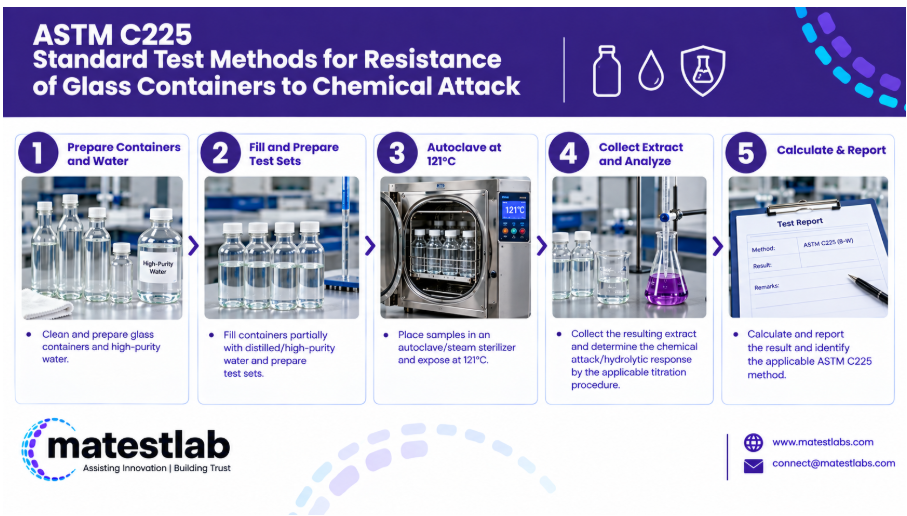
ASTM C225 covers three types of autoclave test methods for evaluating the resistance of glass containers to chemical attack: Test Method B-A for bottles partially filled with dilute acid; Test Method B-W for bottles partially filled with distilled water; and Test Method P-W for powdered glass samples in pure water. Any of the three methods is used to establish specifications for conformity to standard values set by a customer, an agency, or the United States Pharmacopeia, and values stated in SI units are regarded as standard.
- Material type: Glass containers such as bottles (finished) and powdered glass.
- Purpose: Evaluation of chemical resistance and alkali extraction for specification acceptance.
- Properties measured: Amount of alkali removed from the glass surface when the glass is autoclaved.
- Method: Autoclave exposure, followed by titration with dilute acid, distilled water, or pure water as the attacking medium.
- Result: Volume of acid needed to neutralize, converted to equivalent alkali extraction value.
- Test Limitations: Method of selection is dependent on the desired product pH and container size; results are specific to the attacking medium.
- Environmental conditions: Testing simulates the extreme temperature conditions containers experience during sterilization.
- Applications: Quality Control of Glass containers, Specification acceptance, pharmaceutical or food packaging compliance.
What are the Uses of ASTM C225 Testing?
ASTM C225 testing provides laboratories with a standardized method for assessing the chemical resistance of glass containers, and manufacturers use it to ensure the appropriate use of glass for certain packaged products. This standard-
- Uses a controlled autoclave condition to measure the alkali removed from glass containers.
- Accepts specification for products with a pH of less than 5 (Test Method B-A).
- Accepts products in accordance with the pH value specified (Test Method B-W), with a pH of 5.0 or above.
- Helps determine the capacity of small-capacity containers or untreated glass by Test Method P-W.
- Discriminates between whether a treatment is used on the inside of a container to make it last longer.
- Collaborates with product development and quality control of food/beverage and pharmaceutical packaging.
What Materials Can Be Tested Under ASTM C225?
ASTM C225 tests finished glass containers, including bottles for food, beverage, or pharmaceutical products, or powdered glass samples obtained from untreated container glass. Test Method B-A is used directly on bottles, Test Method B-W is used directly on crushed glass powder, and Test Method P-W is used on bottles that are too small to be tested intact. Laboratories select the appropriate method depending on the container’s intended product and its pH.
Why is ASTM C225 Important?
Solubility of glass in contact with food, beverages, or pharmaceutical products is important for safe packaging and storage. Autoclave settings of 121 °C are among the most severe temperatures a container will normally encounter, as sterilization is frequently used in the packaging process. Manufacturers use ASTM C225 testing to ensure that their glass containers are not attacked by these chemicals, thus helping to prevent contamination of the product packaged in the container and helping to meet customer or regulatory specifications.