
ASTM C1606 is the standard test method for sampling container glassware for TCLP testing. It offers a consistent method for preparing decorated glass bottles before performing a Toxicity Characteristic Leaching Procedure (TCLP). The method prepares representative samples of container glassware through breaking, milling, homogenization, and representative sample selection before TCLP testing. analysis. Proper sampling minimizes variation caused by the size and distribution of ceramic decoration and supports reproducible TCLP results for lead and cadmium leaching. ASTM C1606 is useful for environmental compliance, product evaluation, and laboratory quality assurance.
ASTM C1606 Test Method for Sampling Protocol for TCLP Testing of Container Glassware
What is ASTM C1606?
What is the scope of the ASTM C1606 test standard?
ASTM C1606 specifies a standard procedure for preparing container glassware before performing the Toxicity Characteristic Leaching Procedure (TCLP), including sample homogenization and selection of a representative portion. This test standard-
- Defines sampling procedures for decorated container glassware.
- Standardizes sample homogenization prior to TCLP sample analysis.
- Provides representative sample selection methods.
- Reduces sampling variability caused by differences in the distribution of ceramic decoration within the glass.
- Supports subsequent evaluation of lead and cadmium leaching through TCLP testing.
- Enhances repeatability and laboratory reproducibility.
- Assists environmental compliance and waste classification.
What are the Uses of ASTM C1606 Testing?
Laboratories use ASTM C1606 to prepare representative portions of container glassware before performing the Toxicity Characteristic Leaching Procedure (TCLP). The sampling protocol helps laboratories to obtain consistent and reproducible results while evaluating the leaching of hazardous elements such as lead and cadmium from decorated glass containers. The resulting representative samples support subsequent regulatory testing, quality control, and environmental assessments.
- Standardizes sampling for TCLP testing of container glassware.
- Produces representative samples for lead and cadmium leaching analysis.
- Supports environmental compliance and hazardous waste classification.
- Improves laboratory repeatability and reproducibility.
- Assists quality control of decorated glass containers.
- Reduces sampling errors before chemical analysis.
- Supports regulatory testing and product safety evaluations.
What is the Toxicity Characteristic Leaching Procedure (TCLP), and why is it important?
The Toxicity Characteristic Leaching Procedure (TCLP) is an extraction procedure used to evaluate whether contaminants may leach from a waste under specified laboratory conditions. It mimics the leaching process that could follow disposal and determines whether a waste material is hazardous or non-hazardous. For decorated container glassware, subsequent TCLP testing can be used to evaluate the leaching of lead and cadmium from ceramic decoration.
What is the importance of representative sampling for TCLP testing?
Representative sampling helps ensure that the test portion adequately represents the decorated and undecorated portions of the container glassware. Poor sampling can increase variation in subsequent leaching results. The ASTM C1606 standard provides procedures for crushing, homogenizing, and dividing glass samples that are designed to minimize this risk.
Common Challenges and Troubleshooting
It is important that samples are taken correctly and that sample preparation is done properly to obtain accurate TCLP results. Common issues include poor homogenization, segregation of the decorated glass particles, contamination during crushing, and poor sample splitting. Laboratories minimize these errors by following the ASTM C1606 sampling procedure, maintaining a clean sample preparation area with equipment, and ensuring the representative nature of the samples with calibrated sample splitting equipment.
Get Certified ASTM C1606 Testing for Reliable TCLP Sample Preparation
To achieve reproducible TCLP results, it is critical to conduct representative sampling. Inadequate sampling methodologies can contribute to greater variation in the lead and cadmium leaching results, and can impact subsequent waste characterization. ASTM C1606 provides a “standard” method of sampling, which provides repeatability, a good compliance route, and confidence in laboratory results.
ASTM C1606 Equipment and Sample Preparation Guide
The analytical approach to test the TCLP requires proper sample preparation. In the TCLP analysis, technicians must break the glassware, mill, homogenize, and then split it into representative portions before analysis, as per ASTM C1606. A uniform sample preparation technique minimizes sampling error and increases laboratory accuracy.
| Sample and Specimen Details | Technicians select representative containers from the production lot or batch for subsequent TCLP testing. |
| Specimen preparation | Technicians carefully break the glass, thoroughly homogenize the material, and prepare representative portions for subsequent TCLP testing while preventing contamination. |
| Specimen dimensions | Technicians prepare the glass according to the particle-size requirements specified by the TCLP sampling protocol. |
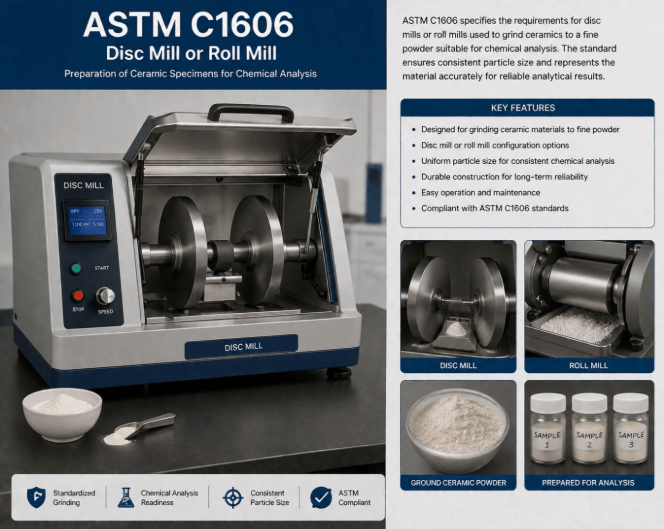
| Instrumentation | Disc Mill or Roll Mill, Jaw Crusher (if needed), Sample Splitter or Riffle Splitter, Analytical Balance, Mixing Containers, Sieves, and Sample Storage Containers. |
Testing Procedures and Requirements
ASTM C1606 establishes a standard method for sampling prior to conducting the Toxicity Characteristic Leaching Procedure (TCLP). The method reduces sampling variation by homogenizing the glass so that decorated and undecorated fragments are more uniformly represented in the sample. The homogenization process improves the reproducibility of subsequent lead and cadmium leaching measurements.
| Sample Selection | Technicians select two sets of 10 representative decorated glass containers for duplicate testing. |
| Glass Breaking and Milling | Technicians safely pre-break the glass and reduce its particle size using a disc mill or roll mill according to the sampling protocol. |
| Sample Homogenization | Technicians thoroughly homogenize the crushed glass using a roller or tumbler and divide the material with a riffle box to obtain representative samples. |
| Representative Sample Collection | Technicians collect representative portions for subsequent TCLP testing to evaluate lead and cadmium leaching. |
ASTM C1606 Testing Process and Data Collection
Testing starts with selecting representative decorated glass containers from a production lot. Technicians safely break the containers into pieces, mill the glass to reduce its particle size, homogenize the material, and divide it with a riffle box to obtain representative laboratory portions for subsequent TCLP testing. During this process, laboratories document sample identification, particle size, homogenization methods, sample mass, and sampling conditions to ensure traceability and repeatability.
ASTM C1606 Analysis Results and Interpretation
- ASTM C1606 defines the sampling strategy that precedes TCLP testing.
- Laboratories may report subsequent TCLP results as concentrations of lead (Pb) and cadmium (Cd) in the TCLP extract, typically in milligrams per liter (mg/L).
- Representative sampling improves the reproducibility of subsequent TCLP results and supports reliable waste characterization.
Updated on August 10, 2026

Testimonials
Real results
Engineers trust us with what matters most
“We had a great experience working with this company for our ASTM E84 testing. They were the first company to respond to our inquiry within just a few minutes of submitting it. From start to finish, the communication was excellent, and the entire process was swift, straightforward, and hassle-free.”

“Very good communication, testing associates were very patient with delays on our end. Reasonable turnaround time for results and nicely detailed report. Analysts were also quick to answer any follow-up questions. Happy with results.”
“Matestlab connected us with an accredited lab within days, cutting weeks off our product validation timeline.”
Start Your Testing
Project Today
Project Today
Define your requirements and get access to
specialized laboratories ready to deliver results
specialized laboratories ready to deliver results
Start Testing
Partners with us
Clients
Vendors