
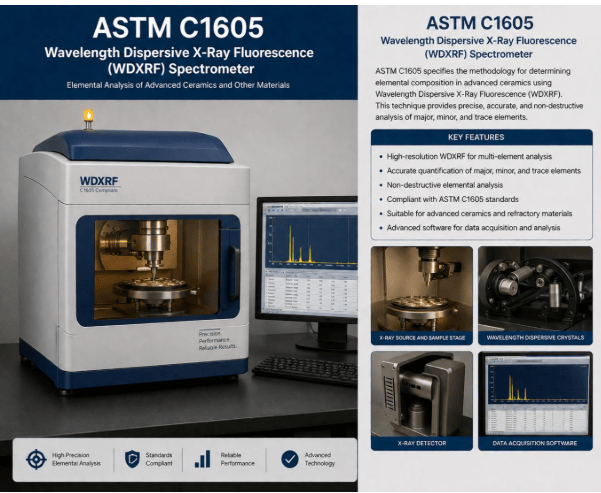
ASTM C1605 is the standard test method for chemical analysis of ceramic whiteware materials using Wavelength Dispersive X-Ray Fluorescence Spectrometry (WDXRF). It offers a standard method for measuring the concentration of the major oxide constituents of ceramic whiteware clays and minerals. The method determines ten major elements reported as SiO₂, Al₂O₃, Fe₂O₃, MgO, CaO, Na₂O, K₂O, TiO₂, P₂O₅, and MnO, along with gravimetric loss on ignition (LOI). Laboratories first ignite the sample, fuse it with lithium tetraborate to produce a homogeneous glass disc, and then analyze the disc using WDXRF. Laboratories use the results for raw material qualification, production control, and development of ceramic formulations.
ASTM C1605 Standard Test Methods for Chemical Analysis of Ceramic Whiteware Materials Using Wavelength Dispersive X-Ray Fluorescence Spectrometry
What is ASTM C1605?
What is the scope of the ASTM C1605 test standard?
ASTM C1605 outlines standard methods for analyzing the chemical composition of ceramic whiteware clay and mineral content via wavelength dispersive X-ray fluorescence spectrometry. The method provides accurate results for major oxide constituents, with minimum matrix and mineralogical effects from fused bead preparation. This test standard-
- Identifies ten key oxide components in ceramic whitewares.
- Measures gravimetric loss on ignition (LOI).
- Uses Wavelength Dispersive X-Ray Fluorescence Spectrometry (WDXRF).
- Employs fused glass bead sample preparation.
- Assists in raw material characterization and quality control.
- Reduces matrix and mineralogical interferences.
- Applies to ceramic whiteware clays and minerals.
What are the Uses of ASTM C1605 Testing?
ASTM C1605 determines the chemical composition of ceramic whiteware materials using Wavelength Dispersive X-Ray Fluorescence Spectrometry (WDXRF). Manufacturers use this method to verify the quality of raw materials, ensure consistent ceramic formulations, and assure product performance and manufacturing requirements. It also offers accurate elemental analysis of ceramic materials, which aids in research, quality assurance, and process optimization. This test standard-
- Determines the chemical composition of ceramic whiteware materials.
- Verifies the concentration of major oxides in raw materials.
- Supports quality control during ceramic manufacturing.
- Assists in raw material selection and supplier qualification.
- Helps optimize ceramic body and glaze formulations.
- Supports research and development of ceramic products.
- Supports comparison of analytical results with applicable material specifications.
What is Wavelength Dispersive X-Ray Fluorescence (WDXRF) and Why is It Used?
Wavelength Dispersive X-Ray Fluorescence (WDXRF) is a non-destructive analytical technique used to determine the elemental composition of solid materials. It separates characteristic X-rays by wavelength, allowing highly accurate measurement of major oxide constituents. The technique is highly precise, repeatable, and sensitive, suitable for regular QC of ceramic raw materials.
Why is Fused Glass Bead Preparation Important?
Fused glass bead preparation improves analytical accuracy by removing the influence of particle size, mineralogy, and sample inhomogeneity. Technicians combine the powdered ceramic sample with a lithium tetraborate flux and fuse it at high temperatures to form a uniform glass disc. Matrix interference affects the WDXRF instrument less, making it more consistent.
- Common Challenges and Troubleshooting in ASTM C1605
To ensure proper chemical analysis, the sample must be adequately prepared, complete fusion is necessary, and analytical equipment must be properly calibrated. Common issues are incomplete fusion, contamination during sample preparation, sample-to-flux ratio error, drift of the instrument, and matrix effects. Laboratories reduce these problems by creating homogeneous fused beads, using certified reference materials, working in a clean laboratory, and performing routine calibration of the spectrometer.
ASTM C1605 Analysis Results and Interpretation
- ASTM C1605 determines the percentage of major oxides in ceramic whiteware materials.
- Laboratory usually presents results in weight percent, such as SiO₂, Al₂O₃, Fe₂O₃, MgO, CaO, Na₂O, K₂O, TiO₂, P₂O₅, MnO, and Loss on Ignition (LOI).
- Variations in the concentrations of major oxides can influence ceramic processing and properties such as firing behavior, strength, color, thermal expansion, and dimensional stability.
- Manufacturers compare analytical results with material specifications to ensure raw material consistency and product quality.
ASTM C1605 Equipment and Sample Preparation Guide
Proper sample preparation and careful calibration of analytical instruments provide accurate WDXRF analysis. The method uses fusion with a suitable flux to reduce mineralogical and matrix effects and to produce a stable homogeneous sample for presentation to the spectrometer. Careful sample preparation reduces matrix interferences and improves the repeatability of analytical results.
| Sample and Specimen details | Analysts use representative ceramic whiteware materials, including clays, feldspars, quartz, and other ceramic raw materials, for chemical composition analysis. |
| Specimen preparation | Dry the sample, calculate Loss on Ignition (LOI), add the ignited material to lithium tetraborate flux, fuse, and make a homogeneous glass bead for WDXRF analysis. |
| Specimen dimensions | Technicians convert the powdered ceramic sample into a fused glass bead suitable for introduction into the WDXRF instrument. |
| Instrumentation | Wavelength Dispersive X-Ray Fluorescence (WDXRF) spectrometer, Platinum-Gold (Pt-Au) crucibles and molds, fusion fluxer, muffle furnace, hot plate, analytical balance, and computer with WDXRF analysis software. |
Testing Procedures and Requirements
ASTM C1605 provides a standard laboratory method for chemical analysis by Wavelength Dispersive X-ray Fluorescence (WDXRF) spectrometry. Technicians reduce mineralogical effects by fusing the powdered sample with a suitable flux to produce a stable homogeneous glass disc for X-ray analysis. This method provides a more accurate and reproducible analysis for the major oxides. The standard also tests Loss on Ignition (LOI) for the full chemical analysis.
| Sample Ignition (LOI) | The analyst heats the specimen to determine the gravimetric loss on ignition before WDXRF analysis. |
| Sample Preparation | The analyst uses Pt-Au crucibles to fuse the ignited sample with lithium tetraborate and produce a homogeneous glass disc. |
| WDXRF Analysis and Chemical Composition | Analysts introduce the fused glass disc into the wavelength-dispersive X-ray spectrometer and use previously prepared calibration standards to determine the concentrations of SiO₂, Al₂O₃, Fe₂O₃, MgO, CaO, Na₂O, K₂O, TiO₂, P₂O₅, and MnO and report the LOI value. |
Get Certified ASTM C1605 Chemical Analysis Testing
The chemical composition of ceramic raw material will directly influence the firing behavior, strength of the products, color, and dimensions of the products. Hence, manufacturers use standard chemical analysis to ensure that their raw materials meet quality standards before production. Professional laboratory testing helps identify variations in oxide composition, improves process consistency, and reduces manufacturing defects. Accurate WDXRF analysis also helps in supplier qualification, research, and product development for ceramic whiteware applications.
ASTM C1605 Testing Process and Data Collection
The testing process starts with drying and preparing a representative ceramic sample. The laboratory measures the Loss on Ignition (LOI) by heating the specimens under controlled heating. The fused sample is then stirred with a lithium tetraborate flux to create a uniform glass bead. Then, fused bead analysis using a wavelength dispersive X-ray fluorescence (WDXRF) spectrometer. The laboratory documents the concentrations of major oxides, the LOI values, the calibration data, and the quality control data prior to the analytical report.
Updated on August 10, 2026

Testimonials
Real results
Engineers trust us with what matters most
“We had a great experience working with this company for our ASTM E84 testing. They were the first company to respond to our inquiry within just a few minutes of submitting it. From start to finish, the communication was excellent, and the entire process was swift, straightforward, and hassle-free.”

“Very good communication, testing associates were very patient with delays on our end. Reasonable turnaround time for results and nicely detailed report. Analysts were also quick to answer any follow-up questions. Happy with results.”
“Matestlab connected us with an accredited lab within days, cutting weeks off our product validation timeline.”
Start Your Testing
Project Today
Project Today
Define your requirements and get access to
specialized laboratories ready to deliver results
specialized laboratories ready to deliver results
Start Testing
Partners with us
Clients
Vendors