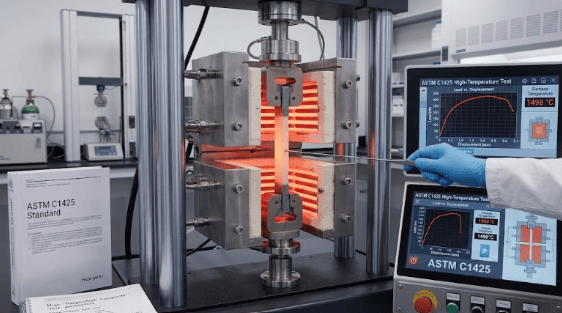
ASTM C1425 measures the interlaminar shear strength of continuous fiber-reinforced ceramic composites at elevated temperatures. It covers advanced ceramic or glass matrix composites reinforced by continuous fibers in laminated unidirectional (1D) or laminated bidirectional (2D) architecture, such as unidirectional ply lay-up or stacked fabrics. The method does not cover nonlaminated 3D fiber architectures or discontinuous fiber-, whisker-, or particulate-reinforced ceramics.
The method includes uniaxial compression of a double-notched specimen and results in interlaminar shear failure between two notches located in the center of the specimen. It covers sample preparation, test modes, loading rates, data collection, and reporting. The method applies to advanced ceramic or glass matrix composites that contain continuous fibers in unidirectional (1D) or bidirectional (2D) laminated architectures. It covers specimens made from unidirectional plies or stacked fabric. The ASTM C1425 test method-
- Evaluates 1D continuous fiber-reinforced ceramic composites by applying uniaxial compression to double-notched specimens and determining the load associated with interlaminar shear failure.
- Evaluates 2D continuous fiber-reinforced ceramic composites by testing laminated structures containing bidirectional reinforcement, such as stacked fabric architectures, under elevated-temperature compression.
- Evaluates advanced ceramic and glass matrix composites by determining their resistance to shear failure between laminated fiber-reinforced layers at elevated temperatures.
- Excludes 3D fiber architectures and discontinuous fiber-, whisker-, and particulate-reinforced ceramics because the test method specifically addresses laminated 1D and 2D continuous fiber architectures.
What Properties Does ASTM C1425 Evaluate?
ASTM C1425 evaluates the following properties-
- Interlaminar Shear Strength: Measures the shear strength of the composite between its laminated fiber-reinforced layers when loaded at higher temperature.
- Failure Load (N): Records the load applied to the double-notched specimen when interlaminar shear failure occurs.
- Specimen Dimensions (mm): Records the specimen dimensions and notch geometry required for calculating and interpreting the interlaminar shear response.
- Testing Temperature (°C): Records the temperature at which the laboratory evaluates the composite to relate its shear performance to elevated-temperature conditions.
- Failure Characteristics: Documents the location and nature of the fracture to determine whether the specimen experienced the intended interlaminar shear failure.
What Materials Can Be Tested According to ASTM C1425?
Here is the list of materials that can be tested using ASTM C1425-
- 1D Continuous Fiber-Reinforced Ceramic Matrix Composites: Assesses the interlaminar shear response of ceramic composite laminates with continuous fibers primarily in one direction at high temperatures.
- 2D Continuous Fiber-Reinforced Ceramic Matrix Composites: Evaluates laminated composites with bidirectional continuous fiber reinforcement, such as stacked fabrics, by determining their interlaminar shear strength under elevated-temperature compression.
- Continuous Fiber-Reinforced Glass Matrix Composites: Applies to glass matrix composites reinforced with continuous fibers with loading at elevated temperatures in 1D or 2D laminate architectures.
Why is ASTM C1425 Testing Important?
Continuous fiber-reinforced ceramic composites are candidate materials for structural applications requiring high degrees of wear, erosion, corrosion resistance, and damage tolerance at high temperatures. ASTM C1425 provides shear-performance information to characterize the behavior of these materials under elevated-temperature conditions. Engineers use the results for material development, material comparison, quality assurance, characterization, and design-data generation. Manufacturers can also use standardized shear-test results for quality-control comparisons under specified primary processing conditions and post-processing heat treatments
How does ASTM C1425 work?
Technicians prepare a double-notched specimen with two centrally located notches machined halfway through its thickness and positioned at a fixed spacing on opposing faces. The laboratory places the specimen in a compression-testing system and establishes the required elevated temperature.
The testing machine then applies uniaxial compression using the specified force- or displacement-control mode. The specimen fails through interlaminar shear between the two notches, and technicians collect the required load and specimen information for calculating and reporting the interlaminar shear strength.
What are the Applications of ASTM C1425 Testing?
ASTM C1425 tests the interlaminar shear strength of 1-D and 2-D continuous fiber-reinforced advanced ceramic matrix composites at elevated temperatures. It is primarily used for high-temperature structural material evaluation in aerospace and energy systems, material performance comparison, research and design, and quality control in manufacturing. This test standard-
- Supports advanced ceramic composite development by providing interlaminar shear-strength data for evaluating new continuous fiber-reinforced ceramic materials.
- Supports material comparison by allowing engineers to compare the elevated-temperature shear performance of different fiber architectures, matrix systems, and processing conditions.
- Supports quality assurance by helping manufacturers compare standardized shear-test results between production batches and processing conditions.
- Supports material characterization by providing information about composite strength and deformation under interlaminar shear stresses.
- Supports engineering design and design-data generation by providing standardized interlaminar shear-strength information for structural applications requiring high-temperature performance.