ASTM C1323 Ultimate Strength of Advanced Ceramics with Diametrally Compressed C-Ring Specimens at Ambient Temperature

    What is ASTM C1323?

    ASTM C1323 is a standard test method for advanced ceramics with diametrally compressed C-ring specimens at ambient temperature. The method determines the ultimate tensile strength of tubular monolithic advanced ceramics by applying diametral compressive loading to a C-ring specimen under controlled laboratory conditions. The method measures the fracture strength of ceramic materials by measuring the maximum load until fracture and then calculating the tensile stress. Engineers use it to evaluate ceramic tubes, rings, and hollow cylindrical parts in structural and high-performance engineering applications.

    Read more

    Get Certified ASTM C1323 Ultimate Strength Testing 

    Mechanical strength is the most important property of advanced ceramic components used in demanding engineering environments. ASTM C1323 (Test Method for Ultimate Strength of Advanced Ceramics with Diametrally Compressed C-Ring Specimens at Ambient Temperature) is a reliable and repeatable procedure for measuring the ultimate strength of tubular ceramics and is useful for manufacturers to ensure structural reliability, compare material performance, and verify product quality.

    The image shows a C-ring compression fixture to determine the ultimate strength of advanced ceramic C-ring specimens according to ASTM C1323.
    ASTM C1323 C-Ring Compression Fixture 

    What is the scope of the ASTM C1323 test standard? 

    ASTM C1323 is a standard test method that specifies a procedure for measuring the ambient-temperature, diametrically compressed C-ring ultimate strength of monolithic advanced ceramics. The method provides reliable strength data for tubular ceramic components in structural applications and for quality assurance, research, and engineering design. This test standard-

    Read more

    • Covers monolithic advanced ceramic materials.
    • Applies diametral compressive loading to C-ring specimens.
    • Tests the ultimate strength at room temperature. 
    • Use for tubular ceramic parts. 
    • Assists in quality control or material qualification. 
    • Provides standardized mechanical strength evaluation. 
    • For conventional and miniature C-ring samples.

    What are the uses of ASTM C1323 testing? 

    ASTM C1323 determines the ultimate tensile strength of C-ring specimens by applying diametral compressive loading to monolithic advanced ceramic tubes and ring-shaped components. The method assesses the quality of the material, compares different types of ceramic compositions, and confirms the integrity of the structural components suitable for demanding engineering applications. The test standard-

    • Evaluates the ultimate strength of advanced ceramic C-ring specimens.
    • Measures the mechanical properties of ceramic tubular parts. 
    • Aids in quality control of ceramic production. 
    • Helps with material development and product qualification. 
    • Compares the strength of different ceramic formulations. 
    • Helps evaluate the influence of machining damage and surface defects on fracture strength.
    • Assists with engineering design and reliability analyses.

    Which materials can be tested according to ASTM C1323? 

    Laboratories use ASTM C1323 to evaluate monolithic advanced ceramic tubes, rings, and other hollow cylindrical components. The method applies to engineering ceramics that are evaluated for ambient temperature strength.

    Why is ASTM C1323 Important? 

    ASTM C1323 is a standard test method for determining the ultimate strength of advanced tubular ceramics. It helps manufacturers evaluate material strength, identify machining-related defects, and compare the mechanical performance of ceramic components.

    Common Challenges and Troubleshooting 

    Accurate strength measurements require properly machined C-ring specimens, fixture alignment, and calibrated test equipment. Common challenges include machining damage, specimen chipping, misalignment during loading, uneven load distribution, dimensional inaccuracies, and premature fracture caused by handling defects. Careful specimen preparation and equipment calibration produce reliable and repeatable results.

    ASTM C1323 Test Method and Data Collection 

    The testing process starts with the machining of a representative tubular ceramic part to C-ring size with the following dimensions. Technicians place the specimen in the compression fixture and apply a steady diametral compressive load until fracture occurs. In testing, laboratories document the specimen dimensions, applied load, fracture load, fracture location, and failure characteristics. Engineers use these measurements to calculate the ultimate tensile strength of the ceramic material.

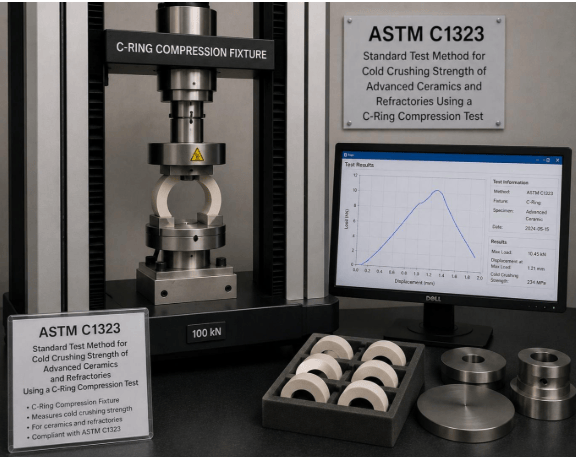
    ASTM C1323 Equipment and Sample Preparation Guide

    Accurate strength testing requires precisely machined C-ring specimens, proper alignment within the loading fixtures, and calibrated testing equipment. ASTM C1323 focuses on specimen preparation, dimensional verification, and controlled loading to ensure that fracture strength is measured accurately and results are repeatable.

    Read more

    Sample and Specimen DetailsTechnicians machine representative monolithic advanced ceramic tubular specimens into C-ring geometry for ultimate strength testing.
    Specimen PreparationTechnicians machine the specimen to the required C-ring dimensions, inspect it for machining damage, and ensure proper alignment before testing.
    Specimen DimensionsTechnicians must accurately measure the external diameter, internal diameter, thickness, width, and slot dimensions to calculate strength.
    InstrumentationUniversal Testing Machine (UTM), C-Ring Compression Fixture, Load Cell, Vernier Caliper, Micrometer, Optical Measuring Device, Data Acquisition System.

    Testing Procedure and Requirements for ASTM C1323 

    ASTM C1323 provides a common method for measuring the ultimate strength of C-ring specimens by diametral compression. Proper specimen preparation and correctly aligned compression fixtures play an important role in obtaining accurate and reliable strength measurements.

    Read more

    C-Ring Specimen PreparationMachine a representative tubular ceramic specimen into the required C-ring geometry and inspect it for surface defects before testing.
    Diametral Compression TestingThe technician places the C-ring specimen in the compression fixture and applies a continuous compressive load until fracture occurs.
    Ultimate Strength DeterminationEngineers record the maximum fracture load and calculate the ultimate tensile strength using the equations and specimen dimensions specified in ASTM C1323.
    Fracture EvaluationInvestigate the fracture location and characteristics to confirm the validity of the test and the material’s performance.

    Analysis Results and Interpretation 

    • Laboratories calculate the ultimate tensile strength using the fracture load and the measured specimen dimensions specified in ASTM C1323.
    • Laboratories normally express results of ultimate strength in megapascals (MPa) or pounds per square inch (psi), fracture load (N or kN), specimen size (mm), and fracture location. 
    • Engineers compare the calculated strength values among specimens to evaluate material consistency and machining quality.
    • Higher ultimate tensile strength indicates greater resistance to fracture under the specified test conditions.
    • Fracture location and fracture origin provide additional information about machining defects or material flaws.

    Link to ASTM C1323

    Read more

    FAQ

    Where can I get the astm c1323 tested?
    You can share your astm c1323 testing requirements with MaTestLab. MaTestLab has a vast network of material testing laboratories, spread across the USA and Canada. We support your all material testing needs ranging from specific astm c1323 test to various testing techniques.
    Please contact us for a detailed quote for your astm c1323 testing needs. Cost incurred to carry out different astm c1323 testing methodology depends on the type of raw material; number of samples, coupons, or specimens; test conditions, turn around time etc. Costs of some ASTM testing methods start from $100 and the final value depends upon the factors listed above. Please contact us for the best and latest prices.
    The required number of samples or specimens should comply with the procedure given in the astm c1323 standard. However, the MaTestLab operations team can assist you for your special requirements once you share your testing details with us.
    MaTestLab has a vast testing laboratory network, hence we bring you the best testing facilities in a cost-effective way. We offer considerable discounts (15-20%) to our returning customers based on test volume and frequency.
    The turnaround time for astm c1323 test methodology depends upon the test procedure mentioned in the standard test document. However, we at MaTestLab understand your research requirements and hence try to get your test completed within the least possible time.
    Suyog Kamble
    About Author
    Suyog Kamble
    Suyog Kamble is an Operations Associate at MaTestLab Inc. and holds a postgraduate degree in Organic Chemistry.
    Testimonials
    Real results
    Engineers trust us with what matters most
    Start Your Testing
    Project Today
    Define your requirements and get access to
    specialized laboratories ready to deliver results
    Partners with us
    Clients
    Vendors
    Process for testing
    • STEP 01

      You share your testing requirements

    • STEP 02

      You share your sample(s)

    • STEP 03

      We deliver your test reports

    Get your testing done

    Let us known your testing requirements and we will be right back with a solution.

      Let us root for each other. Collaborate to grow, expand, and accelerate our businesses.

      Partner with us

        Contact Us

        Discover more from MaTestLab

        Subscribe now to keep reading and get access to the full archive.

        Continue reading