By content81c70d6e36 | Last updated 23rd July 2026

ASTM C1275 Monotonic Tensile Behavior of Continuous Fiber-Reinforced Advanced Ceramics

ASTM C1275 is a standard test method for determining the ambient-temperature monotonic tensile behavior of continuous fiber-reinforced advanced ceramics using solid rectangular test specimens. The test measures tensile strength, stress-strain characteristics, elastic modulus, proportional limit, and strain at failure under controlled uniaxial tensile loading. The test is conducted in the laboratory with the help of a universal testing machine (UTM), which is fitted with a good grip, extensometers, and data acquisition systems. Specimen size, loading conditions, tensile characteristics, stress-strain curve, and failure characteristics are included in the report. The test results are generally expressed in MPa, GPa, and percent strain, which will be useful for applications in material qualification, quality control, research, and structural design.

Read More

GET STARTED

    Share your requirements *

    Provide your contact information *

    What is ASTM C1275?

    ASTM C1275 is a standard test method for determining the tensile properties of CMCs (ceramic matrix composites) produced using continuous fibers. The technique compares the behavior of these advanced materials under uniaxial tensile loading up to failure at room temperature. ASTM C1275 (Standard Test Method for Monotonic Tensile Behavior of Continuous Fiber-Reinforced Advanced Ceramics with Solid Rectangular Cross-Section Test Specimens at Ambient Temperature) assists manufacturers, researchers, and design engineers in characterizing tensile performance, comparing composite materials, and aiding in product development. The results help engineers optimize composite designs and evaluate material performance for aerospace, energy, automotive, defense, and other structural applications.

    Get Certified ASTM C1275 Tensile Testing for Advanced Ceramic Composites

    To utilize continuous fiber-reinforced ceramic composites for high-performance applications, there is a need for accurate mechanical characterization of the composites before use. ASTM C1275 testing provides reliable tensile property data to aid in material qualification, product development, and quality control. Independent laboratory testing is also useful for manufacturers to demonstrate compliance with customer specifications and engineering requirements.

    Service NameRemarks
    ASTM C1275 Testing
    Contact US

    ASTM C1275 Equipment and Sample Preparation

    To accurately measure tensile properties, the specimen must be properly prepared, and the testing equipment must be properly calibrated. Technicians prepare rectangular composite test specimens, inspect specimen dimensions, and set up the test apparatus to obtain uniform tensile loading during testing.

    Sample DetailsContinuous fiber-reinforced advanced ceramic composite specimens with a solid rectangular cross-section.
    Sample PreparationMachine specimens to the specified dimensions; inspect for surface defects; and measure width, thickness, and gauge length before testing.
    Specimen ConfigurationSolid rectangular specimens prepared according to ASTM C1275 dimensional requirements.
    Extensometer VerificationThe extensometer should be calibrated and securely attached within the specified gauge length, ensuring accurate strain measurement throughout the tensile test.
    InstrumentationUniversal Testing Machine, precision tensile grips, clip-on or non-contact extensometer, calibrated load cell, digital micrometer, vernier caliper, alignment fixture, computerized data acquisition system, and analysis software.

    Testing Procedures and Requirements

    ASTM C1275 determines tensile behavior by applying a continuously increasing uniaxial tensile load to a rectangular ceramic composite specimen until fracture. Technicians measure both specimen deformation and the load applied during the test to obtain a full stress-strain curve. The results obtained are used to calculate important mechanical characteristics necessary for the engineering assessment.

    Specimen PreparationThe analyst prepares rectangular composite specimens according to dimensional requirements.
    Dimensional Measurement and Specimen MountingThe analyst measures specimen width, thickness, and gauge length before testing and secures the specimen in tensile grips while maintaining proper alignment.
    Extensometer InstallationThe analyst measures strain accurately during tensile loading.
    Monotonic Tensile LoadingApply tensile force continuously until specimen failure.
    Data AnalysisCalculate tensile strength, elastic modulus, proportional limit, strain to failure, and generate the stress-strain curve.
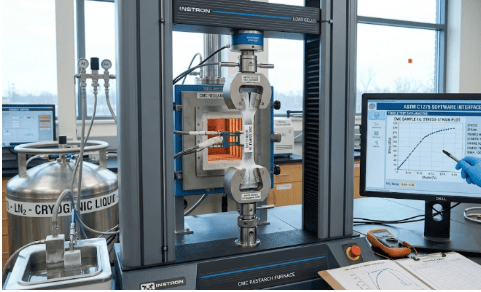
    Universal testing machine equipped with precision grips and an extensometer performing monotonic tensile testing according to ASTM C1275.
    ASTM C1275 Universal Testing Machine (UTM) 

    What is the scope of ASTM C1275?

    ASTM C1275 is a standard test method to determine the monotonic tensile properties of continuous fiber-reinforced, advanced ceramic composites at ambient temperature. The standard characterizes the mechanical performance of continuous fiber-reinforced advanced ceramics and provides standardized tensile property data for material comparison, quality control, research, and structural design. This test standard-

    • Determines tensile strength, elastic modulus, proportional limit, and strain to failure. 
    • Assists and contributes to material qualification and quality control programs. 
    • Compares the tensile performance of different composite materials.
    • Helps to develop products and design structures. 
    • Supplies data on mechanical properties that is standardized for engineering purposes. 

    How Does ASTM C1275 Evaluate the Tensile Behavior of Ceramic Matrix Composites?

    ASTM C1275 is a standard used to determine the tensile properties of continuous fiber-reinforced ceramic matrix composites (CMCs). The test method measures tensile strength, elastic modulus, proportional limit, and strain to failure using a UTM and extensometer for material qualification, quality control, and engineering design.

    What is the use of ASTM C1275 Testing?

    ASTM C1275 testing evaluates the tensile behavior of continuous fiber-reinforced ceramic composites under controlled loading conditions for manufacturers, researchers, and design engineers. The ASTM C1275 standard-

    • Tests the strength characteristics of high-tech CMC materials. 
    • Helps with quality control in composite manufacturing. 
    • Helps research and develop high-performance ceramic materials. 
    • Supplies standardized mechanical property data for aerospace, defense, energy, and other advanced engineering industries and enables comparison of different composite formulations. 
    •  Helps qualify materials and make engineering design decisions. 

    What is Monotonic Tensile Behavior?

    The response of a material to a continuously increasing tensile load applied until fracture is called monotonic tensile behavior. This test evaluates stiffness, strength, deformation, and failure characteristics of continuous fiber-reinforced ceramic matrix composites under a continuously increasing tensile load. 

    Why is ASTM C1275 Testing Important?

    Exceptional strength, light weight, and thermal stability are required for advanced ceramic composite applications. ASTM C1275 offers manufacturers reliable tensile property data to ensure material quality, optimize composite designs, and support product qualification for demanding engineering uses and products. The standardized method also enables comparisons to be made between various types of composite material.

    What Materials Can be Tested According to ASTM C1275?

    ASTM C1275 applies to continuous fiber-reinforced advanced ceramics tested as solid rectangular specimens. The method is commonly applied to continuous fiber-reinforced silicon carbide, oxide, alumina, carbon-containing, and other advanced ceramic composite systems used in aerospace, energy, defense, and structural applications.

    How Does ASTM C1275 Measure Tensile Properties?

    The test involves applying a continuously increasing uniaxial tensile load to a rectangular composite specimen at ambient temperature. An extensometer is used to measure the specimen strain during loading, and the universal testing machine measures the loading force. The results of these measurements are plotted on a stress-strain curve and determine tensile strength, elastic modulus, proportional limit, and strain to failure.

    What are the Common Challenges and troubleshooting?

    Factors such as improper specimen alignment, specimen damage because of the grip, inaccurate strain measurement, and specimen defects may affect tensile test results. Laboratories alleviate such problems through careful specimen preparation, accurate specimen machining, and proper alignment of extensometers and precision grips before testing.

    ASTM C1275 Testing Process and Data Collection Guide

    The technician prepares and checks the composite specimen and installs it in a calibrated universal testing machine (UTM). Deformation is measured using an extensometer while the machine applies increasing tensile force to the material until it breaks. The laboratory then analyzes the recorded load and strain data to create stress-strain curves and determine the necessary tensile properties.

    Analysis Results and Interpretation

    • This test standard reports the tensile strength (MPa), elastic modulus (GPa), and proportional limit of the ceramic matrix composite.
    • Measures the strain to failure and generates a complete stress-strain curve to evaluate the material’s deformation behavior.
    • Engineers compare stress-strain curves from different composite systems to evaluate stiffness, damage tolerance, and overall tensile behavior for material selection and structural design.
    • Identifies the fracture behavior and overall tensile performance of the composite under monotonic loading.
    • Supports material qualification, quality control, engineering design, and comparison of different ceramic composite materials.

    What are the Factors to Consider for ASTM C1275?

    • Speed: Correct specimen preparation and instrument setup increase testing efficiency while maintaining reliability.
    • Expertise: Skilled lab staff members monitor correct specimen alignment, accurate strain measurement, and correct interpretation of tensile properties.
    • Cost: Tensile characterization helps manufacturers optimize composite materials, reduce design risks, minimize material failures, and improve product development efficiency.

    Link to ASTM C1275

    FAQ's

    Where can I get the astm c1275 tested?

    You can share your astm c1275 testing requirements with MaTestLab. MaTestLab has a vast network of material testing laboratories, spread across the USA and Canada. We support your all material testing needs ranging from specific astm c1275 test to various testing techniques.

    How much do I need to pay for the astm c1275 test?

    Please contact us for a detailed quote for your astm c1275 testing needs. Cost incurred to carry out different astm c1275 testing methodology depends on the type of raw material; number of samples, coupons, or specimens; test conditions, turn around time etc. Costs of some ASTM testing methods start from $100 and the final value depends upon the factors listed above. Please contact us for the best and latest prices.

    How many samples are required for astm c1275?

    The required number of samples or specimens should comply with the procedure given in the astm c1275 standard. However, the MaTestLab operations team can assist you for your special requirements once you share your testing details with us.

    How much discount can I get on the astm c1275 test?

    MaTestLab has a vast testing laboratory network, hence we bring you the best testing facilities in a cost-effective way. We offer considerable discounts (15-20%) to our returning customers based on test volume and frequency.

    How many days will it take to complete the astm c1275 test?

    The turnaround time for astm c1275 test methodology depends upon the test procedure mentioned in the standard test document. However, we at MaTestLab understand your research requirements and hence try to get your test completed within the least possible time.

    Where can I get the astm c1275 tested?

    You can share your astm c1275 testing requirements with MaTestLab. MaTestLab has a vast network of material testing laboratories, spread across the USA and Canada. We support your all material testing needs ranging from specific astm c1275 test to various testing techniques.

    POPULAR TESTS
    ONE-STOP FOR ALL
    MATERIAL TESTING NEEDS
    MaTestLab Inc. offers accessible, quick, and affordable material testing, product testing, and failure analysis services. We support your on-demand testing and expert consultation needs with the help of our extensive network of material testing laboratories situated in the US and other parts of the world.
    MATERIAL TESTING
    We offer destructive and non-destructive tests over a range of mechanical, electrical, chemical, thermal, optical, corrosion, radiation, and biological testing methodologies defined by ASTM, ISO and other organizations.
    PRODUCT TESTING
    We help you evaluate and ensure your product quality and performance with standard and custom-made testing solutions. All the tests are done at well-equipped testing laboratories using standard testing methods for best output and satisfaction.
    FAILURE ANALYSIS
    Failure analysis ensures high levels of quality in every manufacturing process. We help you with getting the best failure or root cause analysis to determine the cause of the failure. The results help you identify means to prevent failure recurrences.
    Process for testing
    • STEP 01

      You share your testing requirements

    • STEP 02

      You share your sample(s)

    • STEP 03

      We deliver your test reports

    Get your testing done

    Let us known your testing requirements and we will be right back with a solution.

      Let us root for each other. Collaborate to grow, expand, and accelerate our businesses.

      Partner with us

        close

        Please share your requirement with us

          ×

          Contact Us

          Discover more from MaTestLab

          Subscribe now to keep reading and get access to the full archive.

          Continue reading