ASTM C1274 Advanced Ceramic Specific Surface Area by Physical Adsorption

    What is ASTM C1274?

    ASTM C1274 is a standard test method that measures the specific surface area of advanced ceramic powders by physical gas adsorption using the Brunauer-Emmett-Teller (BET) method. This technique is based entirely on the Brunauer-Emmett-Teller (BET) adsorption principle, which is used to determine the total surface area available by measuring the amount of gas adsorbed on the surface of the material. ASTM C1274 (Standard Test Method for Advanced Ceramic Specific Surface Area by Physical Adsorption) is employed for characterizing ceramic powder, monitoring production quality, and optimizing sintering behavior by manufacturers and researchers. The test results provide information on the powder’s specific surface area, which can help evaluate powder fineness and processing behavior for advanced ceramic applications.

    Read more

    Get Certified ASTM C1274 Testing for Reliable Ceramic Powder Characterization

    The surface area of ceramic powders directly affects sintering behavior, densification, and the performance of the final product. ASTM C1274 testing ensures accurate and repeatable testing to help manufacturers keep their powder consistent. Independent laboratory testing also aids in product development, quality assurance, and meeting customer and industry specifications.

    What is the scope of ASTM C1274?

    Advanced ceramic powders serve as the raw materials used to manufacture advanced ceramic components. ASTM C1274 measures their specific surface area to support material characterization and process optimization. The test can be used to describe powder properties, compare the quality of the powder materials, and to optimize the ceramic process to obtain better products. The ASTM C1274 test method-

    Read more

    • Determines the surface area of advanced ceramic powders. 
    • Describes powder characteristics for research & production. 
    • Supports quality control during advanced ceramic powder manufacturing.
    • Helps to improve the optimization of sintering and densification processes. 
    • Compares the various types of ceramic powder formulations. 
    • Provides consistent surface area measurements to support material development and comparison with product specifications.

    How Does ASTM C1274 Measure the Specific Surface Area of Advanced Ceramic Powders? 

    ASTM C1274 measures the specific surface area of advanced ceramic powders using the Brunauer-Emmett-Teller (BET) physical gas adsorption method. The test is typically performed with a BET surface area analyzer, where a controlled adsorption gas, usually nitrogen, is adsorbed onto the powder surface after proper degassing. 

    What is the use of ASTM C1274 Testing?

    ASTM C1274 testing measures the specific surface area of advanced ceramic powders before processing. These results can help in material selection, process optimization, and quality assurance, as they offer a reliable measurement of surface area. The ASTM C1274 testing

    • Determines the specific surface area. 
    • Supports quality control during powder manufacturing.
    • Helps to research and develop new and advanced ceramic materials. 
    • Supports optimization of sintering and densification processes. 
    • Compares the quality of different batches of powder. 
    • Assists with product development and compliance with materials specifications.

    What is Specific Surface Area in Advanced Ceramics?

    Specific surface area is the surface area of the ceramic powder per unit mass. An important property that affects powder reactivity, sintering behavior, densification, and mechanical properties of ceramic components. A standardized method to accurately measure this property is given in ASTM C1274 by physical gas adsorption.

    What Materials Can be Tested According to ASTM C1274?

    ASTM C1274 covers a broad range of advanced ceramic powders for structural, electronic, biomedical, and high-temperature applications. The method is commonly used for powders such as alumina, zirconia, silicon carbide, silicon nitride, aluminum nitride, boron carbide, and other engineering ceramics used in structural, electronic, biomedical, and high-temperature applications. It supports material characterization before sintering and final component manufacturing. 

    How Does ASTM C1274 Measure Specific Surface Area?

    ASTM C1274 measures the specific surface area by determining the quantity of gas adsorbed onto the surface of a properly degassed ceramic powder. The steps involve degassing the sample under vacuum before exposure to a controlled amount of adsorption gas (usually nitrogen).

    Common Challenges and Troubleshooting

    Measurement accuracy can be affected by moisture contamination, incomplete degassing, sample contamination, incorrect gas pressure, and instrument calibration errors. To prevent these issues, laboratories perform representative sampling, select the right degassing technique, check the calibration of the BET analyzer regularly, and keep the testing conditions stable.

    ASTM C1274 Testing Process and Data Collection Guide

    The representative ceramic powder sample is first taken and then transferred to the degassing unit to remove moisture and gases adsorbed on the powder surface. The sample is then loaded into the BET surface area analyzer, and then the adsorption of a controlled amount of gases is measured. Finally, the software calculates the specific surface area and provides a report of the test conditions, adsorption data, and results.

    ASTM C1274 Equipment and Sample Preparation

    As with all other analytical tools, surface area measurements are only accurate and reproducible if the samples are adequately prepared and the analytical instrument is properly calibrated. Technicians prepare representative powder samples, degas moisture and contaminants, and then analyze the samples via adsorption under controlled conditions in the laboratory.

    Read more

    Sample DetailsTechnicians evaluate advanced ceramic powders, including alumina, zirconia, silicon carbide, silicon nitride, and other engineering ceramics.
    Sample PreparationTechnicians collect a representative powder sample and remove moisture, contaminants, and adsorbed gases through controlled vacuum degassing before analysis.
    Sample RequirementsTechnicians prepare a fine, dry powder sample in sufficient quantity for BET surface area measurement.
    InstrumentationBET surface area analyzer, vacuum degassing unit, nitrogen gas supply (or other adsorption gases), analytical balance, sample tubes, a temperature controller, a vacuum pump, and data acquisition software.

    Testing Procedures and Requirements

    ASTM C1274 is an evaluation method for ceramic powder specific surface area that is based on the amount of gas physically attached to the surface of the material. To ensure accurate adsorption measurements, technicians degas and remove moisture and contaminants from the sample through controlled degassing before analysis. Nitrogen is the most commonly used adsorption gas, although other gases may be used when appropriate for the material being evaluated.

    Read more

    Sample PreparationTechnicians prepare representative ceramic powder samples and remove contaminants before analysis.
    DegassingTechnicians remove moisture and adsorbed gases under controlled vacuum and temperature conditions.
    Gas Adsorption AnalysisTechnicians measure the quantity of adsorption gas retained on the powder surface.
    BET Surface Area CalculationTechnicians calculate the specific surface area using the BET adsorption method.
    Data Verification and Report GenerationTechnicians review the adsorption data for consistency and accuracy and document the specific surface area, test conditions, and specimen information.
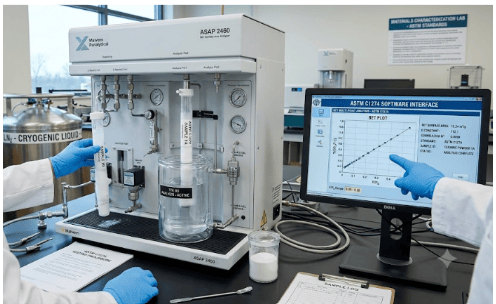
    The image shows a BET surface area analyzer measuring the specific surface area of advanced ceramic powders according to ASTM C1274.
    ASTM C1274 BET Surface Area Analyzer 

    Analysis Results and Interpretation

    • The specific surface area is reported in m²/g. 
    • In general, a higher specific surface area is associated with finer powders and greater surface reactivity.
    • Lower specific surface area may result from larger particle size, particle agglomeration, or reduced surface porosity.
    • The results enable comparison of ceramic powder batches and production processes. 
    • The data guides engineers in optimizing the sintering, densification, and material performance. 
    • Laboratories review adsorption isotherms and BET calculation parameters to confirm that the measured surface area falls within the valid BET analysis range.

    Link to ASTM C1274

    Read more

    Updated on July 23, 2026

    Gokula Srinivasan Selvam
    About Author
    Gokula Srinivasan Selvam is a Material Testing Associate at Matestlab Inc. and holds a postgraduate degree in Ceramic Engineering from IIT (BHU), Varanasi. His academic background and professional experience are centered on advanced ceramic materials, their processing, characterization, and performance evaluation.
    Know More
    Testimonials
    Real results
    Engineers trust us with what matters most
    Start Your Testing
    Project Today
    Define your requirements and get access to
    specialized laboratories ready to deliver results
    Partners with us
    Clients
    Vendors
    Process for testing
    • STEP 01

      You share your testing requirements

    • STEP 02

      You share your sample(s)

    • STEP 03

      We deliver your test reports

    Get your testing done

    Let us know your testing requirements and we will be right back with a solution.

      Let us root for each other. Collaborate to grow, expand, and accelerate our businesses.

      Partner with us

        Discover more from Matestlab

        Subscribe now to keep reading and get access to the full archive.

        Continue reading