ASTM C1182 Determining the Particle Size Distribution of Alumina by Centrifugal Photosedimentation

    What is ASTM C1182? 

    ASTM C1182 is a standard test method for determining the particle size distribution of alumina by centrifugal photosedimentation. It offers a standardized laboratory method for assessing the particle size distribution (PSD) of alumina powders by measuring the sedimentation behavior under centrifugal photosedimentation. The ASTM C1182 method (Standard Test Method for Determining the Particle Size Distribution of Alumina by Centrifugal Photosedimentation) applies to alumina powders with particle sizes ranging from 0.1 to 20 μm, and laboratories may also use it for other ceramic powders with similar particle size characteristics. Manufacturers use particle size distribution in product specification, quality assurance, and research and development.

    Read more

    Get Certified ASTM C1182 Particle Size Distribution Testing 

    The size distribution of alumina powder plays an important role in the characteristics of processing and applications for ceramics, refractories, catalysts, and advanced materials. ASTM C1182 provides a reliable centrifugal photosedimentation method for accurately measuring particle size distribution and helps manufacturers to maintain consistent product quality, optimize manufacturing processes, and verify compliance with material specifications.

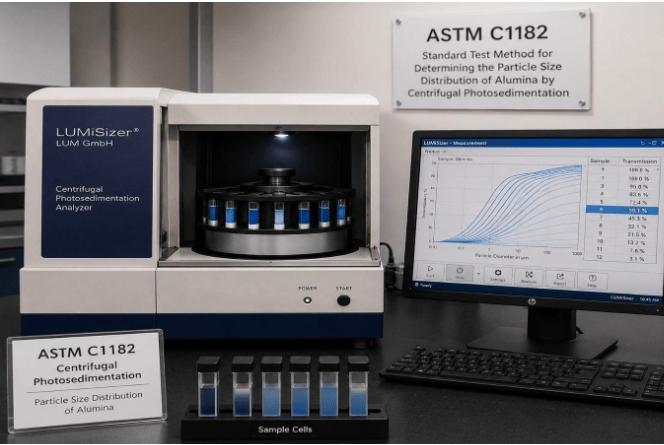
    This image shows a centrifugal sedimentation analyzer determining the particle size distribution of alumina samples as described in ASTM C1182. 
    ASTM C1182 Centrifugal Photosedimentation Analyzer 

    What is the scope of ASTM C1182 test standard?

    ASTM C1182 specifies a centrifugal photosedimentation method for determining the particle size distribution of alumina powders. Laboratories use this method to measure powder particles ranging from 0.1 to 20 μm in size and may apply the procedure to other ceramic powders with similar particle size characteristics. The ASTM C1182 standard

    Read more

    • Covers alumina powders. 
    • Measures particle size distribution by centrifugal sedimentation under the action of light. 
    • Measures particle size between 0.1 and 20 μm. 
    • Designed for powders with median particle diameter (MPD) between 0.5 and 5.0 μm. 
    • May be used on other powders of a similar size that are ceramics. 
    • Assists with quality control and research uses. 
    • Offers standardized particle size characterization.

    What are the Uses of ASTM C1182 Testing? 

    ASTM C1182 is a test method that utilizes centrifugal photosedimentation for the measurement of particle size distribution of alumina powders. The test evaluates the consistency of powders, improves processing conditions, and guarantees appropriate properties of material for ceramic and industrial applications. The ASTM C1182 test method-

    • Measures the particle size distribution of alumina powders. 
    • Determines the consistency and quality of powder. 
    • Qualifies and supports raw materials quality assurance. 
    • Improves ceramic manufacturing and powder processing.
    • Helps in the research and development of more sophisticated ceramic materials. 
    • Compares the size characteristics of particles from production batches. 
    • Checks that product specifications are met.

    What Materials Can Be Tested Under ASTM C1182? 

    The most common application of ASTM C1182 is alumina powders that have a particle size range from 0.1 μm to 20 μm. Laboratories use this method on other fine ceramic powders with a similar particle size, validating its applicability.

    Why is ASTM C1182 Important?

    ASTM C1182 specifies a standard method for determining particle size distribution by accurately measuring the size of the particles by centrifugal photosedimentation. The consistent particle size analysis aids in optimizing product quality, processing efficiency, and material performance in the manufacturing process.

    Common Challenges and Troubleshooting 

    Sedimentation behavior and particle size calculations can be greatly influenced by errors in the choice of dispersant, unstable suspensions, inaccurate particle density values, and air bubbles. To perform accurate particle size analysis, sample dispersion, stable suspension preparation, instrument calibration, as well as the test conditions must be properly taken care of. Common problems include agglomeration, poor dispersion, air, settling instability, contamination, and instrument calibration errors of the instruments. Accurate and repeatable measurements are obtained through routine calibration of instruments and careful sample preparation.

    ASTM C1182 Testing Process and Data Collection Guide

    Testing starts with collecting a representative sample of alumina powder and uniformly dispersing it in an appropriate liquid medium. The prepared suspension is placed inside the centrifugal photosedimentation analyzer, where the centrifugal force increases the sedimentation of the particles. The laboratories receive the identification of the samples, the dispersion conditions, sedimentation data, particle size distribution, and characteristic particle size values for quality evaluation and process control.

    ASTM C1182 Equipment and Sample Preparation Guide 

    Accurate particle size analysis requires representative powder sampling, proper dispersion, and stable suspension preparation before testing. ASTM C1182 suggests uniformly dispersing alumina powder to avoid agglomeration and ensure proper sedimentation measurement. 

    Read more

    Sample and specimen details Technicians collect representative alumina powder specimens from the production batch for particle size distribution. 
    Specimen PreparationTechnicians first disperse the powder in appropriate liquid media to form a homogeneous suspension with minimal agglomeration prior to centrifugal photosedimentation testing.
    Specimen DimensionsLaboratories use this method for alumina powders with median particle diameters ranging from 0.5 to 5.0 μm and particle sizes ranging from 0.1 to 20 μm.
    Instruments Centrifugal Photosedimentation Particle Size Analyzer, Sample Dispersion Unit, Analytical Balance, Ultrasonic Disperser (when necessary), Sample Cell, Computer with Particle Size Analysis Software.

    Testing Procedures and Requirements for ASTM C1182 

    ASTM C1182 is a standard method for measuring the particle size distribution of alumina powders by centrifugal photosedimentation. The method involves careful dispersion of the sample, calibration of the instrument, centrifugal sedimentation, and optical measurement to yield accurate and repeatable particle size distribution data.

    Read more

    Sample DispersionTechnicians prepare a homogeneous suspension of the alumina powder in a suitable liquid medium to minimize particle agglomeration.
    Centrifugal PhotosedimentationTechnicians apply centrifugal force to the dispersed sample and monitor particle sedimentation using the instrument’s optical detection system.
    Particle Size Distribution AnalysisTechnicians measure the sedimentation characteristics and calculate the particle size distribution using the instrument’s analysis software.
    Optical DetectionTechnicians continuously monitor changes in light transmission during particle sedimentation and use the recorded data to calculate the particle size distribution.
    Result VerificationTechnicians verify result accuracy and repeatability by reviewing instrument performance and particle size data.

    Analysis Results and Interpretation 

    • ASTM C1182 determines the particle size distribution of alumina powders.
    • Laboratories usually express results in micrometers (μm) and include characteristic particle size values such as D10, D50 (median particle size), and D90, along with the complete particle size distribution curve. 
    • Manufacturers use these results to measure powder uniformity, compare production batches, and optimize manufacturing processes.

    Link to ASTM C1182

    Read more

    FAQ

    Where can I get the astm c1182 tested?
    You can share your astm c1182 testing requirements with MaTestLab. MaTestLab has a vast network of material testing laboratories, spread across the USA and Canada. We support your all material testing needs ranging from specific astm c1182 test to various testing techniques.
    Please contact us for a detailed quote for your astm c1182 testing needs. Cost incurred to carry out different astm c1182 testing methodology depends on the type of raw material; number of samples, coupons, or specimens; test conditions, turn around time etc. Costs of some ASTM testing methods start from $100 and the final value depends upon the factors listed above. Please contact us for the best and latest prices.
    The required number of samples or specimens should comply with the procedure given in the astm c1182 standard. However, the MaTestLab operations team can assist you for your special requirements once you share your testing details with us.
    MaTestLab has a vast testing laboratory network, hence we bring you the best testing facilities in a cost-effective way. We offer considerable discounts (15-20%) to our returning customers based on test volume and frequency.
    The turnaround time for astm c1182 test methodology depends upon the test procedure mentioned in the standard test document. However, we at MaTestLab understand your research requirements and hence try to get your test completed within the least possible time.
    Suyog Kamble
    About Author
    Suyog Kamble
    Suyog Kamble is an Operations Associate at MaTestLab Inc. and holds a postgraduate degree in Organic Chemistry.
    Testimonials
    Real results
    Engineers trust us with what matters most
    Start Your Testing
    Project Today
    Define your requirements and get access to
    specialized laboratories ready to deliver results
    Partners with us
    Clients
    Vendors
    Process for testing
    • STEP 01

      You share your testing requirements

    • STEP 02

      You share your sample(s)

    • STEP 03

      We deliver your test reports

    Get your testing done

    Let us known your testing requirements and we will be right back with a solution.

      Let us root for each other. Collaborate to grow, expand, and accelerate our businesses.

      Partner with us

        Contact Us

        Discover more from MaTestLab

        Subscribe now to keep reading and get access to the full archive.

        Continue reading