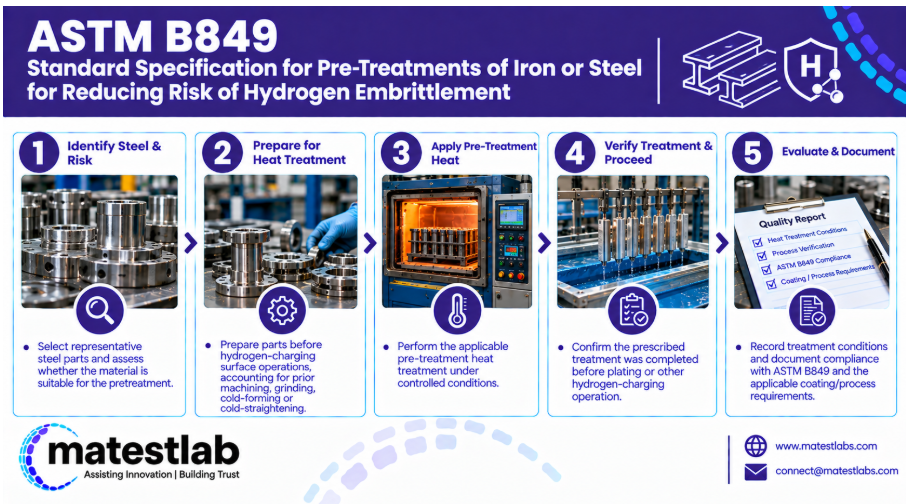
ASTM B849 provides procedures for minimizing the susceptibility to hydrogen embrittlement or degradation that occur during electroplating, autocatalytic plating, porcelain enameling, chemical conversion coating, phosphating, and the related pre-treatment processes. The specification applies to steels whose properties are not deteriorated by baking at 190 °C or above. The heat treatment procedures specified in this specification are found effective for reducing the susceptibility of steel parts with 1000 MPa or greater tensile strength that are subsequently machined, ground, cold formed, or cold straightened, and they take precedence over any operation that hydrogen charges the parts.
The scope of ASTM B849 includes:
- Material type: Iron or steel parts, especially high-strength steel (1000MPa or above).
- Purpose: To prevent hydrogen embrittlement and/or degradation before hydrogen charging.
- Properties measured: Susceptibility, or degree of susceptibility, to hydrogen embrittlement and delayed brittle failure.
- Method: Bake at 190 °C to 230 °C or more before electroplating, autocatalytic plating, porcelain enameling, chemical conversion coating, or phosphating.
- Result: Lower risk of parts getting hydrogen embrittlement after subsequent exposure to hydrogen charging.
- Test Limitations: The test is applicable only to steels that will not be adversely affected by the temperatures listed below.
- Environmental conditions: Applied before cleaning operations and other operations that may hydrogen charge the parts.
- Applications: Autocatalytically plated, chemically coated, porcelain enameled, and electroplated iron or steel components.
What are the Uses of the ASTM B849 Specification?
ASTM B849 pre-treatment is a standard method for manufacturers to minimize the risk of hydrogen embrittlement in iron and steel parts and uses the procedure to preserve components prior to coating processes. This standard-
- Reduces the susceptibility of high-strength steel parts to hydrogen embrittlement.
- Works with pre-treatment before electroplating and autocatalytic plating.
- Helps prepare steel parts for porcelain enameling without causing embrittlement.
- Helps minimize risk of embrittlement prior to chemical conversion coating and phosphating.
- Works on heat-treated, machined, ground, cold-formed, and cold-straightened steel components.
- Helps to avoid brittle fracture failure in high-strength steel parts.
What Materials Can Be Tested Under ASTM B849?
ASTM B849 is primarily used for iron or steel parts to be electroplated, autocatalytically plated, porcelain enameled, chemically converted, or phosphated. The specification is of particular importance for machine, ground, cold formed,d and cold straightened steel components of tensile strength 1000 MPa or higher after heat treatment. The specification is limited to steels in which the required baking temperatures do not affect mechanical properties.
Why is ASTM B849 Important?
ASTM B849 is significant as pre-treatment helps minimize the risk of stress cracking and unexpected failures in high-strength steel components by using a specific baking procedure prior to hydrogen-charging operations. Hydrogen embrittlement may lead to delayed brittle fracture of high-strength steel components long after their service life, so it is a serious issue of safety and reliability. Operations such as the cleaning procedures used prior to electroplating, autocatalytic plating, porcelain enameling, and other chemical coating processes introduce hydrogen into the steel.