
By Laraib Hashmi | Last updated 5th June 2026

ASTM B49 Standard Specification for Copper Rod for Electrical Purposes

ASTM B49 specifies the requirements for copper rods for electrical purposes. The electrical and manufacturing industries use this test to assess the conductivity, mechanical strength, chemical composition, and dimensional accuracy of copper rods. This specification covers the requirements for rods in diameters from 1/4 in. to 1 3/8 in. (6.4 mm to 35 mm) produced from high-conductivity coppers. This specification includes the manufacturing requirements, test methods, surface quality, and inspection requirements for electrical-grade copper products. Tests include electrical conductivity, tensile strength, chemical composition, and dimensional measurements. ASTM B49 helps manufacturers maintain the quality, electrical characteristics, and reliability of products for electrical applications.

Read More

GET STARTED

    Share your requirements *

    Provide your contact information *

    ASTM B49 Introduction

    ASTM B49 (Standard Specification for Copper Rod for Electrical Purposes) includes the properties of copper rods for electrical conductors and other applications. The specification tests the electrical conductivity, mechanical hardness, and chemical purity of copper products. ASTM B49 provides an effective way for copper rods to meet energy and mechanical performance requirements across a variety of industries. Manufacturers use this test for the production of power wires, power cables, transformers, motors, turbines, and conductors made of copper rods. 

    Get Certified ASTM B49 Testing for Reliable Electrical Copper Performance

    The certification ensures that the copper rods will have the necessary mechanical strength and conductivity before they are put to industrial use. Certified testing helps to achieve higher electrical performance, product reliability, and manufacturing quality. 
    Service NameRemarks
    ASTM B49 Testing
    Contact US

    Testing Procedures and Requirements

    First, the manufacturer makes a copper rod with a controlled casting and rolling process. The laboratory then tests the electrical conductivity and chemical composition. The technician also conducts tensile testing and dimensional inspection to ensure that each component meets the specification requirements. Lastly, the inspector checks surface quality and accepts the products.

    This document also contains certain specifications, such as ASTM B846, ASTM E53, and  ASTM B224.

    Specimen SelectionTechnicians take a random sample of the representative copper rod from the batch or production lot. They ensure that the specimens have no defects or damage to obtain accurate test results.
    Tensile ElongationDetermine elongation as a permanent increase in length, caused by the breaking of the rod in tension, measured between gauge marks placed originally 10 in. (250 mm) apart on the test specimen.
    Surface Oxide AnalysisPasses a constant electric current through the copper sample inside an electrolyte bath. The electrical charge required to reduce the oxide back to metal determines the exact thickness of the surface film.
    Electrical ResistivityThe specimen’s resistivity is measured after cleaning, processing to a diameter of 0.080 in. (2.0 mm), and annealing at 932 °F (500 °C) for 30 min.
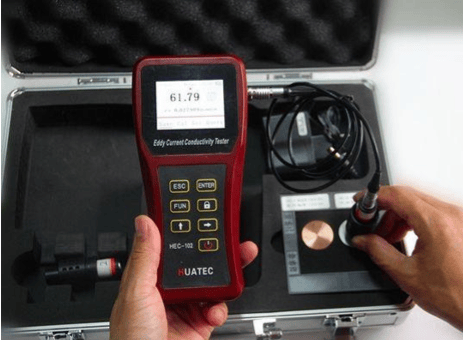
    The image shows an electrical conductivity tester measuring the conductivity of copper rods during ASTM B49 testing.
    ASTM B49 Electrical Conductivity Tester

    Scope of ASTM B49

    • Establishes specifications for copper rods for electrical use. 
    • Analyze the conductivity and mechanical properties 
    • Uses the appropriate tools to help ensure quality control and consistency in manufacturing 
    • Use in the manufacturing of electrical conductors (EC). 
    • Helps in the assessment of electrical performance 

    ASTM B49 Equipment and Sample Preparation

    Specimen DetailsTechnicians select a sample of the copper rod coil for testing and evaluation. The specimen is the total of the production batch or lot. They carefully prepare the specimen to ensure accurate and consistent test results. 
    Specimen DimensionsTake samples from the suspected rod coil and condition them at 850 °C ± 25 °C before testing. Technicians make tensile strength specimens in cylindrical or rectangular forms. They make dog-shaped elongation test samples with narrow grip sections. The rod coils are furnished in continuous lengths with or without joints. Technicians use circular or rectangular specimens for resistivity testing.

    Use of ASTM B49

    • Checks the electrical conductivity of copper rods. 
    • Provides material for conductor and cable production.
    • Suitable for conductor and cable making. 
    • Allows monitoring of copper purity and quality. 
    • Helps with quality assurance and inspection. 
    • Avoids the need to replace electrical components. 

    Why is copper purity critical?

    The higher the purity of the copper, the better its conductivity, corrosion resistance, and mechanical reliability. Impurities reduce electrical performance and adversely affect long-term performance.

    Common Challenges and Troubleshooting 

    The technical challenges during testing include surface defects, size variation, misreading of conductivity, contamination, etc. These problems affect the quality & performance of the products. But with good specimen handling, properly calibrated equipment, and controlled manufacturing processes, the testing becomes more accurate and consistent.

    ASTM B49 Testing Technique, Process, and Data Collection

    The technician processes and prepares copper rod samples for testing and inspection. It then measures the conductivity, tensile, and chemical properties. The expert assesses the size, surface quality, and mechanical properties. Lastly, the inspector documents the results.

    Analysis Results and Interpretation

    ASTM B49 refers to the percent International Annealed Copper Standard (% IACS) for electrical conductivity. The specification specifies the tensile strength in megapascals (MPa) or kilopascals (kPa). The correct tensile strength values ensure a reliable mechanical behavior in wire drawing and electrical applications.

    Factors to Consider for ASTM B49 Testing

    • Speed: Efficient testing enables quicker material approval and manufacturing times.
    • Expertise: The expert technicians provide accurate conductivity and mechanical testing.
    • Cost: Streamlined manufacturing and inspection processes lower costs.

    Direct Link to ASTM B49 

    FAQ's

    Where can I get the astm b49 tested?

    You can share your astm b49 testing requirements with MaTestLab. MaTestLab has a vast network of material testing laboratories, spread across the USA and Canada. We support your all material testing needs ranging from specific astm b49 test to various testing techniques.

    How much do I need to pay for the astm b49 test?

    Please contact us for a detailed quote for your astm b49 testing needs. Cost incurred to carry out different astm b49 testing methodology depends on the type of raw material; number of samples, coupons, or specimens; test conditions, turn around time etc. Costs of some ASTM testing methods start from $100 and the final value depends upon the factors listed above. Please contact us for the best and latest prices.

    How many samples are required for astm b49?

    The required number of samples or specimens should comply with the procedure given in the astm b49 standard. However, the MaTestLab operations team can assist you for your special requirements once you share your testing details with us.

    How much discount can I get on the astm b49 test?

    MaTestLab has a vast testing laboratory network, hence we bring you the best testing facilities in a cost-effective way. We offer considerable discounts (15-20%) to our returning customers based on test volume and frequency.

    How many days will it take to complete the astm b49 test?

    The turnaround time for astm b49 test methodology depends upon the test procedure mentioned in the standard test document. However, we at MaTestLab understand your research requirements and hence try to get your test completed within the least possible time.

    Where can I get the astm b49 tested?

    You can share your astm b49 testing requirements with MaTestLab. MaTestLab has a vast network of material testing laboratories, spread across the USA and Canada. We support your all material testing needs ranging from specific astm b49 test to various testing techniques.

    POPULAR TESTS
    ONE-STOP FOR ALL
    MATERIAL TESTING NEEDS
    MaTestLab Inc. offers accessible, quick, and affordable material testing, product testing, and failure analysis services. We support your on-demand testing and expert consultation needs with the help of our extensive network of material testing laboratories situated in the US and other parts of the world.
    MATERIAL TESTING
    We offer destructive and non-destructive tests over a range of mechanical, electrical, chemical, thermal, optical, corrosion, radiation, and biological testing methodologies defined by ASTM, ISO and other organizations.
    PRODUCT TESTING
    We help you evaluate and ensure your product quality and performance with standard and custom-made testing solutions. All the tests are done at well-equipped testing laboratories using standard testing methods for best output and satisfaction.
    FAILURE ANALYSIS
    Failure analysis ensures high levels of quality in every manufacturing process. We help you with getting the best failure or root cause analysis to determine the cause of the failure. The results help you identify means to prevent failure recurrences.
    Process for testing
    • STEP 01

      You share your testing requirements

    • STEP 02

      You share your sample(s)

    • STEP 03

      We deliver your test reports

    Get your testing done

    Let us known your testing requirements and we will be right back with a solution.

      Let us root for each other. Collaborate to grow, expand, and accelerate our businesses.

      Partner with us

        close

        Please share your requirement with us

          ×

          Contact Us

          Discover more from MaTestLab

          Subscribe now to keep reading and get access to the full archive.

          Continue reading