ASTM B363 Standard Specification for Seamless and Welded Unalloyed Titanium and Titanium Alloy Welding Fittings

    What is ASTM B363?

    ASTM B363 is a standard specification for fittings that are factory-formed from unalloyed titanium and titanium alloys for general corrosion-resisting and elevated-temperature applications. Welding Fittings are used for butt-welding fittings such as 45° elbows, 90° elbows, 180° returns, caps, tees, reducers, and stub ends for lap joints. Titanium welding fittings are supplied as billets, bars, plates, or seamless or welded pipe or tube, conforming to all manufacturing processes, testing, chemical composition, and mechanical property requirements specified in ASTM B861 and B862 for the specific titanium grades covered. Manufacturers use ASTM B363 (Standard Specification for Seamless and Welded Unalloyed Titanium and Titanium Alloy Welding Fittings) to produce titanium fittings of Grades 1, 2, 3, 7, 9, and 11 which are either seamless or contain welded seams or joints fabricated by fusion welding using welders, welding operators, and welding procedures qualified under Section IX of the ASME Boiler and Pressure Vessel Code. Department of Defense agencies have approved this specification for use. 

    Read more

    Get Certified ASTM B363 Testing for Reliable Titanium Welding Fitting Performance 

    Titanium welding fittings in corrosion-resisting and high-temperature piping systems provide reliable chemical composition, mechanical properties, and weld integrity in challenging industrial environments. Testing to ASTM B363, along with a certificate of conformance, verifies that a seamless or welded titanium fitting meets the chemical composition and mechanical properties required for its grade. Accredited testing in the laboratory provides mill certification, incoming material inspection, and fabrication quality control for chemical processing, aerospace, marine, and power generation applications. Certified ASTM B363 testing assures purchasers that delivered titanium fittings are manufactured, tested, and welded to the standards required for a dependable piping system. 
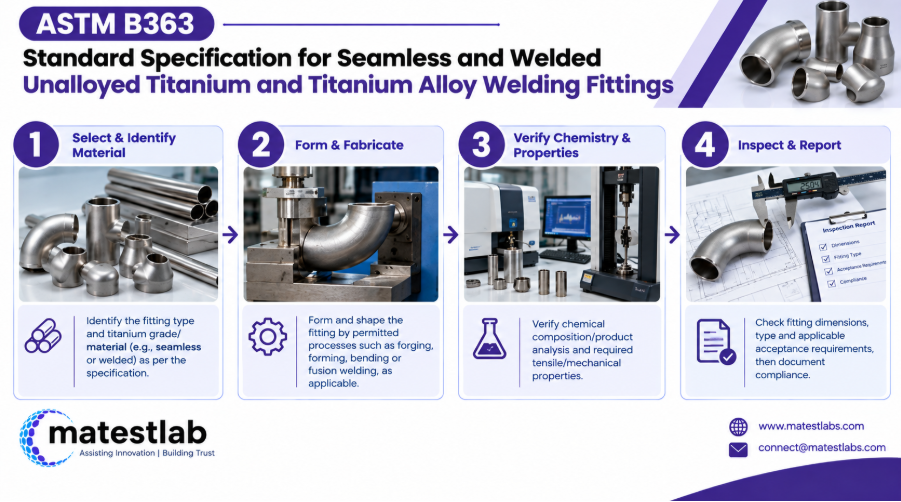
    What is the Scope of ASTM B363?

    ASTM B363 specifies the requirements for fittings for general corrosion-resisting and elevated-temperature services, all made from unalloyed titanium and titanium alloys in the factory. Welding fittings are parts used in butt-welding with other parts and are manufactured in accordance with various dimensional and end-finish standards established by ANSI/ASME B16.9. The scope of ASTM B363 includes: 

    Read more

    • Material type: Unalloyed titanium and titanium alloys, such as Grades 1, 2, 3, 7, 9, and 11, in the form of billets, bars, plates, or seamless or welded pipe or tube.  
    • Purpose: Fabrication Specification for Butt-Welding Fittings for Corrosion-Resistant and high-temperature titanium piping systems. 
    • Properties measured: Chemical composition and mechanical properties, such as tensile strength, yield strength, and elongation. 
    • Method: Production according to the prescribed forging, forming, and/or shaping operations; welders and procedures qualified per ASME Boiler and Pressure Vessel Code Section IX for fusion-welded fittings. 
    • Result: Fittings conforming to the chemistry and mechanical property specifications required for the applicable grade in B861/B862.   
    • Test Limitations: Welded seams/joins in fittings welded by fusion welding meet the requirements of the qualified welding procedure.
    • Environmental Conditions: Outside diameter from 10.3 mm to 914.4 mm (NPS 1/8 in. to 36 in.), wall thickness from 1.65 mm to 30.96 mm (0.065 in. to 1.219 in.), across schedules SCH5S through SCH80. 
    • Applications: Corrosion resistance, elevated temperature, chemical processing, marine and desalination piping, ducting in the aerospace industry.  

    What are the Uses of the ASTM B363 Specification?

    Manufacturers use ASTM B363 testing to confirm that the chemical composition and mechanical properties of titanium welding fittings meet the requirements for their specified grade. Fabricators or buyers use the results to verify fit before installation. This standard-

    • Confirms the chemical composition to the grade-specific thresholds for aluminum, iron, oxygen, and nitrogen.
    • Validates mechanical characteristics such as tensile strength, yield strength, and elongation of the relevant grade.
    • Knows how to qualify fusion welding procedures under ASME Boiler and Pressure Vessel Code Section IX.
    • Helps confirm that dimensions meet ANSI/ASME B16.9 fitting standards.
    • Ensures quality control during titanium fitting manufacturing.
    • Offers a common starting point for the design of corrosion-resistant and high-temperature pipe systems. 

    What Materials Can Be Tested Under ASTM B363? 

    ASTM B363 is for unalloyed titanium and titanium alloy welding fittings made from billets, bars, plates, seamless or welded pipe or tube, and fabricated under the “total holding” method in the factory. This specification applies to parts for butt-welding of elbows, returns, caps, tees, reducers, and lap-joint stub ends ranging in size from NPS 1/8 in. through NPS 36 in. Before material verification, an analyst confirms the required grade and whether the fitting has welded seams that must be qualified for welding procedures under ASME Section IX. 

    Why is ASTM B363 Important? 

    ASTM B363 is the standard specification for titanium welding fittings that are required for applications where the capability to resist corrosion and elevated temperatures is critical. Titanium’s corrosion resistance and weight-to-strength ratio are desirable for chemical processing, marine and aerospace piping, but stable chemical composition and mechanical properties are crucial for predictable performance. Using welders, welding operators, and procedures qualified in accordance with Section IX of the ASME Boiler and Pressure Vessel Code helps ensure weld integrity at critical piping connections. Manufacturers and purchasers use this specification to maintain consistent quality in titanium fittings for piping systems where safety and corrosion resistance are critical. 

    ASTM B363 Equipment and Sample Preparation Guide

    ASTM B363 requires standard chemical analysis equipment for composition verification and tension testing equipment for mechanical property confirmation. Technicians take samples randomly from the production lot for verification, which are representative fittings.

    Read more

    Sample and Specimen DetailsRepresentative unalloyed titanium or titanium alloy welding fitting samples, covering Grades 1, 2, 3, 7, 9, or 11, factory-made from billets, bars, plates, or seamless or welded pipe or tube. 
    Specimen PreparationTechnicians select representative samples for chemical analysis and mechanical property testing according to the manufacturing process, forging, forming, or shaping operation used.
    Specimen DimensionsTechnicians select specimen size according to the fitting’s outside diameter, ranging from 10.3 mm to 914.4 mm (NPS 1/8 in. to 36 in.), and wall thickness, ranging from 1.65 mm to 30.96 mm (0.065 in. to 1.219 in.).
    InstrumentationChemical analysis equipment for Product Analysis, a tensile testing machine for mechanical property verification, and welding qualification records per ASME Boiler and Pressure Vessel Code Section IX. 

    Testing Procedures and Requirements for ASTM  B363 

    ASTM B363 testing verifies the chemical composition and mechanical properties of each titanium welding fitting. Product analysis and tensile testing of representative fitting samples are conducted in the laboratory to ensure compliance prior to acceptance. 

    Read more

    The other referenced ASTM standards include ASTM B265, B338, B348, B367, B381, B600, B861, and B862. 

    Chemical Composition Verification Technicians perform product analysis to verify elements such as aluminum, carbon, chromium, hydrogen, iron, molybdenum, nickel, nitrogen, and oxygen against the grade-specific limits. 
    Mechanical Property TestingTechnicians perform tension testing to determine tensile strength, yield strength at 0.2% offset, and elongation for the applicable grade.
    Welding Procedure VerificationFor fittings containing welded seams, technicians confirm that welders, welding operators, and welding procedures are qualified under Section IX of the ASME Boiler and Pressure Vessel Code.
    Dimensional VerificationTechnicians measure fitting dimensions against the applicable outside diameter, wall thickness, and schedule requirements per ANSI/ASME B16.9.
    Result Reporting Laboratories report chemical composition, mechanical property results, and welding qualification status, along with the grade and fitting type. 

    ASTM B363 Testing Process and Data Collection

    Verification starts with representative samples from every manufacturing process: hammering, pressing, piercing, extruding, upsetting, rolling, bending, fusion welding, or a combination of these methods. Product analysis ensures the product’s chemical composition stays within limits for that product grade, and tensile testing measures tensile strength, yield strength, and elongation. The operator is satisfied that welders, welding operators, and welding procedures are qualified to perform welding in accordance with Section IX of the ASME Boiler and Pressure Vessel Code for fittings with welded seams or welded joints formed by fusion welding. Technicians also check the outside diameter, wall thickness, and schedule requirements of the fitting type against the dimensional requirements. This data is collected in the lab to help with mill certification, incoming material, and fabrication quality control.

    The image shows a technician performing chemical composition analysis on a titanium welding fitting as per ASTM B363
    ASTM B363 Chemical Composition Testing of a Titanium Welding Fitting

    Common Challenges and Troubleshooting

    Common issues with ASTM B363 verification are: chemical inconsistencies between production lots, unqualified welding procedures on fusion-welded fittings, and dimensional deviations from ANSI/ASME B16.9 standards. The issues result in fit and cause purchaser/producer disputes. Different sample analyses of the product yield test data that do not reflect the true composition of the final product. All welders and procedures that are not qualified according to ASME Section IX for fusion-welded seams carry weld integrity risk. Out-of-roundness or wall thickness may impact fitment compatibility with the desired piping system. These can be minimized using good sampling practices, adequate welding qualification records, and calibrated dimensional measuring equipment. Experienced technicians ensure reliable results by following standard procedures and checking grade-specific requirements. 

    ASTM B363 Results and Interpretation

    The report gives a summary of the chemical composition and mechanical property results of the tested titanium welding fitting. The results are then compared with the requirements for the appropriate grade.

    Read more

    •  The laboratory provides product analysis, reporting values for elements such as Al, Fe, O, and N and comparing them with grade-specific limits.
    • The laboratory reports the tested grade’s tensile strength, yield strength at 0.2% offset, and elongation.
    • The laboratory keeps welding qualification records of fittings with fusion-welded seams.
    • The results show whether the tested fitting matches the required outside diameter, wall thickness, and schedule for its size.
    • The laboratory records the fitting type (elbow, tee, reducer, cap, or stub end), as well as the grade and method of manufacture.
    • Standard sampling and test protocols provide laboratories with consistent and comparable results within production lots.
    • Laboratories use test results to support mill certification and help buyers evaluate products for corrosion-resistant and high-temperature piping applications.

    Link to ASTM B363 

    FAQ

    What are the types of fittings covered by ASTM B363?
    Welding fittings are butt-welding components like 45° and 90° elbows, 180° returns, caps, tees, reducers, and lap-joint stub ends, which are produced in accordance with ANSI/ASME B16.9.
    ASTM B363 specifies the chemical composition and mechanical properties for unalloyed titanium and titanium alloy fittings in Grades 1, 2, 3, 7, 9, and 11.
    Fittings with welded seams or joints formed by fusion welding shall be welded by welders, welding operators, and welding procedures qualified as per the requirements of Section IX of the ASME Boiler and Pressure Vessel Code.
    This specification covers fittings from 10.3 mm to 914.4 mm (NPS 1/8 in. to 36 in.) outside diameter, with wall thickness from 1.65 mm to 30.96 mm (0.065 in. to 1.219 in.).

    Updated on September 28, 2026

    Divakar Shukla
    About Author
    Divakar Shukla is an Electrical and Electronics Engineer specializing in the convergence of embedded systems architecture, industrial automation, and applied artificial intelligence.
    Know More
    Testimonials
    Real results
    Engineers trust us with what matters most
    Why Choose Matestlab?
    Matestlab is a unified testing services partner based in the USA. Matestlab offers raw material and product testing services through accredited, expert laboratories primarily based in the USA. Matestlab supports physical, thermal, chemical, electrical, mechanical, environmental, and characterization testing needs through its global network of 2200+ accredited testing laboratories. Matestlab's in-house materials science experts curate and design comprehensive testing programs matched to the sample material and specific testing need, with regulatory requirements and confidentiality in mind.

    If you are looking for a managed and trusted testing partner to achieve your research goals, feel free to schedule a meeting with us or send us a request at connect@matestlabs.com to learn more about our services. For a quick quote, call us at (302)244-7710. We are happy to serve you.
    Start Your Testing
    Project Today
    Define your requirements and get access to
    specialized laboratories ready to deliver results
    Partners with us
    Clients
    Vendors
    Process for testing
    • STEP 01

      You share your testing requirements

    • STEP 02

      You share your sample(s)

    • STEP 03

      We deliver your test reports

    Get your testing done

    Let us know your testing requirements and we will be right back with a solution.

      Let us root for each other. Collaborate to grow, expand, and accelerate our businesses.

      Partner with us