ASTM B328 Standard Test Method for Density, Oil Content, and Interconnected Porosity of Sintered Metal Structural Parts and Oil-Impregnated Bearings

    What is ASTM B328?

    ASTM B328 is a standard test method for determining the density, oil content, and interconnected porosity of sintered metal structural parts and oil-impregnated bearings. This test method applies to powder metallurgy (P/M) products with or without oil impregnation, and it uses Archimedes’ principle to measure the volume of complex sintered shapes that calipers or micrometers cannot measure accurately. Laboratories use ASTM B328 (Standard Test Method for Density, Oil Content, and Interconnected Porosity of Sintered Metal Structural Parts and Oil-Impregnated Bearings) to report density in g/cm³ and oil content and porosity as percent by volume. Engineers use these results to verify self-lubrication performance and mechanical suitability of sintered bearings and structural components.

    Read more

    Get Certified ASTM B328 for Uncompromising Quality and Project Success 

    Certification ensures that a sintered bearing or structural part meets the required density, oil content, and porosity for the design before use. Representative samples are submitted to the accredited laboratory for testing, and a report records compliance with the applicable P/M specification. This ensures the buyer is not exposed to the risk of lubrication failure and early bearing wear.

    What is the Scope of the ASTM B328 Test Standard? 

    ASTM B328 is a standard test method that provides procedures for measuring the density, oil content, and interconnected porosity of sintered metal parts. It includes applicable Archimedes’ principle testing of parts of structure and oil-impregnated bearings. These requirements vary depending on whether the part is oil-impregnated or not and the desired accuracy of the application. ASTM B328 is primarily used to test sintered metal parts for consistency of density, self-lubrication ability, and porosity characteristics. The standard includes procedures for dry weight, water immersion, oil extraction, and porosity calculation.

    Read more

    The scope of ASTM B328 includes: 

    • Material type: Sintered metal structural parts and oil-impregnated bearings. 
    • Properties evaluated: Check density, oil content, and porosity of powder metallurgy components 
    • Testing method: Density, oil content, interconnected (open) porosity, and total porosity. 
    • Results: Use appropriate procedures to determine volume per Archimedes’ principle and oil per gravimetric analysis. 
    • Test Limitations: Technicians exclude parts with surface-connected porosity that absorbs water or reacts with immersion liquids, and adapt procedures to accommodate varying part geometries and oil-impregnation statuses. 
    • Use conditions: Technicians perform testing at ambient laboratory temperature under controlled conditions to simulate in-service density and lubrication characteristics, noting that the method excludes long-term wear or thermal cycling evaluation. 
    • Applications: Sintered bearing evaluation, structural P/M part quality control, and self-lubrication assessment.

    What are the Uses of ASTM B328 Testing?

    ASTM B328 testing determines the density and lubrication properties of sintered metal parts. Engineers then use the results to compare P/M formulations and determine a part’s performance in bearing and/or structural applications. This standard-

    • Measures the density of sintered structural parts and bearings.
    • Measures oil content in oil-saturated bearings.
    • Evaluates the interconnected porosity available to hold oil.
    • Helps compare powder metallurgy formulations and compaction techniques.
    • Contributes to quality control in producing sintered parts.
    • Helps design self-lubricating bearings.
    • Helps to select P/M materials for applications in automobiles, appliances, and machinery.

    Which materials can be tested under ASTM B328?

    ASTM B328 covers powder metallurgy fabricated metal parts that are sintered, such as structural parts and self-lubricating bearings. The test method is used on parts with or without oil impregnation, as appropriate. Before starting the test program, an analyst establishes the part geometry, the nature of the oil impregnation, and the properties to be tested. 

    Why is ASTM B328 Important? 

    ASTM B328 defines a controlled Archimedes’ principle methodology used for the determination of the density, oil content, and porosity of sintered metal parts. A poor bearing density or lack of connected porosity results in poor self-lubrication and early bearing wear. The results help the engineer compare sintered parts and decide whether a particular formulation serves its intended purpose acceptably for its intended service.

    ASTM B328 Equipment and Sample Preparation Guide

    The ASTM B328 specifies the use of an analytical balance and a water-immersion apparatus to measure the volume of complex sintered shapes. Laboratories prepare representative samples with suitable surfaces for testing and subsequent evaluation. 

    Read more

    Sample and Specimen Details Laboratories test oil-impregnated bearings and sintered structural products for density and oil content, respectively, using representative samples.
    Specimen Preparation Specimens are cleaned, dried, and weighed prior to testing, and the oil impregnation status of each specimen is recorded.
    Specimen FormSpecimen size and shape follow the actual production geometry of the part or bearing under test, and the technician selects the sample based on the part being evaluated and the accuracy required for the density and oil-content results.
    Instrumentation The test uses an analytical balance, a water-immersion apparatus, a vacuum oil-impregnation chamber, and an oven to extract the oil.

    Testing Procedures and Requirements for ASTM B328 

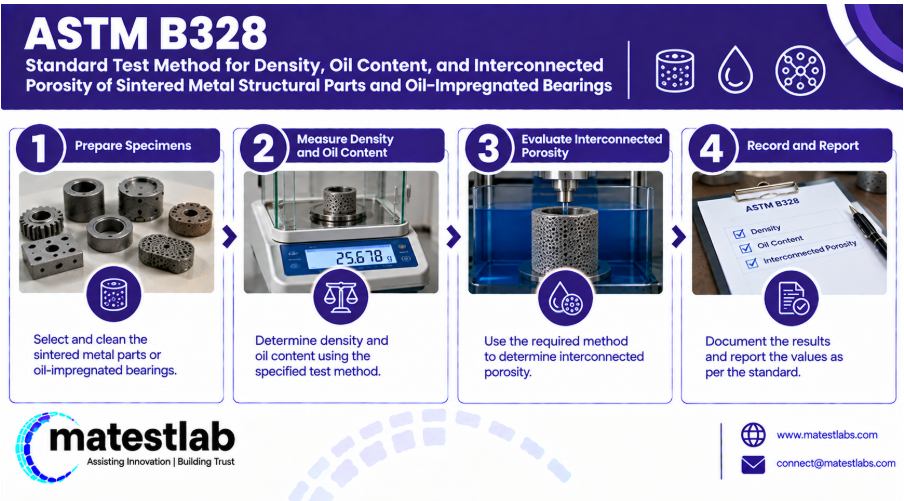
    This test method tests sintered metal products for oil content, porosity, and density. The laboratory performs each procedure, with the technician setting the test parameters. The ASTM B328 test methods include the following test procedures: 

    Read more

    Initial Evaluation Technicians measure the mass of the dry specimen to determine the initial mass for further testing.
    Density Determination Technicians submerge the object in water and use Archimedes’ principle to determine its volume and density measurements.
    Oil Content Determination Technicians remove the impregnated oil and use the mass loss to calculate the oil volume. 
    Interconnected Porosity Determination Technicians impregnate the dry specimen with oil under vacuum and determine open porosity from the mass increase.
    Result Reporting Laboratories report density, oil content, and interconnected porosity in the appropriate units.

    ASTM B328 Testing Process and Data Collection

    The analyst selects representative sintered parts and tests whether they are impregnated with oil. Then technicians weigh each dry specimen and record the mass before testing. To measure volume, the operator submerges the specimen in water, measures its weight, removes or adds oil as needed, and reweighs it at each step. The mass values are compared to the ASTM B328 calculations of density, oil content, and interconnected porosity, and the data are recorded for a compliance report.

     The image shows a sintered bearing specimen undergoing water-immersion density testing under ASTM B328.
    ASTM B328 Density and Oil Content Testing of Sintered Metal Bearings 

    Common Challenges and Troubleshooting

    Technicians carefully blot specimens after water immersion to prevent distortion of mass readings from remaining surface moisture. Oil extraction time improves the oil content results if the time is extended due to incomplete extraction. In some more complex geometries, it is possible for air bubbles to become trapped during the immersion, and the technicians have to tap the specimen lightly to expel the bubbles before taking the volume measurement. A testing program minimizes these problems through consistent equipment calibration and trained personnel. 

    ASTM B328 Analysis Results and Interpretation

    This report is a summary of the properties measured on the sintered metal samples following the appropriate ASTM B328 tests. The tested part is compared to the specification ranges of the P/M grade and oil impregnation ordered.

    Read more

    • Dry mass and water-displacement volume are used to calculate the density, which is reported in the lab in g/cm³.
    • Analysts measure oil by percent volume by mass difference before and after oil extraction.
    • The lab reports interconnected porosity as percent by volume, determined by mass gain after vacuum oil impregnation.
    • The report doesn’t just provide one overall performance value for the material; it also compares the measured values to the P/M specification and documents whether the part meets the density and lubrication requirements. 

    Link to ASTM B328 

    FAQ

    What products does ASTM B328 cover?
    ASTM B328 provides specifications for sintered metal structural components and oil-impregnated bearings, both with and without oil impregnation, manufactured by powder metallurgy.
    The test method includes dry weighing, water-immersion density determination, oil extraction for oil content, and vacuum oil impregnation for interconnected porosity.
    The method used for the testing involves dry weighing, water-immersion density determination, oil extraction for oil content, and vacuum oil impregnation for interconnected porosity.

    Updated on October 7, 2026

    Divakar Shukla
    About Author
    Divakar Shukla is an Electrical and Electronics Engineer specializing in the convergence of embedded systems architecture, industrial automation, and applied artificial intelligence.
    Know More
    Testimonials
    Real results
    Engineers trust us with what matters most
    Why Choose Matestlab?
    Matestlab is a unified testing services partner based in the USA. Matestlab offers raw material and product testing services through accredited, expert laboratories primarily based in the USA. Matestlab supports physical, thermal, chemical, electrical, mechanical, environmental, and characterization testing needs through its global network of 2200+ accredited testing laboratories. Matestlab's in-house materials science experts curate and design comprehensive testing programs matched to the sample material and specific testing need, with regulatory requirements and confidentiality in mind.

    If you are looking for a managed and trusted testing partner to achieve your research goals, feel free to schedule a meeting with us or send us a request at connect@matestlabs.com to learn more about our services. For a quick quote, call us at (302)244-7710. We are happy to serve you.
    Start Your Testing
    Project Today
    Define your requirements and get access to
    specialized laboratories ready to deliver results
    Partners with us
    Clients
    Vendors
    Process for testing
    • STEP 01

      You share your testing requirements

    • STEP 02

      You share your sample(s)

    • STEP 03

      We deliver your test reports

    Get your testing done

    Let us know your testing requirements and we will be right back with a solution.

      Let us root for each other. Collaborate to grow, expand, and accelerate our businesses.

      Partner with us